July 9, 2023

Muntzing is reducing the components inside an electronic appliance to the minimum required for it to function in most operating conditions, reducing design margins above minimum requirements toward zero.
The term is named after Earl “Madman” Muntz, a car and electronics salesman, who was not formally educated or trained in any science or engineering discipline. Muntz built a low part TV in the 1950s.
read more »
Posted in Language, Money, Technology |
Leave a Comment »
July 5, 2023

In machine learning, a stochastic [stuh-kas-tik] parrot is a large language model (LLM) that is good at generating convincing language, but does not actually understand the meaning of the language it is processing. The term was coined by computational linguistics professor Emily M. Bender in the 2021 artificial intelligence research paper ‘On the Dangers of Stochastic Parrots: Can Language Models Be Too Big?’
Stochastic means ‘random and involving chance or probability.’ A stochastic parrot,’ according to Bender, is an entity ‘for haphazardly stitching together sequences of linguistic forms … according to probabilistic information about how they combine, but without any reference to meaning.’ Less formally, the term refers to ‘large language models that are impressive in their ability to generate realistic-sounding language but ultimately do not truly understand the meaning of the language they are processing.’
read more »
Posted in Humor, Language, Technology |
1 Comment »
May 15, 2023
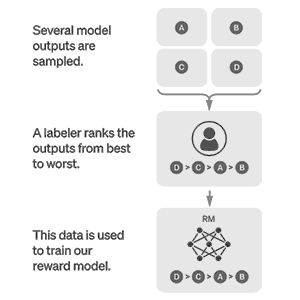
In machine learning, reinforcement learning from human feedback (RLHF) is a method of training AI models by learning from responses by humans about its performance. If an AI model makes a prediction or takes an action that is incorrect or suboptimal, human feedback can be used to correct the error or suggest a better response.
Over time, this helps the model to learn and improve its responses. RLHF is used in tasks where it’s difficult to define a clear, algorithmic solution but where humans can easily judge the quality of the AI’s output (e.g. if the task is to generate a compelling story, humans can rate different AI-generated stories on their quality, and the AI can use their feedback to improve its story generation skills).
read more »
Posted in Technology |
Leave a Comment »
April 25, 2023

The clear craze was a marketing fad from the late 1980s to early 2000s, often equating transparency with purity. Inspired by Ivory’s ’99 and 44/100 percent pure’ campaign for bath soap, and by low-calorie or ‘light’ beverages, sodas were redesigned in the 1980s and 1990s as being free of artificial dyes, such as the caffeine-free and preservative-free Crystal Pepsi. Personal hygiene products were then relaunched as clear dye-free gels, and many electronics had transparent cases.
Gillette released versions of its existing deodorants and shaving creams in a clear gel form, which have continued indefinitely. Through the 1990s, the clear trend included transparent watches, staplers, calculators, handheld gaming devices such as the Nintendo Game Boy, and computers such as Apple’s iMac G3.
read more »
Posted in Money, Technology |
Leave a Comment »
April 10, 2023

In artificial intelligence (AI), a hallucination or artificial hallucination (also occasionally called delusion) is a confident response by an AI that does not seem to be justified by its training data. For example, a hallucinating chatbot with no knowledge of Tesla’s revenue might internally pick a random number (such as $13.6 billion) that the chatbot deems plausible, and then go on to falsely and repeatedly insist that Tesla’s revenue is $13.6 billion, with no sign of internal awareness that the figure was a product of its own imagination.
Users complained that such bots often seemed to ‘sociopathically’ and pointlessly embed plausible-sounding random falsehoods within its generated content. Another example of hallucination in artificial intelligence is when the AI or chatbot forget that they are one and claim to be human.
read more »
Posted in Technology |
Leave a Comment »
January 12, 2023

El Paquete Semanal (‘The Weekly Package’) or ‘El Paquete’ is a one terabyte collection of digital material distributed since around 2008 on the underground market in Cuba as a substitute for broadband Internet. Since 2015, it has been the primary source of entertainment for millions of Cubans, as Internet in Cuba has been suppressed for many years. El Paquete Semanal has its own page that is running in the United States, where one could view its contents and is consistently updated every week.
The Cuban Government has also been investing in more internet access for the people, with the use of ETECSA, a service that the citizens could pay 1 CUC (equivalent to an American Dollar) for one hour of internet use. This has become the most popular method for people to become connected to the internet, mainly used to connect to social media, such as Facebook.
read more »
Posted in Politics, Technology, World |
1 Comment »
January 3, 2023

Libs of TikTok is a far-right anti-LGBT Twitter account owned by Chaya Raichik, a former real estate agent, that reposts social media content created by left-wing and LGBT people with hostile, mocking, or derogatory commentary. The account has over 1.5 million followers and has become influential among American conservatives and the political right.
The account harasses teachers, medical providers, and children’s hospitals. It spreads false claims and hateful commentary, especially relating to medical care of transgender children. Libs of TikTok regularly slurs LGBT people, as well as those who provide mental health services to LGBT youth and LGBT sex education to students, as ‘groomers.’ Raichik’s social media accounts have received several temporary suspensions and a permanent suspension from TikTok.
read more »
Posted in Politics, Sex, Technology |
3 Comments »
December 13, 2022

Acoustic Kitty is a project launched by the C.I.A. Directorate of Science & Technology in the 1960s, which intended to use cats to spy on the Kremlin and Soviet embassies.
In an hour-long procedure, a veterinary surgeon implanted a microphone in the cat’s ear canal, a small radio transmitter at the base of its skull, and a thin wire into its fur. This would allow the cat to innocuously record and transmit sound from its surroundings. Due to problems with distraction, the cat’s sense of hunger had to be addressed in another operation. Victor Marchetti, a former CIA officer, said Project Acoustic Kitty cost about $20 million.
read more »
Posted in Technology, War, World |
Leave a Comment »
November 16, 2022

A fatberg is a rock-like mass of waste matter in a sewer system formed by the combination of flushed non-biodegradable solids, such as wet wipes, and fat, oil and grease (FOG) deposits. The handling of FOG waste and the buildup of its deposits are a long-standing problem in waste management, with ‘fatberg’ a more recent neologism.
Giant fatbergs have blocked sewers in London, New York, Denver, Valencia, and Melbourne and are becoming more prevalent with the rise in usage of disposable (so-called ‘flushable’) cloths. Several prominent examples were discovered in the 2010s in Great Britain, their formation accelerated by aging Victorian sewers. Fatbergs are costly to remove, and have given rise to public awareness campaigns about flushable waste.
read more »
Posted in Technology, World |
Leave a Comment »
November 8, 2022

The fruit machine was a device developed in Canada by Frank Robert Wake, a Carleton University psychology professor in the 1950s, that was supposed to be able to identify gay men (derogatorily referred to as ‘fruits’). The subjects were made to view pornography; the device then measured the diameter of the pupils of the eyes (pupillary response test), perspiration, and pulse for a supposed erotic response.
The machine was employed in Canada in the 1950s and 1960s during a campaign to eliminate all gay men from the civil service, the Royal Canadian Mounted Police (RCMP), and the military. A substantial number of workers did lose their jobs. Although funding for the project was cut off in the late 1960s, the investigations continued, and the RCMP collected files on 9,000 people who had been investigated.
read more »
Posted in Politics, Sex, Technology |
Leave a Comment »
November 6, 2022

The fediverse (a portmanteau of ‘federation’ and ‘universe’) is an ensemble of federated (i.e. interconnected) servers that are used for web publishing (i.e. social networking, microblogging, blogging, or websites) and file hosting, but which, while independently hosted, can communicate with each other.
Their are federated alternatives to many mainstream websites: PeerTube (YouTube); Funkwhale (SoundCloud); Mastodon, Hubzilla, and pump.io (Twitter); Frendica (Facebook); Drupal (WordPress); Pixelfed (Instagram); and Lemmy (Reddit).
read more »
Posted in Technology |
1 Comment »
September 6, 2022

A reply allpocalypse, also called an email storm, is a sudden spike of “reply all” messages on an email list. When members respond, often pleading for the cessation of messages, a chain reaction is triggered, generating traffic that can render the email servers inoperative.
Some email viruses also have the capacity to create email storms by sending copies of themselves to an infected user’s contacts, including distribution lists, infecting the contacts in turn.
read more »
Posted in Humor, Technology |
Leave a Comment »


 The Daily Omnivore