December 19, 2012
The Edgewood Arsenal experiments (also known as Project 112) are said to be related to or part of CIA mind-control programs after World War II, such as MKULTRA. Journalist Linda Hunt, citing records from the U.S. National Archives, revealed that eight German scientists worked at Edgewood, under Project Paperclip (the US program recruiting Nazi scientists after the war).
The experiments were performed at the Edgewood Arsenal, northeast of Baltimore, Maryland, and involved hallucinogens such LSD, THC, and BZ, in addition to biological and chemical agents. Experiments on human subjects utilizing such agents goes back to at least World War I. In the mid-1970s, in the wake of many health claims made from exposure to such agents, including psychotropic drugs administered in later experiments, the U.S. Congress began investigations of misuse of such experiments, and inadequate informed consent given by the soldiers and civilians involved.
Posted in Drugs, Health, War |
Leave a Comment »
December 15, 2012

Assault weapon is a political term, often used by gun control advocates, typically referring to firearms ‘designed for rapidly firing at human targets from close range,’ sometimes described as military-style features useful in combat. The term was most notably used in the language of the now-expired Public Safety and Recreational Firearms Use Protection Act of 1994, more commonly known as the Federal Assault Weapons Ban, which expired in 2004.
The federal assault weapons ban specifically prohibited 19 guns considered to be assault weapons. These were all semi-automatic firearms, meaning that they can eject spent shell casings and chamber the next round without additional human action, but (as opposed to automatic firearms) only one round is fired per pull of the trigger.
read more »
Posted in Death, Politics, War |
1 Comment »
December 10, 2012

Project Iceworm was the code name for a US Army Top Secret proposal during the Cold War (a study was started in 1958), to build a network of mobile nuclear missile launch sites under the Greenland ice sheet. The ultimate objective of placing medium-range missiles under the ice – close enough to Moscow to strike targets within the Soviet Union – was kept secret from the Danish government.
To study the feasibility of working under the ice, a highly publicized ‘cover’ project, known as ‘Camp Century’ was launched in 1960. However, unsteady ice conditions within the ice sheet caused the project to be cancelled in 1966. Details of the missile base project were classified for decades, and first came light in 1997, when the Danish Foreign Policy Institute (DUPI) was asked by the Danish Parliament to research the history of nuclear weapons in Greenland during the Thulegate scandal.
read more »
Posted in Politics, War, World |
Leave a Comment »
December 10, 2012
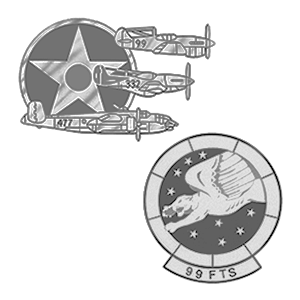
The Tuskegee [tuhs-kee-gee] Airmen is the popular name of a group of African-American pilots who fought in World War II. During World War II, African Americans in many U.S. states were still subject to discriminatory Jim Crow laws. The American military was racially segregated, as was the federal government. The Tuskegee Airmen were treated with prejudice both within and outside the army. Despite these adversities, they trained and flew with distinction. The Fighter Group saw action in Sicily and Italy, before being deployed as bomber escorts in Europe, where they were very successful.
The Tuskegee Airmen initially were equipped with Curtiss P-40 Warhawks fighter-bomber aircraft, briefly with Bell P-39 Airacobras, later with Republic P-47 Thunderbolts, and finally with the aircraft with which they became most commonly associated, the North American P-51 Mustang. When the pilots painted the tails of their P-47s and later, P-51s, red, the nickname ‘Red Tails’ was coined. Bomber crews applied a more effusive ‘Red-Tail Angels’ sobriquet. A B-25 bomb group, was forming in the U.S., but was not able to complete its training in time to see action.
read more »
Posted in Politics, War |
1 Comment »
December 6, 2012


The Policy Analysis Market (PAM), part of the FutureMAP project, was a proposed futures exchange developed by the United States’ Defense Advanced Research Projects Agency (DARPA) and based on an idea first proposed by Net Exchange, a San Diego research firm specializing in the development of online prediction markets. PAM was to be ‘a market in the future of the Middle East,’ and would have allowed trading of futures contracts based on possible political developments in several Middle Eastern countries.
The theory behind such a market is that the monetary value of a futures contract on an event reflects the probability that that event will actually occur, since a market’s actors rationally bid a contract either up or down based on reliable information. One of the models for PAM was a political futures market run by the University of Iowa, which had predicted U.S. election outcomes more accurately than either opinion polls or political pundits. PAM was also inspired by the work of George Mason University economist Robin Hanson.
read more »
Posted in Death, Money, War |
1 Comment »
November 29, 2012

A detection dog or sniffer dog is a dog that is trained to and works at using its senses (almost always the sense of smell) to detect substances such as explosives, illegal drugs, or blood. Hunting dogs that search for game and search dogs that search for missing humans are generally not considered detection dogs.
There is some overlap, as in the case of human remains detection dogs (sometimes called cadaver dogs), trained to detect human remains. They are also used for drug raids to find where the drugs are. In the state of California, dogs are trained to detect the Quagga Mussel on boats at public boat ramps, as it is a invasive species.
read more »
Posted in Drugs, Politics, War |
Leave a Comment »
November 27, 2012

Patton’s Speech to the Third Army was given by General George S. Patton on June 5, 1944, the day before D-day. Patton delivered variations of the speech on several different occasions to his troops, although the June 5 date is the most well known. A hard copy of the speech exists. It has since become immortalized in George C. Scott’s rendition in the movie ‘Patton,’ where he delivers it in front of a large American flag. Patton’s actual words were so colorful that the movie edited and toned down the language, e.g. substituting ‘fornicating’ for ‘fucking.’ Certain phrases from the speech were also used in Scott’s dialogue later on in the film.
Patton’s speech was largely designed to motivate U.S. troops that were to be under fire. There had been much talk about superior German firepower, and the level of fear and doubt was so great in the armed forces that the U.S. Army even resorted to making propaganda films claiming that the infamous German machine gun, the MG-42 (a reliable and deadly weapon), had a bark louder than its bite. The Army did not want US soldiers to get pinned down, and knew that their forces would have to be motivated as they were to be charging German heavy fire on foot.
read more »
Posted in Death, Language, War |
2 Comments »
November 6, 2012
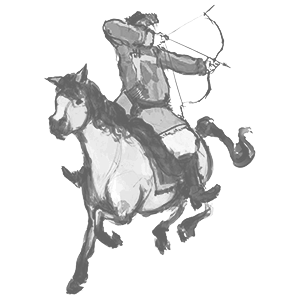
The Parthian [pahr-thee-uhn] shot was a military tactic made famous by the Parthians (an ancient Iranian empire). Their archers mounted on light horse, while retreating at a full gallop, would turn their bodies back to shoot at the pursuing enemy. The maneuver required superb equestrian skills, since the rider’s hands were occupied by his bow. As the stirrup had not been invented yet, the rider relied solely on pressure from his legs to guide his horse. The tactic was first employed by Eurasian nomads, including the Scythians, Huns, Turks, Magyars, and Mongols, before spreading to armies away from the Eurasian steppe, such as the Sassanid clibanariis and cataphract.
The Parthians famously used it to defeat the Roman general Crassus in the Battle of Carrhae. The phrase ‘parting shot’ has its origins from the Parthian shot. The first recorded usage was by John McCleod, surgeon on board the HMS Alceste contained in: ‘A narrative of a Voyage to the Yellow Sea’ (1818). The two phrases have rather similar phonetic soundings but are actually separately derived at different times. Although the Parthian archers of old have been famous for their shooting, the term ‘parthian shot’ was recorded for the first time in 1832 by Captain Mundy, ADC to Lord Combermere on a hunting trip in India.
Posted in Language, War, World |
1 Comment »
October 31, 2012

Grand Admiral Thrawn is a fictional character and a major antagonist in the ‘Star Wars’ universe. He first appeared in ‘Heir to the Empire,’ part of Timothy Zahn’s Thrawn trilogy published between 1992 and 1994. In these books, set five years after ‘Return of the Jedi,’ Thrawn has assumed command of the remaining forces of the Empire and is planning to battle the New Republic.
Zahn describes Thrawn’s command style as considerably different from that of Darth Vader and other typical Imperial commanders; instead of punishing failure and dissent, Thrawn promotes creativity among his crew and accepts ideas from subordinates. He is a tactical genius who has made extensive study of military intelligence and art, and is willing to retreat instead of making a stand in a losing battle. His study of his enemies’ artwork gives him insight into their thought processes and cultures, allowing him to create highly effective tailor-made strategies.
read more »
Posted in Art, War |
Leave a Comment »
October 28, 2012

Die Glocke (‘The Bell’) was a purported top secret Nazi scientific technological device, secret weapon, or ‘Wunderwaffe.’ First described by Polish journalist Igor Witkowski in 2000, it was later popularized by military journalist and author Nick Cook as well as by writers such as Joseph P. Farrell, who associates it with Nazi occultism and antigravity or free energy research.
According to Patrick Kiger writing in ‘National Geographic,’ Die Glocke has become a ‘popular subject of speculation’ and a following similar to science fiction fandom exists around it and other alleged Nazi ‘miracle weapons.’ Mainstream reviewers such as former aerospace scientist David Myhra express skepticism that such a device ever actually existed.
read more »
Posted in Philosophy, War |
Leave a Comment »
October 28, 2012

‘Vril, the Power of the Coming Race’ is an 1871 novel by Edward Bulwer-Lytton, originally printed as ‘The Coming Race.’ Many readers believe that its account of a superior subterranean master race and the energy-form called ‘Vril’ is accurate, to the extent that some theosophists accepted the book as truth. A popular book, ‘The Morning of the Magicians’ (1960) suggested that a secret Vril Society existed in pre-Nazi Berlin.
The novel centers on a young, independently wealthy traveler (the narrator), who accidentally finds his way into a subterranean world occupied by beings who seem to resemble angels and call themselves Vril-ya. The hero soon discovers that the Vril-ya are descendants of an antediluvian civilization who live in networks of subterranean caverns linked by tunnels.
read more »
Posted in Philosophy, Politics, War |
Leave a Comment »
October 28, 2012
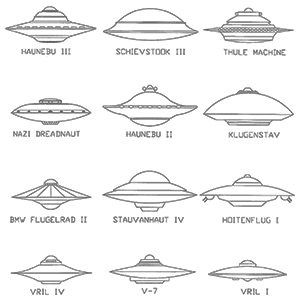
In science fiction, conspiracy theory, and underground comic books, stories or claims circulate linking UFOs to Nazi Germany.
These German UFO theories describe supposedly successful attempts to develop advanced aircraft or spacecraft prior to and during World War II, and further assert the post-war survival of these craft in secret underground bases in Antarctica, South America, or the United States, along with their creators.
read more »
Posted in Humor, Technology, War |
Leave a Comment »


 The Daily Omnivore