

Kevin Carter (1960 – 1994) was an award-winning South African photojournalist and member of the ‘Bang-Bang Club,’ a collective of war photojournalists that also included Greg Marinovich, Ken Oosterbroek, and Joao Silva.
read more »
Everything is Interesting
Kevin Carter (1960 – 1994) was an award-winning South African photojournalist and member of the ‘Bang-Bang Club,’ a collective of war photojournalists that also included Greg Marinovich, Ken Oosterbroek, and Joao Silva.
read more »

The Bang-Bang Club was a name primarily associated with four photographers active within the townships of South Africa during the Apartheid period, particularly between 1990 and 1994, from when Nelson Mandela was released from jail to the 1994 elections. Kevin Carter, Greg Marinovich, Ken Oosterbroek, and Joao Silva were the four main men associated with the name, although a number of photographers and photojournalists worked alongside them (such as James Nachtwey and Gary Bernard).
The name ‘Bang-Bang Club’ was born out of an article published in the South African magazine ‘Living.’ Originally named the ‘Bang-Bang Paparazzi,’ it was changed to ‘Club’ because the members felt the word paparazzi misrepresented their work. The name comes from the culture itself; township residents spoke to the photographers about the ‘bang-bang’ in reference to violence occurring within their communities, but more literally, ‘bang-bang’ refers to the sound of gunfire and is a colloquial form of nomenclature used by conflict photographers.


A baseball cap is a type of hat with a long, stiff brim, that is a part of the traditional baseball uniform worn by players, with the brim pointing forward to shield the eyes from the sun.
In 1860, the Brooklyn Excelsiors wore the ancestor of the modern rounded-top baseball cap, and by 1900, the ‘Brooklyn style’ cap became popular. During the 1940s, latex rubber became the stiffening material inside the hat and the modern baseball cap was born. The ‘bill’ or ‘brim’ was designed to protect a player’s eyes from the sun. Typically, the brim was much shorter in the earlier days of the baseball hat. Also, the hat has become more structured, versus the overall ‘floppy’ cap of the 19th and early 20th centuries.
read more »

The Four Chaplains, also sometimes referred to as the ‘Immortal Chaplains,’ were four United States Army chaplains who gave their lives to save other civilian and military personnel during the sinking of the troop ship USAT Dorchester during World War II. They helped other soldiers board lifeboats and gave up their own life jackets when the supply ran out. The chaplains joined arms, said prayers, and sang hymns as they went down with the ship.
The four men were relatively new chaplains, who all held the rank of lieutenant. They included Methodist Reverend George L. Fox, Rabbi Alexander D. Goode, Roman Catholic Priest John P. Washington and Reformed Church in America Reverend Clark V. Poling. Their backgrounds, personalities, and faiths were different. They met at the Army Chaplains School at Harvard University.
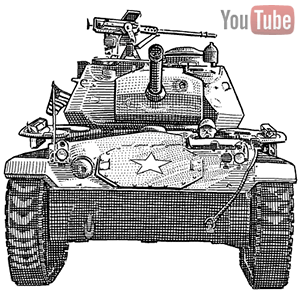
Shawn Nelson (1959 – 1995) was a U.S. Army veteran and unemployed plumber who stole an M60 Patton tank from a United States National Guard Armory in San Diego, California and went on a rampage, destroying cars, fire hydrants, and an RV before being shot dead by police. The tank’s weaponry was unloaded, but Nelson led police on a 23-minute, televised chase through the streets of San Diego. The tank had a top speed of just 30 miles per hour, but the 57-ton vehicle easily plowed through road signs, traffic lights, and crushed a van against a recreational vehicle, then plowed through the RV.
Nelson attempted to knock down a bridge by running in to the supports, but gave up after he failed to topple it with the first few hits. He eventually became caught on a concrete median of State Route 163, as he attempted to cross the median into the oncoming traffic. Four police officers climbed onto the tank and were able to open the hatch. The officers ordered Nelson to surrender, but he said nothing and began lurching the tank back and forth in attempt to free it from the median. Officer Paxton’s partner, Richard Piner, leaned in and shot Nelson. The bullet struck Nelson in the shoulder. Nelson later died in the hospital.
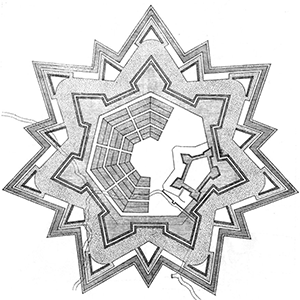
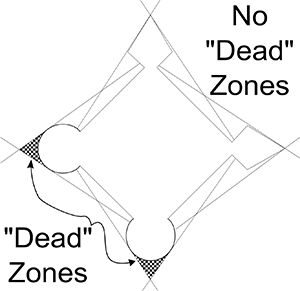
A star fort, or ‘trace italienne,’ is a fortification in the style that evolved during the age of gunpowder, when cannon came to dominate the battlefield, and was first seen in the mid-15th century in Italy. Passive ring-shaped (enceinte) fortifications of the Medieval era proved vulnerable to damage or destruction by cannon fire, when it could be directed from outside against a perpendicular masonry wall.
In addition, an attacking force that could get close to the wall was able to conduct undermining operations in relative safety, as the defenders could not shoot at them from nearby walls. In contrast, the star fortress was a very flat structure composed of many triangular bastions, specifically designed to cover each other, and a ditch. Further structures, such as ravelins, hornworks or crownworks, and detached forts could be added to create a complex symmetrical structure.

Sébastien Le Prestre, Seigneur de Vauban (1633 – 1707), commonly referred to as Vauban [voh-bahn], was a Marshal of France and the foremost military engineer of his age, famed for his skill in both designing fortifications and breaking through them. He also advised Louis XIV on how to consolidate France’s borders, to make them more defensible. Vauban made a radical suggestion of giving up some land that was indefensible to allow for a stronger, less porous border with France’s neighbors.
Vauban was born in Burgundy, to a family of minor nobility, but at the age of ten he was left an orphan, and his youth was spent amongst the peasantry of his native place. A fortunate event brought him under the care of a member of the Carmelites (a Catholic religious order), who undertook his education, and the grounding in mathematics, science and geometry.
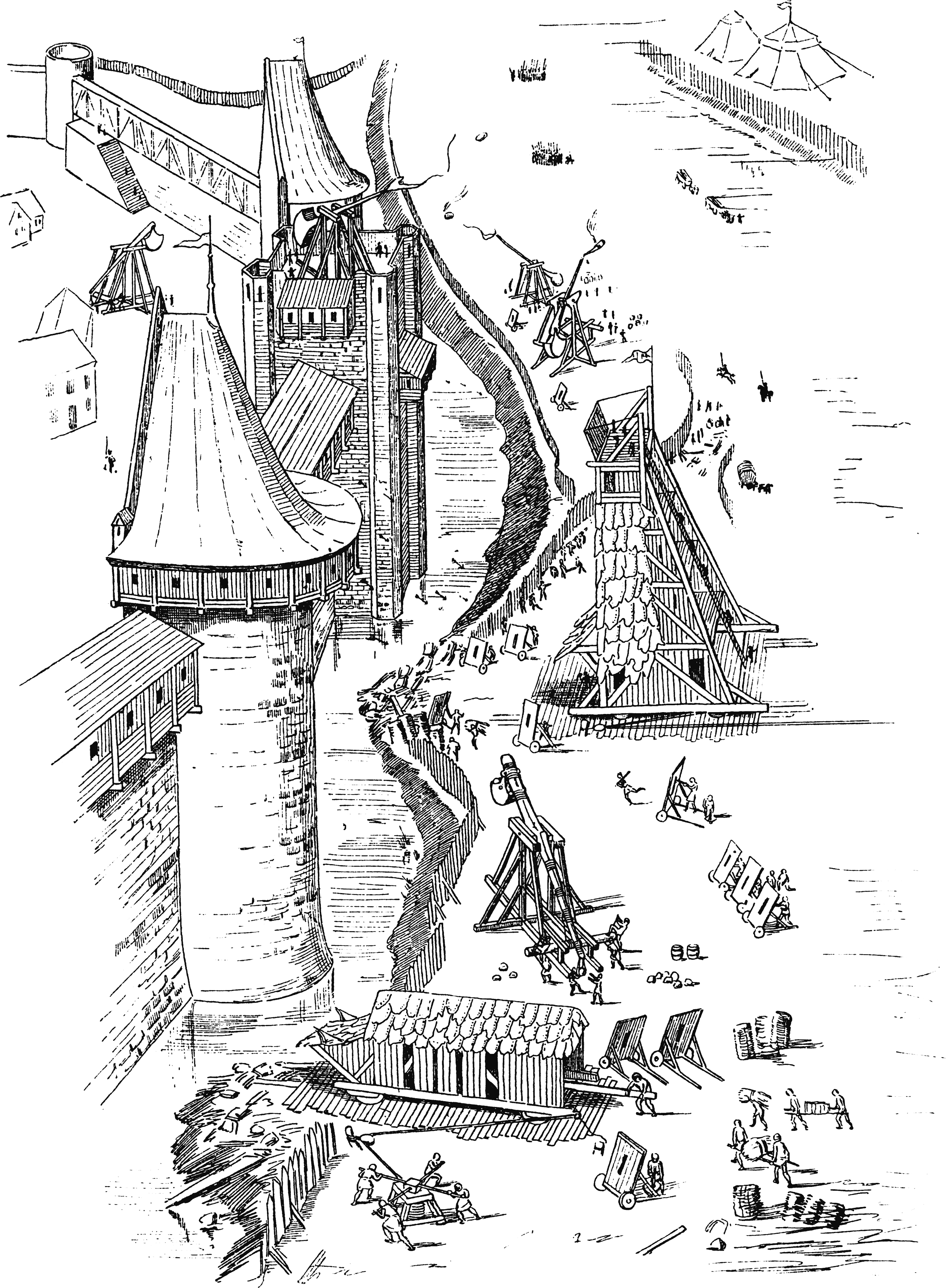
A siege engine is a device that is designed to break or circumvent city walls and other fortifications in siege warfare. Some are operated close to the fortifications, while others attack from a distance. From antiquity, siege engines were constructed largely of wood and tended to use mechanical advantage to fling stones and similar missiles. With the development of gunpowder and improved metallurgical techniques, siege engines became artillery. Collectively, siege engines or artillery combined with the necessary troops and transport vehicles to conduct a siege are referred to as a ‘siege-train.’
The earliest engine was the battering ram, developed by the Assyrians, followed by the catapult in ancient Greece. The Spartans used battering rams in the Siege of Plataea in 429 BCE, but it seems that the Greeks limited their use of siege engines to assault ladders, though Peloponnesian forces used something resembling flamethrowers. The Carthaginians used siege towers and battering rams against the Greek colonies of Sicily.
read more »
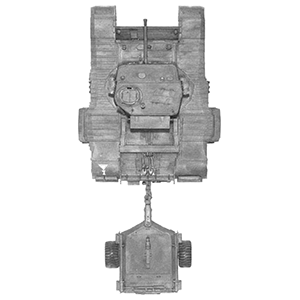
The Churchill Crocodile was a British flame-throwing tank of late Second World War. It was introduced as one of the specialized armored vehicles developed under Major-General Percy Hobart and known as one of ‘Hobart’s Funnies.’ It was produced from October 1943, in time for the Normandy invasion.
400 imperial gallons of fuel and the compressed nitrogen propellant, enough for eighty one-second bursts, were stored in a 6½ ton detachable armored trailer towed by the Crocodile. The trailer, connected to the tank by a three way armored coupling, could be jettisoned from within the tank if necessary. The thrower had a range of up to 120 yards.
read more »
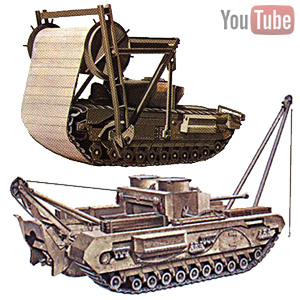
Hobart’s Funnies were a number of unusually modified tanks operated during World War II by the United Kingdom’s 79th Armored Division or by specialists from the Royal Engineers. They were designed in light of problems that more standard tanks experienced during the Allied attack on the German-occupied port of Dieppe on the northern coast of France in 1942.
These tanks played a major part on the Commonwealth beaches during the landings at Normandy. They may be considered the forerunners of the modern Combat engineering vehicle. They were named after their commander, British Military engineer Percy Hobart.
read more »

Dragon Skin a bulletproof vest made by Pinnacle Armor of California. Its characteristic two-inch-wide circular discs overlap like scale armor, creating a flexible vest that allows a good range of motion and can allegedly absorb a high number of hits compared with other military body armor.
The discs are composed of silicon carbide ceramic matrices and laminates, much like the larger ceramic plates in other types of bullet resistant vests. This armor has been known to withstand grenade blasts, and up to 40 rounds of ammo.
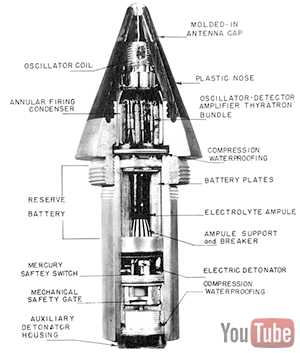
A proximity fuze is designed to detonate an explosive device automatically when the distance to target becomes smaller than a predetermined value or when the target passes through a given plane. A shell with a standard ‘contact fuze’ explodes upon impact, and a ‘time fuze’ after a specified number of seconds. A ‘proximity fuze,’ however uses a radio detection system, and explodes when within a certain distance from a target.
One of the first practical proximity fuzes was codenamed the ‘VT fuze,’ an acronym of ‘Variable Time fuze,’ as deliberate camouflage for its operating principle. The VT fuze concept in the context of artillery shells originated in the UK with British researchers (particularly Sir Samuel Curran) and was developed under the direction of physicist Merle A. Tuve at The Johns Hopkins University Applied Physics Lab. It is considered one of the most important technological innovations of World War II.


 The Daily Omnivore