November 3, 2010

The DARPA PowerSwim program is developing a human-powered swimming device for use by combat and reconnaissance swimmers. The device uses the same oscillating foil approach to swimming that is exhibited by many fish and aquatic birds. This propulsion approach is more than 80-percent efficient in conversion of human motions to forward propulsion. Typical recreational swim fins are no more than 15-percent efficient in their conversion of human exertion to propulsive power, and freestyle swimming converts only 3-percent.
Posted in Technology, War |
Leave a Comment »
October 20, 2010

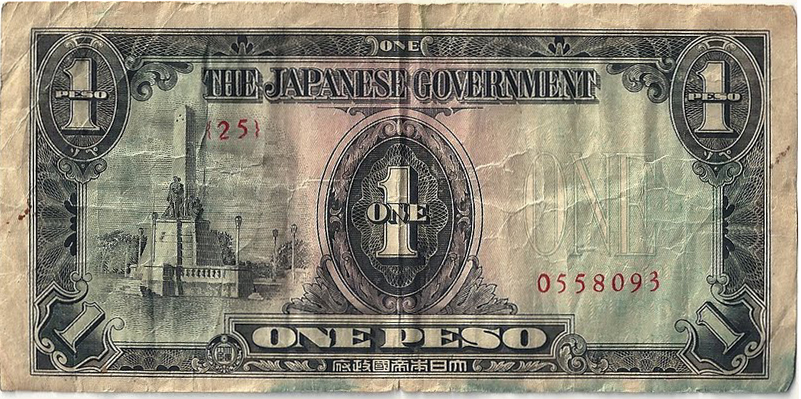
During World War II in the Philippines, the occupying Japanese government issued fiat currency in several denominations; this is known as the Japanese government-issued Philippine fiat peso, or simply the Japanese peso. The Japanese-sponsored Second Philippine Republic under Jose P. Laurel outlawed possession of guerilla currency, and declared a monopoly on the issuance of money, so that anyone found to possess guerrilla notes could be arrested.
The Filipinos called the fiat peso ‘Mickey Mouse money,’ because it was similar to play money and next to worthless. Many survivors of the war tell stories of going to the market laden with suitcases or ‘bayong’ (native bags made of woven coconut or buri leaf strips) overflowing with the Japanese-issued bills. In 1944, a box of matches cost more than 100 Mickey Mouse pesos.
Posted in Money, Politics, War |
Leave a Comment »
October 18, 2010


Weatherman, known colloquially as the Weathermen and later the Weather Underground Organization (WUO), was an American radical left organization. It originated in 1969 as a faction of Students for a Democratic Society (SDS). Their goal was to create a clandestine revolutionary party for the violent overthrow of the US government and the establishment of a dictatorship of the proletariat. With leadership whose revolutionary positions were characterized by Black separatist rhetoric, the group conducted a campaign of bombings through the mid-1970s, including aiding the jailbreak and escape of Timothy Leary.
read more »
Posted in Politics, War |
Leave a Comment »
October 14, 2010
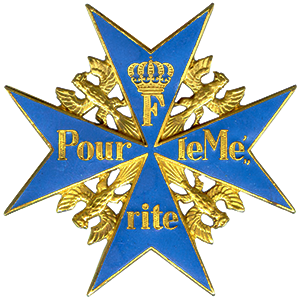
The Pour le Mérite, known informally during World War I as the Blue Max, was the Kingdom of Prussia’s highest military order for German soldiers until the end of World War I. The award was a blue-enameled Maltese Cross with eagles between the arms based on the symbol of the Johanniter Order, the Prussian royal cypher, and the French legend Pour le Mérite (‘for Merit’) arranged on the arms of the cross. A civil version of the order, for accomplishments in the arts and sciences, still exists in the Federal Republic of Germany.
Posted in Politics, War, World |
Leave a Comment »
October 1, 2010


Unit 731 was a covert biological and chemical warfare research and development unit of the Imperial Japanese Army that undertook lethal human experimentation during the Second Sino-Japanese War (1937–1945) and World War II. It was responsible for some of the most notorious war crimes carried out by Japanese personnel. Unit 731 was the code name of an Imperial Japanese Army unit officially known as the Epidemic Prevention and Water Purification Department of the Kwantung Army. It was initially set up under the Kempeitai military police of the Empire of Japan to develop weapons of mass destruction for potential use against Chinese, and possibly Soviet forces.
read more »
Posted in Death, Politics, War |
Leave a Comment »
September 30, 2010

Unit 8200 is an Israeli Defence Force (IDF) Intelligence Corps unit, responsible for collecting signal intelligence and code decryption. It is the largest unit in the IDF, with several thousand soldiers. It is comparable in its function to the United States’ National Security Agency, except that it is not a separate civilian body.
In March 2004, The Commission to investigate the intelligence network following the War in Iraq recommended turning the unit into a civilian National SIGINT Agency, as is largely the case in other Western countries, but this proposal has yet to be implemented. Urim SIGINT Base is the most important signal intelligence-gathering installation operated by Israel’s military and is part of Unit 8200. The Urim base is located in the Negev desert approximately 30km from Beersheba.
Posted in Politics, War |
Leave a Comment »
September 27, 2010

Stuxnet is a Windows computer worm discovered in July 2010 that targets industrial software and equipment. While it is not the first time that hackers have targeted industrial systems, it is the first discovered malware that spies on and subverts industrial systems. The worm initially spreads indiscriminately, but includes a highly specialized malware payload that is designed to target only Siemens Supervisory Control And Data Acquisition systems that are configured to control and monitor specific industrial processes.
The probable target of Stuxnet is widely suspected to be uranium enrichment infrastructure in Iran, which confirmed that its nuclear program had indeed been damaged. The infestation by this worm may therefore have damaged Iran’s nuclear facilities in Natanz and eventually delayed the start up of Iran’s Bushehr Nuclear Power Plant. Security experts have concluded that the sophisticated attack could only have been conducted with nation-state support and it has been speculated that Israel may have been involved.
Posted in Technology, War |
Leave a Comment »
September 26, 2010

The Ahnenerbe was a Nazi German think tank that promoted itself as a ‘study society for Intellectual Ancient History.’ Founded on July 1, 1935, by Heinrich Himmler, Herman Wirth, and Richard Walther Darré, the Ahnenerbe’s goal was to research the anthropological and cultural history of the Aryan race, and later to experiment and launch voyages with the intent of proving that prehistoric and mythological Nordic populations had once ruled the world.
The Ahnenerbe had several different research institutions. Most of these were archeological and anthropological but others included a meteorology department, devoted to ‘Welteislehre’ (World Ice Theory), a pseudoscientific cosmological theory proposed by Hans Hörbiger, an Austrian engineer and inventor. According to his theory, ice was the basic substance of all cosmic processes, and ice moons, ice planets, and the ‘global ether’ (also made of ice) had determined the entire development of the universe. There was also a section devoted to musicology, whose aim was to determine ‘the essence’ of German music. The section made sound recordings, transcribed manuscripts and songbooks, and photographed and filmed instrument use and folk dances. The lur, a Bronze Age musical instrument, became central to this research, which concluded that Germanic consonance was in direct conflict to Jewish atonalism.
Posted in Science, War |
Leave a Comment »
September 24, 2010


The Reagan Doctrine was a strategy orchestrated and implemented by the United States under the Reagan Administration to oppose the global influence of the Soviet Union during the final years of the Cold War. While the doctrine lasted less than a decade, it was the centerpiece of United States foreign policy from the early 1980s until the end of the Cold War in 1991. Under the Reagan Doctrine, the U.S. provided overt and covert aid to anti-communist guerrillas and resistance movements in an effort to ‘rollback’ Soviet-backed communist governments in Africa, Asia and Latin America. Most notably, the mujahideen in Afghanistan and the contras in Nicaragua.
The doctrine was designed to serve the dual purposes of diminishing Soviet influence in these regions, while also potentially opening the door for capitalism (and sometimes liberal democracy) in nations that were largely being governed by Soviet-supported socialist governments. However, since the September 11 attacks, some critics have argued that, by facilitating the transfer of large amounts of weapons to various areas of the world and by training military leaders in these regions, the Reagan Doctrine actually contributed to ‘blowback’ by strengthening some political and military movements that ultimately developed hostility toward the United States, such as al-Qaeda in Afghanistan.
Posted in Politics, War |
Leave a Comment »
September 16, 2010
The Anarchist Cookbook, first published in 1971, is a book that contains instructions for the manufacture of explosives, rudimentary telecommunications hacking devices, and other quasi-legal and contraband items.
It was written by William Powell to protest United States involvement in the Vietnam War. Since writing the book, Powell has converted to Anglican Christianity and attempted to have the book removed from circulation.
Posted in Language, Politics, War |
Leave a Comment »
September 11, 2010

The Phantom Works division is the main research and development arm of The Boeing Company. Founded by McDonnell Douglas before the merger with Boeing, its primary focus had been development of advanced military products and technologies. After the merger, research and development expanded to cover commercial and space applications as well. Phantom Works has been a driving factor behind nearly all of the company’s large contracts, including the upcoming X-45 UCAV (unmanned combat air vehicle).
Posted in Money, Technology, War |
Leave a Comment »
September 11, 2010

Skunk Works is an official alias for Lockheed Martin’s Advanced Development Programs. Skunk Works is responsible for a number of famous aircraft designs, including the U-2, the SR-71 Blackbird, the F-117 Nighthawk, and the F-22 Raptor. Its largest current project is the F-35 Lightning II, which will be used in the air forces of several countries around the world. Production is expected to last for up to four decades. The designation ‘skunk works’ is widely used in business, engineering, and technical fields to describe a group within an organization given a high degree of autonomy and unhampered by bureaucracy, tasked with working on advanced or secret projects.
The term came from Al Capp’s satirical, hillbilly comic strip Li’l Abner, which was immensely popular in the 1940s and ’50s. The ‘Skonk Works’ was a dilapidated factory in the backwoods of Kentucky. According to the strip, scores of people were done in yearly by the toxic fumes of the concentrated ‘skonk oil,’ which was brewed and barreled daily for some mysterious, never specified purpose. The original Lockheed facility was located adjacent to a malodorous plastics factory. Engineer, Irving Culver, first referred to the facility as ‘Skonk Works.’ The name stuck, and at the request of the comic strip copyright holders, Lockheed changed the name of the advanced development company to ‘Skunk Works’ in the 1960s.
Posted in Money, Technology, War |
Leave a Comment »



 The Daily Omnivore