August 17, 2010
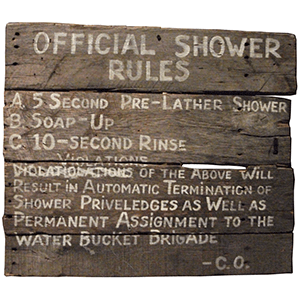
A navy shower (or ‘sea shower’) is a method of showering that allows for significant conservation of water and energy. The total time for the water being on is typically under two minutes. Navy showers originated on naval ships, where supplies of fresh water were often scarce. Using this method, crew members were able to stay clean, while conserving their limited water supply.
The idea has been adopted by many people who wish to conserve water and the energy needed to heat the water, for both environmental and economic reasons. Maritime cruisers often take navy showers when they are not in a port with easy access to fresh water. A ten-minute shower takes as much as 60 gallons of water, while a navy shower usually takes as little as three gallons; one person can save 15,000 gallons per year. The United States Navy refers to long lavish showers without limits on water usage as ‘Hollywood showers.’
Posted in Language, War |
Leave a Comment »
August 10, 2010
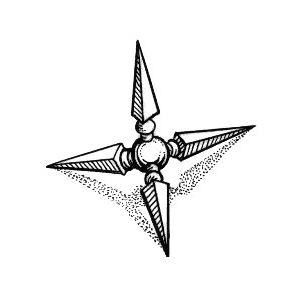
A caltrop is an antipersonnel weapon made up of two or more sharp nails or spines arranged in such a manner that one of them always points upward from a stable base. They may be thought of as the landmines of antiquity, useful to shape the battlefield and force the enemy into certain paths and approaches, or to provide a passive defense as part of a defensive works system. Caltrops served to slow down the advance of horses, war elephants, and human troops. They were said to be particularly effective against the soft feet of camels. In more modern times, caltrops are used against wheeled vehicles with pneumatic tires.
Posted in Technology, War |
Leave a Comment »
August 10, 2010

Wojtek (1942–1963), was a Syrian brown bear cub adopted by soldiers of the 22nd Artillery Supply Company of the Polish II Corps. During the Battle of Monte Cassino, Wojtek helped move ammunition. The name Wojtek is Slavic and has two meanings: ‘he who enjoys war’ or ‘smiling warrior.’
The bear was fed with fruits, marmalade, honey and syrup, and was often rewarded with beer, which became his favourite drink. He also enjoyed eating cigarettes. As one of the officially enlisted ‘soldiers’ of the company, he lived with the other men in their tents or in a transportable wooden crate. After the war, Wojtek was given to the Edinburgh Zoo. There he spent the rest of his days, often visited by journalists and former Polish soldiers, some of whom would toss him cigarettes. Wojtek died in December of 1963, at the age of 22.
Posted in Humor, War |
Leave a Comment »
August 9, 2010
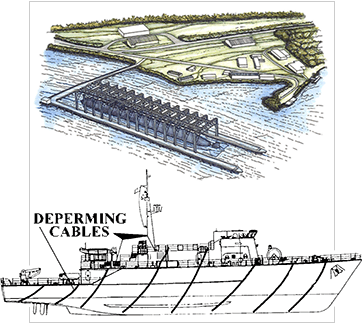
Deperming [dee-purm-ing] is a procedure for erasing the permanent magnetism from ships and submarines to camouflage them against magnetic detection vessels and enemy marine mines. A sea-going metal-hulled ship or submarine, by its very nature, develops a magnetic signature as it travels due to a magneto-mechanical interaction with the Earth’s magnetic field. This signature can be exploited by magnetic mines, or facilitate the detection of a submarine by ships or aircraft with magnetic anomaly detection (MAD) equipment.
Specialized deperming facilities, such as the United States Navy’s Lambert’s Point Deperming Station are used to perform the procedure. Heavy gauge copper cables are wrapped around the hull and superstructure of the vessel, and very high electrical currents (as high as 4000 amps) are pulsed through the cables. This has the effect of ‘resetting’ the ship’s magnetic signature. It is also possible to assign a specific signature that is best suited to the particular area of the world in which the ship will operate. Over time the deperm will begin to degrade and the procedure must be redone periodically to maintain the desired effect.
Posted in Technology, War |
Leave a Comment »
August 4, 2010
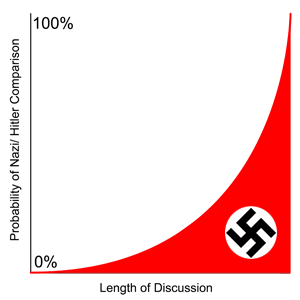
Godwin’s law is a humorous observation made by Mike Godwin in 1990 which has become an Internet adage. It states: ‘As an online discussion grows longer, the probability of a comparison involving Nazis or Hitler approaches 1.’ In other words, given enough time, all discussions —regardless of topic or scope —inevitably wind up being about Hitler and the Nazis. Also the poster who mentioned Nazis loses all debates/discussions they had in said topic, and their insults are nullified. Godwin’s law is often cited in online discussions as a deterrent against the use of arguments in the widespread reductio ad Hitlerum form.
The rule does not make any statement about whether any particular reference or comparison to Adolf Hitler or the Nazis might be appropriate, but only asserts that the likelihood of such a reference or comparison arising increases as the discussion progresses. It is precisely because such a comparison or reference may sometimes be appropriate, Godwin has argued that overuse of Nazi and Hitler comparisons should be avoided, because it robs the valid comparisons of their impact. Although in one of its early forms Godwin’s law referred specifically to Usenet newsgroup discussions, the law is now applied to any threaded online discussion: electronic mailing lists, message boards, chat rooms, and more recently blog comment threads, wiki talk pages, and social networking sites.
Posted in Humor, Language, War |
Leave a Comment »
August 1, 2010
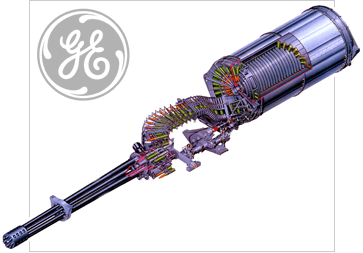
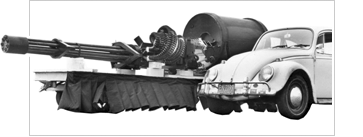
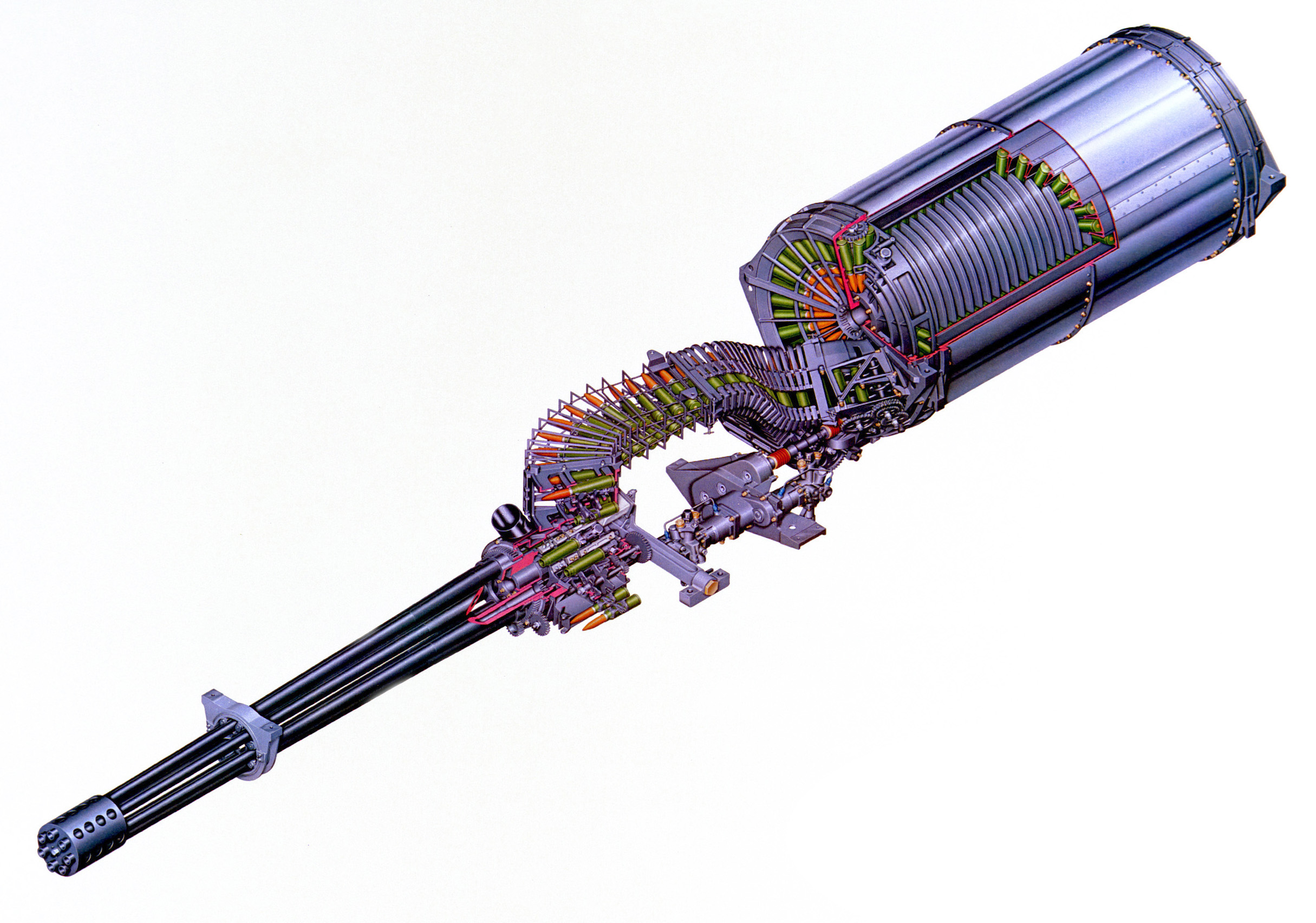
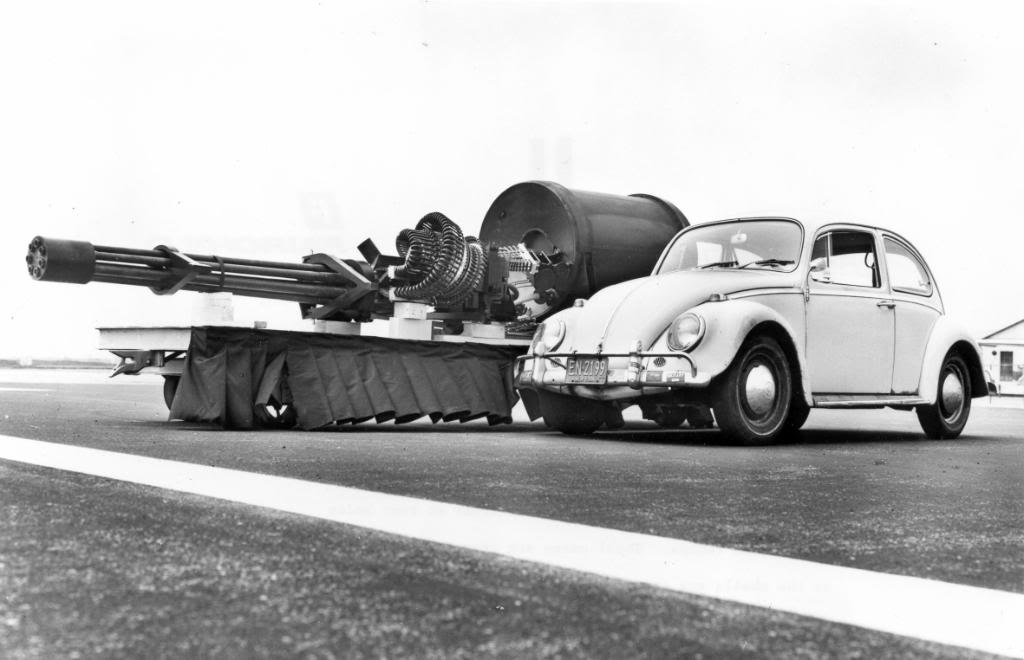
The General Electric GAU-8/A Avenger is a 30 mm, hydraulically-driven seven-barrel Gatling-type rotary cannon that is mounted on the United States Air Force’s A-10 Thunderbolt II. It is among the largest, heaviest and most powerful aircraft cannons in the United States military. Designed specifically for the anti-tank role, the Avenger delivers very powerful rounds at a high rate of fire, 3900 rounds per minute.
It was designed for the A-10 ‘Warthog’ ground attack aircraft. The entire GAU-8 assembly represents about 16% of the A-10 aircraft’s unladen weight. The recoil force of the gun is 10,000 pounds-force, which is slightly more than the output of one of the A-10’s two engines. While this recoil force is significant, in practice cannon fire only slows the aircraft a few miles per hour.
Posted in Technology, War |
Leave a Comment »
June 29, 2010

Balkanization [bawl-kuhn-uh-zey-shuhn] is a geopolitical term originally used to describe the process of fragmentation or division of a region or state into smaller regions or states that are often hostile or non-cooperative with each other. The term arose from conflicts in the 20th century Balkans. While what is now termed Balkanization has occurred throughout history, the term originally described the creation of smaller, ethnically diverse states following the breakup of the Ottoman Empire after World War I.
The term is also used to describe other forms of disintegration, including, for instance, the subdivision of the Internet into separate enclaves, the division of subfields and the creation of new fields from sociology, and the breakdown of cooperative arrangements due to the rise of independent competitive entities.
Posted in Language, Politics, War |
Leave a Comment »
June 28, 2010

Dazzle camouflage, also known as Razzle Dazzle or Dazzle painting, was a camouflage paint scheme used on ships, extensively during World War I and to a lesser extent in World War II. Credited to artist Norman Wilkinson, it consisted of a complex pattern of geometric shapes in contrasting colours, interrupting and intersecting each other.
Dazzle did not conceal the ship but made it difficult for the enemy to estimate its type, size, speed and heading. The idea was to disrupt the visual rangefinders used for naval artillery. Its purpose was confusion rather than concealment. An observer would find it difficult to know exactly whether the stern or the bow is in view; and it would be equally difficult to estimate whether the observed vessel is moving towards or away from the observer’s position.
Posted in Art, Technology, War |
Leave a Comment »
June 25, 2010

Mine Resistant Ambush Protected (MRAP) vehicles are a family of armored fighting vehicles designed to survive IED attacks and ambushes, which are replacing many High Mobility Multipurpose Wheeled Vehicles (HMMWVs) in Iraq and Afghanistan. There is no common MRAP vehicle design; there are several vendors, each with a competing entry.
Posted in Politics, Technology, War |
Leave a Comment »





 The Daily Omnivore