April 22, 2015


The StingRay is an IMSI-catcher (International Mobile Subscriber Identity), a controversial cellular phone surveillance device, manufactured by the Harris Corporation. Initially developed for the military and intelligence community, the StingRay and similar Harris devices are in widespread use by local and state law enforcement agencies across the US. Stingray has also become a generic name to describe these kinds of devices.
The StingRay has with both passive (digital analyzer) and active (cell site simulator) capabilities. When operating in active mode, the device mimics a wireless carrier cell tower in order to force all nearby mobile phones and other cellular data devices to connect to it. The devices can be mounted on cars, airplanes, helicopters, and unmanned aerial vehicles, as well as carried by hand. They are primarily used for surveillance, but can also conduct denial of service attacks (radio jamming).
read more »
Posted in Politics, Technology, War |
Leave a Comment »
April 21, 2015

Project Blue Book was one of a series of systematic studies of unidentified flying objects (UFOs) conducted by the United States Air Force. It started in 1952, and it was the third study of its kind (the first two were projects ‘Sign’ in 1947 and ‘Grudge’ in 1949). A termination order was given for the study in 1969. Project Blue Book had two goals: To determine if UFOs were a threat to national security, and To scientifically analyze UFO-related data. Thousands of UFO reports were collected, analyzed and filed.
As the result of the ‘Condon Report’ (1968), which concluded there was nothing anomalous about UFOs, Project Blue Book was ordered shut down in 1970. Ultimately, Project Blue Book stated that UFOs sightings were generated as a result of: hysteria, fraud, hoaxes, and misidentification. The Air Force continues to provide the following summary of its investigations: ‘There was no evidence indicating that sightings categorized as ‘unidentified’ were extraterrestrial vehicles.’
read more »
Posted in Humor, Technology, War |
Leave a Comment »
March 12, 2015
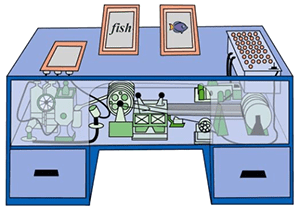
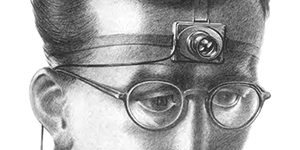
‘As We May Think‘ is an essay by engineer and Raytheon founder Vannevar Bush, first published in ‘The Atlantic’ in July 1945, and republished again as an abridged version two months later — before and after the atomic bombings of Hiroshima and Nagasaki. Bush expresses his concern for the direction of scientific efforts toward destruction, rather than understanding, and explicates a desire for a sort of collective memory machine with his concept of the memex that would make knowledge more accessible, believing that it would help fix these problems. Through this machine, Bush hoped to transform an information explosion into a knowledge explosion.
The article was a reworked and expanded version of Bush’s 1939 essay ‘Mechanization and the Record’ where he described a machine that would combine lower level technologies to achieve a higher level of organized knowledge (like human memory processes). Shortly after the publication of this essay, Bush coined the term ‘memex’ in a letter written to the editor of ‘Fortune’ magazine. That letter became the body of ‘As We May Think,’ adding only an introduction and conclusion.
read more »
Posted in Language, Technology, War |
Leave a Comment »
March 3, 2015

The Up Against the Wall Motherfuckers (often referred to as simply ‘The Motherfuckers,’ or UAW/MF) was an anarchist affinity group based in New York City. This ‘street gang with analysis’ was famous for its Lower East Side direct action and is said to have inspired members of the Weather Underground (a radical leftist group), as well as counterculture leader Abbie Hoffman’s Yippies.
The Motherfuckers grew out of a Dada-influenced art group called Black Mask with some additional people involved with the anti-Vietnam War ‘Angry Arts’ week, held in January 1967. Formed in 1966 by painter Ben Morea and the poet Dan Georgakas, Black Mask produced a broadside of the same name and declared that revolutionary art should be ‘an integral part of life, as in primitive society, and not an appendage to wealth.’ In May 1968, Black Mask changed its name and went underground. Their new name, ‘Up Against the Wall Motherfuckers,’ came from a poem by Amiri Baraka. Abbie Hoffman characterized them as ‘the middle-class nightmare… an anti-media media phenomenon simply because their name could not be printed.’
read more »
Posted in Art, Politics, War |
Leave a Comment »
February 15, 2015

I. Spiewak & Sons, Inc., commonly known simply as Spiewak, is a New York-based apparel manufacturer founded in 1904. Spiewak currently manufactures high-visibility safety apparel, EMS protective gear, and other uniforms for private businesses (including American Airlines and Avis) and government agencies (including the FBI, ATF, Secret Service, and Postal Service). During WWI, Spiewak produced wool coats and breeches for the US Army and Navy, including pea coats, which are still made by the company today. During WWII parkas, flight jackets, flight suits, and field jackets were produced for the US military. Spiewak also offers a line of consumer outerwear constructed with ‘workwear’ values.
Isaac Spiewak grew up in Warsaw, Poland and fled to Brooklyn, NY in 1903. He started a small family business, making sheepskin vests by hand and selling them on the docks of Williamsburg in 1904. By 1906, Isaac’s vests were in sufficient demand around New York for him to establish a small manufacturing space, calling it ‘House of the Golden Fleece.’ As his brothers entered into various facets of the outerwear business, the Spiewaks developed different, and sometimes competing, lines and companies to capitalize on prevailing trends and emerging market segments. Their family of brands including Bronco Manufacturing, Ram Manufacturing, United Sheeplined Clothing Company, Spiewak Brothers, Swiss Blouse, Excalibur, Frost King, Pan-Jac, Trappings, Prince Jason, and Flight Deck USA.
Posted in Money, War |
Leave a Comment »
February 12, 2015
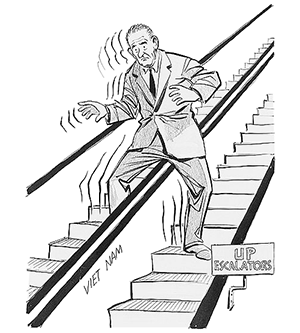
Escalation of commitment was first described by business professor Barry M. Staw in his 1976 paper, ‘Knee deep in the big muddy: A study of escalating commitment to a chosen course of action.’ More recently the term ‘sunk cost fallacy’ has been used to describe the phenomenon where people justify increased investment in a decision, based on the cumulative prior investment, despite new evidence suggesting that the cost, starting today, of continuing the decision outweighs the expected benefit. Such investment may include money, time, or even — in the case of military strategy— human lives (the term has been used to describe the US commitment to military conflicts including Vietnam and Iraq).
The phenomenon and the sentiment underlying it are reflected in such proverbial images as ‘Throwing good money after bad,’ ‘In for a dime, in for a dollar,’ or ‘In for a penny, in for a pound.’ A common example irrational escalation is a bidding war; the bidders can end up paying much more than the object is worth to justify the initial expenses associated with bidding (such as research), as well as part of a competitive instinct. The main drivers of the tendency to invest in losing propositions are: Social (peer pressure), Psychological (gambling), Project (past commitments), and Structural (cultural and environmental factors). After a heated bidding war, Canadian financier Robert Campeau ended up buying Bloomingdale’s for an estimated $600 million more than it was worth. The ‘Wall Street Journal’ noted that ‘we’re not dealing in price anymore but egos.’ Campeau was forced to declare bankruptcy soon afterwards.
Posted in Money, Science, War |
1 Comment »
November 24, 2014


Most new laws in the US are made by Congress, however the Constitution also grants the President some legislative authority in the form of executive orders for the purpose of empowering officers and agencies of the Executive branch and managing operations within the federal government itself. Congress can also explicitly delegate to the President discretionary powers (delegated legislation) for a particular law. Like both legislative statutes and regulations promulgated by government agencies, executive orders are subject to judicial review, and may be struck down if deemed by the courts to be unsupported by statute or the Constitution.
Major policy initiatives usually require approval by the legislative branch, but executive orders have significant influence over the internal affairs of government, deciding how and to what degree laws will be enforced, dealing with emergencies, waging war, and in general fine-tuning policy choices in the implementation of broad statutes.
read more »
Posted in Politics, War |
Leave a Comment »
November 21, 2014
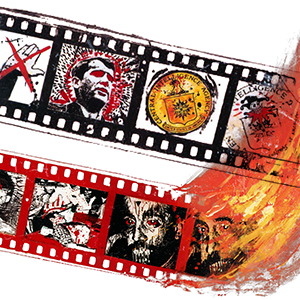
The Christic [kris-tik] Institute was a public interest law firm founded in 1980 by Daniel Sheehan, his wife, Sara Nelson and their partner, William J. Davis, a Jesuit priest, after the successful conclusion of their work on the Silkwood case. Karen Silkwood was an American chemical technician and labor union activist known for raising concerns about worker safety in a nuclear facility. She is most famous for her mysterious death, which was the subject of a victorious lawsuit against the chemical company Kerr-McGee.
Based on the ecumenical teachings of French philosopher and Jesuit Pierre Teilhard de Chardin, and on the lessons they learned from their experience in the Silkwood fight, the Christic Institute combined investigation, litigation, education and organizing into a unique model for social reform in the United States. Christic represented victims of the nuclear disaster at Three Mile Island; they prosecuted KKK members for killing civil rights demonstrators in the Greensboro Massacre, and they defended Catholic workers providing sanctuary to Salvadoran refugees (American Sanctuary Movement).
read more »
Posted in Politics, War, World |
Leave a Comment »
November 9, 2014


‘The Caine Mutiny‘ is a 1951 Pulitzer Prize-winning novel by American author Herman Wouk. The book grew out of Wouk’s personal experiences aboard a destroyer-minesweeper in the Pacific in World War II and deals with, among other things, the moral and ethical decisions made at sea by the captains of ships. The mutiny of the title is legalistic, not violent, and takes place during a historic typhoon in December 1944. The court-martial that results provides the dramatic climax to the plot.
The story is told through the eyes of Willis Seward ‘Willie’ Keith, an affluent, callow young man who signs up for midshipman school with the Navy to avoid being drafted into the Army during World War II. After barely surviving a series of misadventures that earn him the highest number of demerits in the history of the school, he is commissioned and assigned to the destroyer minesweeper USS Caine, an obsolete warship converted from a World War I-era destroyer.
read more »
Posted in Art, Politics, War |
Leave a Comment »
September 11, 2014


Simulator sickness is a condition where a person exhibits symptoms similar to motion sickness (e.g. headache, drowsiness, nausea, dizziness, vomiting, sweating) caused by playing computer/simulation/video games. Researchers the University of Minnesota had students play the first person shooter ‘Halo’ for less than an hour, and found that up to 50 percent felt sick afterwards. The phenomenon was well known in popular culture before it was known as simulation sickness. In the 1983 comedy film ‘Joysticks,’ the manager of a local video arcade says, ‘The reason why I never play any of these games, well, they make me physically ill. I mean, every time I look in one of the screens, they make me dizzy.’
In 1995, the US Army Research Institute for the Behavioral and Social Sciences published the results of a study of 742 pilot exposures from 11 military flight simulators. Half of the pilots reported post-effects of some kind. Symptoms dissipated in under an hour for one third, after four hours for six percent, after six hours for four percent, and one percent reported cases of spontaneously occurring flashbacks.
read more »
Posted in Health, Technology, War |
Leave a Comment »
July 10, 2014


Nonviolent Communication (NVC) is an interpersonal communicative process developed by psychologist Marshall Rosenberg beginning in the 1960s. NVC often functions as a conflict resolution process. It focuses on three aspects of communication: self-empathy (a deep and compassionate awareness of one’s own inner experience), empathy (listening to another with deep compassion), and honest self-expression (expressing oneself authentically in a way that is likely to inspire compassion in others).
NVC is based on the idea that all human beings have the capacity for compassion and only resort to violence or behavior that harms others when they don’t recognize more effective strategies for meeting needs. Habits of thinking and speaking that lead to the use of violence (psychological and physical) are learned through culture. NVC theory supposes all human behavior stems from attempts to meet universal human needs and that these needs are never in conflict. Rather, conflict arises when strategies for meeting needs clash. NVC proposes that if people can identify their needs, the needs of others, and the feelings that surround these needs, harmony can be achieved.
read more »
Posted in Health, Language, War |
1 Comment »
May 6, 2014

The Long Peace is a term for the historical period following the end of World War II in 1945. The ensuing half century was marked by the absence of major wars between the great powers of the period, the USA and the USSR, who were locked in a Cold War. Following the collapse of the Soviet Union in 1991 and the rise of China as a major power, there followed two decades of continued absence of direct conflict between major states, though lesser military conflicts occurred.
It is speculated that the obvious political errors leading to World War I and World War II with their consequent horrors and, thereafter, the acquisition of thermonuclear weapons by the opposing powers of the United States and the Soviet Union exerted a restraining influence on the leaderships of the major powers. A jockular expression in Europe to describe the strangely long stretch of peace is: ‘It has been 2,000 years since an army has not crossed the Rhine for so long a time.’
Posted in Politics, War, World |
Leave a Comment »



 The Daily Omnivore