March 31, 2014

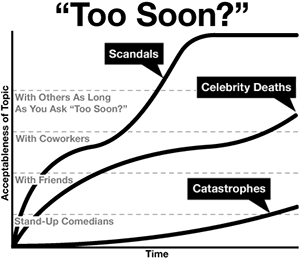
9/11 humor is black comedy or off-color humor that aims to make light of the September 11, 2001 terrorist attacks. A number of scholars have studied the ways in which humor has been used to deal with the trauma of the event. Researcher Bill Ellis found jokes about the attacks from Americans the day afterwards, and sociologist Giselinde Kuipers found jokes on Dutch websites a day later. Kuipers had collected around 850 online jokes about 9/11, Osama Bin Laden, and the Afghanistan war by 2005.
An early public attempt at 9/11 humor was made by Gilbert Gottfried just a few weeks after the attacks. During a comedy roast at the Friars Club his 9/11 gags ellicited angry shouts of ‘too soon.’ Gottfried improvised and performed ‘The Aristocrats’ routine (a famously vulgar joke), which got great applause from the crowd.
read more »
Posted in Death, Humor, War |
Leave a Comment »
March 7, 2014

The ship’s cat has been a common feature on many trading, exploration, and naval ships, and dates back to ancient times. Cats have been carried on ships for many reasons, the most important being to catch mice and rats. These rodents aboard a ship can cause damage to ropes and woodwork. Also, rodents threatened the stores the ship carried and were a source of disease, which is dangerous for ships that are at sea for long periods of time.
The natural ability of cats to adapt to new surroundings made them suitable for service on a ship. They also offered companionship and a sense of home, security and camaraderie to sailors who could be away from port for long periods, especially in times of war.
read more »
Posted in War, World |
1 Comment »
February 10, 2014

The Monuments, Fine Arts, and Archives (MFAA) program under the Civil Affairs and Military Government Sections of the Allied armies was established in 1943 to help protect cultural property in war areas during and after World War II. The group of about 400 servicemembers and civilians worked with military forces to safeguard historic and cultural monuments from war damage, and as the conflict came to a close, to find and return works of art and other items of cultural importance that had been stolen by the Nazis or hidden for safekeeping.
Many of the men and women of the MFAA, also known as Monuments Men, went on to have prolific careers. Largely art historians and museum personnel, they had formative roles in the growth of many of the United States’ greatest cultural institutions, including the National Gallery of Art, the Metropolitan Museum of Art, and the New York City Ballet, as well as in museums and other institutions in Europe.
read more »
Posted in Art, War |
Leave a Comment »
January 29, 2014

Swords to plowshares is a concept in which military weapons or technologies are converted for peaceful civilian applications. An expression of this concept can be seen a bronze statue in the United Nations garden called ‘Let Us Beat Swords into Plowshares,’ a gift from the Soviet Union sculpted by Evgeniy Vuchetich, representing the figure of a man hammering a sword into the shape of a plowshare.
The phrase originates from the Book of Isaiah: ‘And many people shall go and say, Come ye, and let us go up to the mountain of the Lord, to the house of the God of Jacob; and He will teach us of His ways, and we will walk in His paths: for out of Zion shall go forth the law, and the word of the Lord from Jerusalem. And He shall judge among the nations, and shall rebuke many people: and they shall beat their swords into plowshares, and their spears into pruning hooks: nation shall not lift up sword against nation, neither shall they learn war any more.
read more »
Posted in Politics, War, World |
Leave a Comment »
January 24, 2014

Cryptonomicon is a 1999 novel by American author Neal Stephenson depicting the exploits of two groups of people in two different time periods, presented in alternating chapters. The first group is World War II-era Allied codebreakers and tactical-deception operatives affiliated with the Government Code and Cypher School at Bletchley Park in the UK and disillusioned Axis military and intelligence figures whom they encounter.
The second narrative is set in the late 1990s with descendants of the first narrative’s characters employing cryptologic, telecom, and computer technology to build an underground data haven in the fictional Sultanate of Kinakuta. Their goal is to facilitate anonymous Internet banking using electronic money and (later) digital gold currency, with a longer range objective to distribute Holocaust Education and Avoidance Pod (HEAP) media for instructing genocide-target populations on defensive warfare.
read more »
Posted in Language, Technology, War |
1 Comment »
November 18, 2013
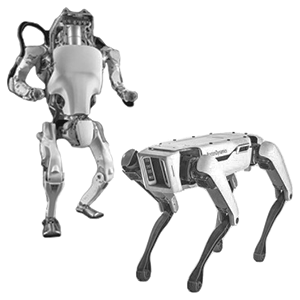
Boston Dynamics is an engineering and robotics company spun off from MIT in 1992 that is best known for the development of ‘BigDog,’ a quadruped robot designed for the US military with funding from Defense Advanced Research Projects Agency (DARPA), and ‘DI-Guy,’ software for realistic human simulation.
Early in the company’s history, it worked with the American Systems Corporation under a contract from the Naval Air Warfare Center Training Systems Division to replace naval training videos for aircraft launch operations with interactive 3D computer simulations.
read more »
Posted in Money, Technology, War |
Leave a Comment »
October 23, 2013

Colossus: The Forbin Project is a 1970 American science fiction thriller film based on a 1966 novel Colossus, by Dennis Feltham Jones, about a massive American defense computer, named Colossus, becoming sentient and deciding to assume control of the world. The machine was built in secret by Dr. Charles A. Forbin to control all of the United States and Allied nuclear weapons systems.
Colossus is built to be impervious to any attack, encased within a mountain and powered by its own nuclear reactor, filling the area with gamma radiation. When it is activated, the President of the United States announces its existence at a press conference with Forbin in Washington, proudly proclaiming it a perfect defense system that will ensure peace.
read more »
Posted in Art, Technology, War |
Leave a Comment »
October 2, 2013

‘The Pentagon Wars‘ is a 1998 HBO film, directed by Richard Benjamin, based on a book of the same name (subtitled: ‘Reformers Challenge the Old Guard’) by Colonel James G. Burton, USAF (retired).
Starring Kelsey Grammer, Cary Elwes and Richard Schiff, the film is a dark comedy describing the development of the M2 Bradley fighting vehicle.
read more »
Posted in Humor, Money, War |
Leave a Comment »
September 27, 2013

Precision guided firearms (PGFs) are long-range rifle systems designed to improve the accuracy of shooting at targets at extended ranges through target tracking, heads-up display, and advanced fire control.
Inspired by missile lock-on and fighter jet technology, the application of PGF technology to small arms mitigates multiple sources of marksman error including mis-aim, trigger jerk and shot setup miscalculation. PGFs can significantly increase first shot success probability (FSSP) out to extreme ranges of 1,200 yards or more. PGFs are fully integrated systems consisting of a standard caliber bolt action or semi-automatic rifles combined with a networked tracking scope and a guided trigger.
Posted in Technology, War |
Leave a Comment »
August 31, 2013
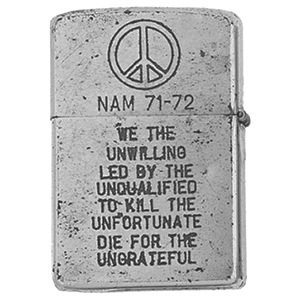
Search and Destroy, Seek and Destroy, or even simply S&D, refers to a military strategy that became a large component of the Vietnam War. The idea was to insert ground forces into hostile territory, search out the enemy, destroy them, and withdraw immediately afterward. The strategy was the result of a new technology, the helicopter, which resulted in a new form of warfare, air cavalry, and was thought to be ideally suited to counter-guerrilla jungle warfare.
The complementary conventional strategy, which entailed attacking and conquering an enemy position, then fortifying and holding it indefinitely, was known as ‘clear and hold’ or ‘clear and secure.’ In theory, the traditional methods of ‘taking ground’ could not be used in this war. Therefore the U.S. pursued a war of attrition instead, in which raw ‘body count’ would be the measuring tool to determine the success of a strategy.
read more »
Posted in Death, War, World |
Leave a Comment »
August 31, 2013

A Vietnam veteran is someone who served in the armed forces of participating countries during the Vietnam War. Common usage distinguishes between those who served ‘in country’ as ‘Vietnam veterans’ and the others as ‘Vietnam-era veterans.’ The U.S. government officially refers to all as ‘Vietnam-era veterans.’ According to the U.S. Department of Labor, the Vietnam Era Veterans’ Readjustment Assistance Act of 1974 (VEVRAA), ‘A Vietnam era veteran is a person who: ‘served on active duty for a period of more than 180 days, any part of which occurred between August 5, 1964 and May 7, 1975, and was discharged or released with other than a dishonorable discharge.’
The U.S. Census Bureau (2004) reports there are 8.2 million ‘Vietnam Era Veterans.’ Of these 2.59 million are reported to have served ‘in country.’ More than 58,000 US personnel died as a result of the conflict (this comprises deaths from all categories including deaths while missing, captured, non-hostile deaths, homicides, and suicides).
read more »
Posted in Health, War, World |
Leave a Comment »
August 22, 2013

Otto Rahn (1904 – 1939) was a German medievalist and First Lieutenant of the SS. Speculation still surrounds Rahn and his research. From an early age, he became interested in the legends of Parsifal, the Holy Grail, Lohengrin, and the Nibelungenlied. While attending the University of Giessen he was inspired by his professor, the Baron von Gall, to study the Albigensian (Catharism) movement, and the massacre that occurred at Montségur. Rahn is quoted as saying that ‘It was a subject that completely captivated me.’
In 1931 he travelled to the Pyrenees region of southern France where he conducted most of his research. Aided by the French mystic and historian Antonin Gadal, Rahn argued that there was a direct link between Wolfram Von Eschenbach’s Parzival and the Cathar Grail mystery. He believed that the Cathars held the answer to this sacred mystery and that the keys to their secrets lay somewhere beneath the mountain pog where the fortress of Montségur remains, the last Cathar fortress to fall during the Albigensian Crusade.
read more »
Posted in Philosophy, War |
Leave a Comment »



 The Daily Omnivore