August 12, 2013

‘The Day the Clown Cried‘ is an unreleased 1972 film directed by and starring Jerry Lewis. It is based on a script of the same name by Joan O’Brien, who had co-written the original script with Charles Denton ten years previously.
The film was met with controversy regarding its premise and content, which features a circus clown who is imprisoned in a Nazi concentration camp. ‘The Day the Clown Cried’ has become somewhat infamous among film historians and movie buffs as a film that has never officially been released.
read more »
Posted in Art, Humor, War |
Leave a Comment »
July 24, 2013

‘How to Survive a Robot Uprising: Tips on Defending Yourself Against the Coming Rebellion’ is a 2005 semi-satirical book by contributing editor to ‘Popular Mechanics’ Daniel Wilson. The book gives tongue-in-cheek advice on how one can survive in the event that robots become too intelligent and rebel against the human race. The book blends scientific facts with deadpan humor. Wilson received a Ph.D. in Robotics from Carnegie Mellon University’s Robotics Institute in Pittsburgh.
In the summer of 2005, Paramount Pictures optioned film rights to the book and hired Thomas Lennon and Robert Ben Garant (both members of the State comedy troupe and co-creators of the Reno 911! television series) to write a script based on the book. In 2006 comedian Mike Myers signed with Paramount to star in the movie adaptation.
Posted in Humor, Technology, War |
Leave a Comment »
July 24, 2013
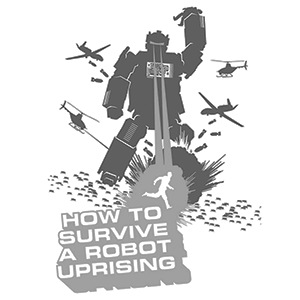
The Butlerian Jihad is an event in the back-story of Frank Herbert’s fictional ‘Dune’ universe. Occurring over 11,000 years in the future (10,000 years before the events chronicled in ‘Dune’), this jihad leads to the outlawing of certain technologies, primarily ‘thinking machines,’ a collective term for computers and artificial intelligence of any kind.
This prohibition is a key influence on the nature of Herbert’s fictional setting. Herbert may have coined the name from 19th-century author Samuel Butler, who has the citizens of ‘Erewhon’ enact a prohibition on machines newer than 270 years fearing that, ‘it was the race of the intelligent machines and not the race of men which would be the next step in evolution.’
read more »
Posted in Language, Technology, War |
Leave a Comment »
June 10, 2013

Ice-nine is a fictional material appearing in Kurt Vonnegut’s novel ‘Cat’s Cradle.’ Ice-nine is supposedly a polymorph of water more stable than common ice; instead of melting at 0 °C (32 °F), it melts at 45.8 °C (114.4 °F). When ice-nine comes into contact with liquid water below 45.8 °C (thus effectively becoming supercooled), it acts as a seed crystal and causes the solidification of the entire body of water, which quickly crystallizes as more ice-nine.
In the story, it is developed by the Manhattan Project for use as a weapon, but abandoned when it becomes clear that any quantity of it would have the power to destroy all life on earth. As people are mostly water, ice-nine kills nearly instantly when ingested or brought into contact with soft tissues exposed to the bloodstream, such as the eyes. A global catastrophe involving freezing the world’s oceans with ice-nine is used as a plot device in Vonnegut’s novel.
read more »
Posted in Science, War |
Leave a Comment »
June 3, 2013
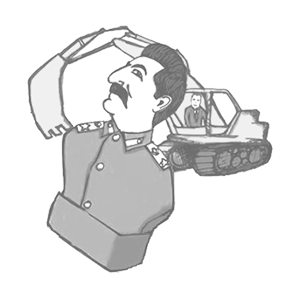
De-Stalinization refers to the process of eliminating the cult of personality, Stalinist political system and the Gulag labor-camp system created by Soviet leader Joseph Stalin. Stalin was succeeded by a collective leadership after his death in 1953. The central Soviet strongmen at the time were Lavrentiy Beria, head of the Ministry of the Interior; Nikita Khrushchev, First Secretary of the Central Committee of the Communist Party of the Soviet Union (CPSU); and Georgi Malenkov, Premier of the Soviet Union.
Contemporary historians regard the process of de-Stalinization as a significant turning point in the history of modern Russia. References to Stalin were embedded in the lyrics of the National Anthem of the Soviet Union, after which the Stalin-centric and World War II-era references were excised where an instrumental version was used.
read more »
Posted in Politics, War, World |
Leave a Comment »
June 3, 2013
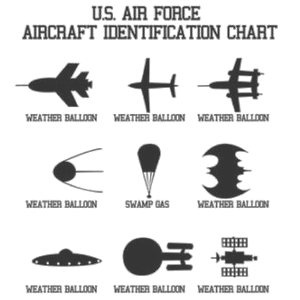
Area 51 is a military base, and a remote detachment of Edwards Air Force Base. It is in the southern portion of Nevada, 83 miles north-northwest of downtown Las Vegas. At its center, on the southern shore of Groom Lake, is a large military airfield. The base’s primary purpose is to support development and testing of experimental aircraft and weapons systems. Though the name ‘Area 51’ is used in official CIA documentation, other names used for the facility include ‘Dreamland,’ ‘Paradise Ranch,’ ‘Home Base,’ ‘Watertown Strip,’ ‘Groom Lake,’ and most recently ‘Homey Airport.’
The area is part of the Nellis Military Operations Area, and the restricted airspace around the field is referred to as R- 4808N, known by the military pilots in the area as ‘The Box’ or ‘the Container.’ The intense secrecy surrounding the base, the very existence of which the US government did not even acknowledge until 2003, has made it the frequent subject of conspiracy theories and a central component to unidentified flying object (UFO) folklore.
Posted in Humor, Technology, War |
Leave a Comment »
May 24, 2013


Star Wars, the popular science fantasy saga, and cultural touchstone, is acknowledged to have been inspired by many sources. These include Hinduism, Qigong (‘Life Energy Cultivation’), Greek philosophy, Greek mythology, Roman history, Roman mythology, parts of the Abrahamic religions, Confucianism, Shintō, and Taoism, not to mention countless cinematic precursors including Akira Kurosawa and Sergio Leone.
George Lucas has said that chivalry, knighthood, paladinism, and related institutions in feudal societies inspired some concepts in the Star Wars movies, most notably the Jedi Knights. The work of the mythologist Joseph Campbell, most notably his book ‘The Hero with a Thousand Faces,’ directly influenced Lucas, and was what drove him to create the ‘modern myth’ of ‘Star Wars.’ The supernatural flow of energy known as The Force is believed to have originated from the concept of prana, or ki/qi/chi, ‘the all-pervading vital energy of the universe.’
read more »
Posted in Art, War, World |
Leave a Comment »
May 21, 2013
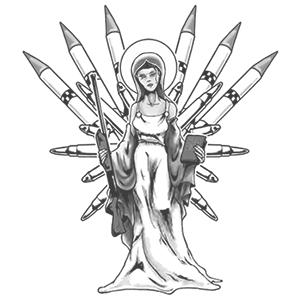
‘Praise the Lord and Pass the Ammunition‘ is an American patriotic song written by Frank Loesser and published as sheet music in 1942 by Famous Music Corp. The song was a response to the attack on Pearl Harbor that marked United States involvement in World War II.
The song describes a chaplain (‘sky pilot’) being with some fighting men who are under attack from an enemy. He is asked to say a prayer for the men who were engaged in firing at the oncoming planes. The chaplain puts down his Bible, mans one of the ship’s gun turrets and begins firing back, saying, ‘Praise the Lord and pass the ammunition.’
read more »
Posted in Philosophy, War |
Leave a Comment »
May 14, 2013
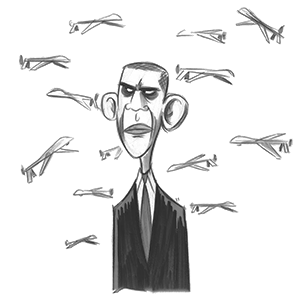
The Disposition Matrix is a database that United States officials describe as a ‘next-generation capture/kill list’ developed by the Obama Administration beginning in 2010. It is a blueprint for tracking, capturing, rendering, or killing terrorism suspects. It is intended to become a permanent fixture of American policy. The process determining criteria for killing is not public, but has been heavily shaped by presidential counterterrorism adviser John Brennan.
Under the Presidency of George W. Bush, Brennan served as top aide to CIA director George Tenet, where he defended the administration’s use of extraordinary rendition and enhanced interrogation, also described as torture. Brennan’s association with the CIA’s interrogation program was controversial, and forced him to withdraw his candidacy for directorship of the CIA or National Intelligence in 2008.
read more »
Posted in Death, Politics, War |
1 Comment »
May 14, 2013

‘The Constitution is not a suicide pact‘ is a phrase in American political and legal discourse which expresses the belief that constitutional restrictions on governmental power must be balanced against the need for survival of the state and its people. It is most often attributed to Abraham Lincoln, as a response to charges that he was violating the United States Constitution by suspending habeas corpus (the right of detainees to contest their imprisonment) during the American Civil War.
Although the phrase echoes statements made by Lincoln, and although versions of the sentiment have been advanced at various times in American history, the precise phrase ‘suicide pact’ was first used by Justice Robert H. Jackson in his dissenting opinion in ‘Terminiello v. Chicago,’ a 1949 free speech case. The phrase also appears in the same context in ‘Kennedy v. Mendoza-Martinez,’ a 1963 U.S. Supreme Court decision written by Justice Arthur Goldberg.
read more »
Posted in Death, Politics, War |
Leave a Comment »
April 24, 2013

The Big Lie is a propaganda technique. The expression was coined by Adolf Hitler, when he dictated his 1925 book ‘Mein Kampf,’ about the use of a lie so ‘colossal’ that no one would believe that someone ‘could have the impudence to distort the truth so infamously.’
Hitler asserted the technique was used by Jews to unfairly blame Germany’s loss in World War I on German Army officer Erich Ludendorff.
read more »
Posted in Language, Politics, War |
Leave a Comment »
April 8, 2013

The Shouting Hill is a hill in the Israeli controlled portion of the Golan Heights. During the Six Day War, Israel captured the majority of the heights. The Shouting Hill is located close to the ceasefire line that separates Syrian controlled territory and the territory occupied by Israel. The hill is situated near the Druze village of Majdal Shams; community members were separated after the war.
Very few visits were allowed between the families from both sides of the ceasefire line. Israel and Syria are still in an official state of war. There is also no telecommunications or mail allowed between the sides. As a result families come to the hill from both sides of the border to see and talk (actually shout into megaphones) to their relatives on the other side. However, with the advent of mobile phones, people don’t do this as often, except on special occasions like weddings or when they want to see each other and they use binoculars.
Posted in Politics, War, World |
1 Comment »


 The Daily Omnivore