April 7, 2013

Leaderless resistance, or phantom cell structure, is a political resistance strategy in which small, independent groups (covert cells), including individuals (solo cells), challenge an established adversary such as a government. Leaderless resistance can encompass anything from non-violent disruption and civil disobedience to bombings, assassinations and other violent agitation. Leaderless cells lack bidirectional, vertical command links and operate without hierarchical command.
Given the simplicity of the strategy, as well as the fact that it is difficult to stamp out, leaderless resistance has been employed by a wide-range of movements, from terrorist and hate groups, advocating on a range of issues like animal-liberation, radical environmentalism, anti-corporatism, anti-abortion activism, and resistance to military invasion or colonialism.
read more »
Posted in Politics, War |
Leave a Comment »
April 2, 2013

Food Not Bombs is a loose-knit group of independent collectives, serving free vegan and vegetarian food to others. Food Not Bombs’ ideology is that myriad corporate and government priorities are skewed to allow hunger to persist in the midst of abundance.
To demonstrate this (and to reduce costs), a large amount of the food served by the group is surplus food from grocery stores, bakeries and markets that would otherwise go to waste. This group exhibits a form of franchise activism. The organization was founded in 1980 in Cambridge, Massachusetts by anti-nuclear activists. One of the co founders was C.T. Lawrence Butler.
Posted in Food, Politics, War |
Leave a Comment »
March 31, 2013

‘Pirates and Emperors, Old and New: International Terrorism in the Real World’ is a book by political theorist Noam Chomsky, titled after an observation by St. Augustine in ‘City of God,’ proposing that what governments coin as ‘terrorism’ in the small simply reflects what governments utilize as ‘warfare’ in the large. Yet, governments coerce their populations to denounce the former while embracing the latter.
In the ‘City of God,’ St. Augustine tells the story of a pirate captured by Alexander the Great, who asked him ‘how dare he molest the sea.’ ‘How dare you molest the whole world’ the pirate replied. ‘Because I do it with a little ship only, I am called a thief; you, doing it with a great navy, are called an emperor.’ The book inspired a humorous short web animation titled ‘Pirates & Emperors (or, Size Does Matter),’ illustrating Chomsky’s thesis.
Posted in Money, Politics, War |
Leave a Comment »
March 22, 2013
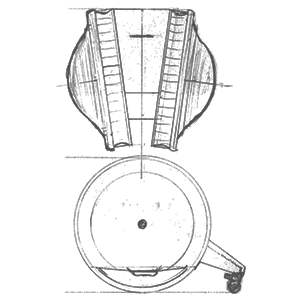
The Kugelpanzer (‘spherical tank’) was a prototype reconnaissance tank built by Nazi Germany during World War II. It was one of the most unusual armored fighting vehicles ever built.
Only one example of this Rollzeug (rolling vehicle) exists in Russia as part of the Kubinka Tank Museum’s collection of German armored vehicles. The Kugelpanzer is simply listed as Item #37 and is painted gloss gray. From fragmentary information, the drive has been removed from the vehicle and no metal samples are allowed to be taken from it.
read more »
Posted in Technology, War |
Leave a Comment »
March 20, 2013

The rasputitsa refers to the biannual mud seasons when unpaved roads become difficult to traverse in parts of Belarus, Russia, and Ukraine. The word may be translated as the ‘quagmire season’ because during this period the large flatlands become extremely muddy and marshy, as do most unpaved roads. The rasputitsa occurs more strongly in the spring due to the melting snow but it usually recurs in the fall due to frequent heavy rains. The rasputitsa seasons of Russia are well known as a great defensive advantage in wartime. Napoleon found the mud in Russia to be a very great hindrance in 1812.
During the Second World War the month-long muddy period slowed down the German advance during the Battle of Moscow, and may have helped save the Soviet capital, as well as the presence of ‘General Winter,’ that followed the autumn rasputitsa period – this sort of wintertime hindrance to German military motor vehicle transport on the Eastern Front partly inspired the design and mass production of a unique fully tracked artillery tractor for such conditions.
read more »
Posted in Language, War, World |
Leave a Comment »
March 18, 2013
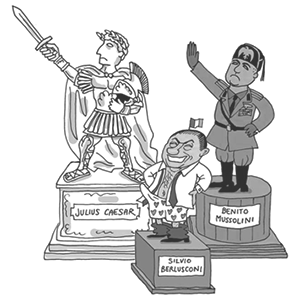
The Roman salute (Saluto Romano) is a gesture in which the arm is held out forward straight, with palm down, and fingers touching. In some versions, the arm is raised upward at an angle; in others, it is held out parallel to the ground. The former is a well known symbol of fascism that is commonly perceived to be based on a custom in ancient Rome. However, no Roman text gives this description and the Roman works of art that display gestures of salutation bear little resemblance to the modern Roman salute.
Jacques-Louis David’s painting ‘The Oath of the Horatii’ (1784) provided the starting point for the gesture that became later known as the Roman salute. The gesture and its identification with Roman culture was further developed in other French neoclassic artworks.
read more »
Posted in Politics, War, World |
1 Comment »
March 18, 2013
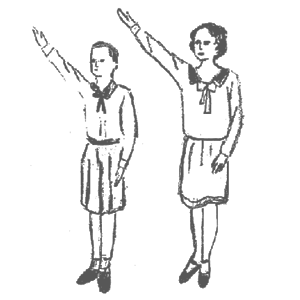
The Bellamy salute is a salute chosen by American socialist Francis Bellamy to accompany the American Pledge of Allegiance, which he wrote. During the period when it was used with the Pledge of Allegiance, it was sometimes known as the ‘flag salute.’ During the 1920s and 1930s, Italian fascists and Nazis adopted salutes which were similar in form, resulting in controversy over the use of the Bellamy salute in the United States.
It was officially replaced by the hand-over-heart salute when Congress amended the Flag Code in December of 1942. The inventor of the saluting gesture was James B. Upham, junior partner and editor of ‘The Youth’s Companion.’ Bellamy recalled Upham, upon reading the pledge, came into the posture of the salute, snapped his heels together, and said ‘Now up there is the flag; I come to salute; as I say ‘I pledge allegiance to my flag,’ I stretch out my right hand and keep it raised while I say the stirring words that follow.’
read more »
Posted in Politics, War, World |
1 Comment »
March 15, 2013

Tachypsychia [tak-ee-sahy-kee-uh] is a neurological condition that alters the perception of time, usually induced by physical exertion, drug use, or a traumatic event. It is sometimes referred to by martial arts instructors and self defense experts as an ‘adrenaline dump.’
For someone affected by tachypsychia events appear to slow down and objects appear as moving in a speeding blur. It is believed that tachypsychia is induced by a combination of high levels of dopamine and norepinephrine, usually during periods of great physical stress and/or in violent confrontation. Tachypsychia is related to the ‘fight or flight’ response of the body to events considered life threatening.
read more »
Posted in Health, War |
Leave a Comment »
March 12, 2013
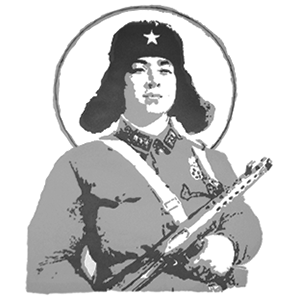
Lei Feng (1940 – 1962) was a soldier of the People’s Liberation Army of China. After his death, Lei was characterized as a selfless and modest person who was devoted to the Communist Party, Chairman Mao Zedong, and the people of China. In 1963, he became the subject of a nationwide, posthumous propaganda campaign ‘Follow the examples of Comrade Lei Feng.’ Lei was portrayed as a model citizen, and the masses were encouraged to emulate his selflessness, modesty, and devotion to Mao.
After Mao’s death, Lei Feng remained a cultural icon representing earnestness and service; his name entered daily speech and his imagery appeared on t-shirts and memorabilia. Although someone named Lei Feng probably existed, the accounts of his life as depicted by Party propaganda are heavily disputed, leading him to become a source of cynicism and subject of derision among segments of the Chinese population. Nevertheless, Lei’s image as a role model serviceman has survived decades of political change in China.
read more »
Posted in Politics, War, World |
Leave a Comment »
March 8, 2013
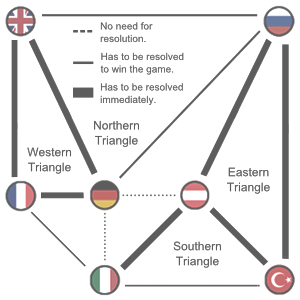
Diplomacy is a strategic board game created by American mail carrier Allan B. Calhamer in 1954 and released commercially in 1959. Its main distinctions from most board wargames are its negotiation phases (players spend much of their time forming and betraying alliances with other players and forming beneficial strategies) and the absence of dice or other game elements that produce random effects.
Set in Europe just before the beginning of World War I, Diplomacy is played by two to seven players, each controlling the armed forces of a major European Power (or, with few players, multiple powers). Each player aims to move his or her few starting units—and defeat those of others—to win possession of a majority of strategic cities and provinces marked as ‘supply centers’ on the map; these supply centers allow players who control them to produce more units.
read more »
Posted in Games, Politics, War |
Leave a Comment »
March 7, 2013

‘The Trap: What Happened to Our Dream of Freedom’ is a 2007 BBC documentary series by English filmmaker Adam Curtis, well known for other documentaries including ‘The Century of the Self’ and ‘The Power of Nightmares.’
The series consists of three one-hour programs which explore the concept and definition of freedom, specifically, ‘how a simplistic model of human beings as self-seeking, almost robotic, creatures led to today’s idea of freedom.’
read more »
Posted in Philosophy, Politics, War |
Leave a Comment »
March 5, 2013
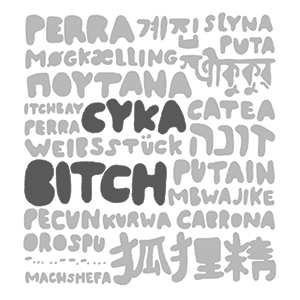
The Bitch Wars occurred within the Soviet labor camp system between 1945 and 1953 (around the death of Joseph Stalin). The Russian word ‘suka’ (literally, ‘bitch’) has a stronger negative connotation than its English equivalent.
In Russian criminal argot, it specifically refers to a person from the criminal world who had cooperated with law enforcement or the government, or ‘went bitch.’ Within the Russian prison system, there was a historical and social structure that had existed since the Tsarist era. One of the important tenets of the system was that members would not serve or collaborate with the Tsarist and later Soviet government. This rule encompassed any kind of collaboration, not only ‘snitching’ or ‘ratting.’
read more »
Posted in Language, War, World |
Leave a Comment »


 The Daily Omnivore