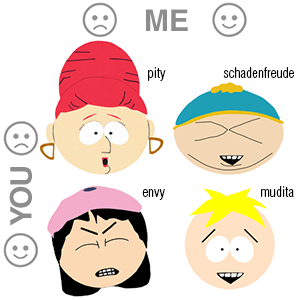
Muditā [moo-dee-tah] means ‘joy’ in sanskrit, especially sympathetic or vicarious joy. it is the pleasure that comes from delighting in other people’s well-being rather than begrudging it. The traditional paradigmatic example of this mind-state is the attitude of a parent observing a growing child’s successes, but it is not to be confounded with pride as the person feeling mudita must not have any interest or direct income from the accomplishments of the other. Its antonym is the German word ‘schadenfreude’ (‘pleasure derived from the misfortunes of others’).
Many Buddhist teachers interpret joy more broadly as an inner spring of infinite joy that is available to everyone at all times, regardless of circumstances. The more deeply one drinks of this spring, the more secure one becomes in one’s own abundant happiness, and the easier it then becomes to relish the joy of other people as well. Joy is also traditionally regarded as the most difficult to cultivate of the four immeasurables (the ‘four sublime attitudes’). To show joy is to celebrate happiness and achievement in others even when we are facing tragedy ourselves.
Mudita
Only Nixon Could Go to China
The phrase ‘Nixon goes to China‘ or ‘It took Nixon to go to China’ is a historical reference to President Richard Nixon’s 1972 visit to the People’s Republic of China, where he met with Chairman Mao Zedong.
As a political metaphor, it refers to the ability of a politician with an unassailable reputation among his supporters for representing and defending their values to take actions that would draw their criticism and even opposition if taken by someone without those credentials. Although Nixon’s example is that of a hardliner taking steps toward peace with a traditional enemy (the most common application of the metaphor), it could also be applied to a reputedly cautious diplomat defying expectations by taking military action, or a political leader reforming aspects of the political system of which they have been strong supporters.
read more »
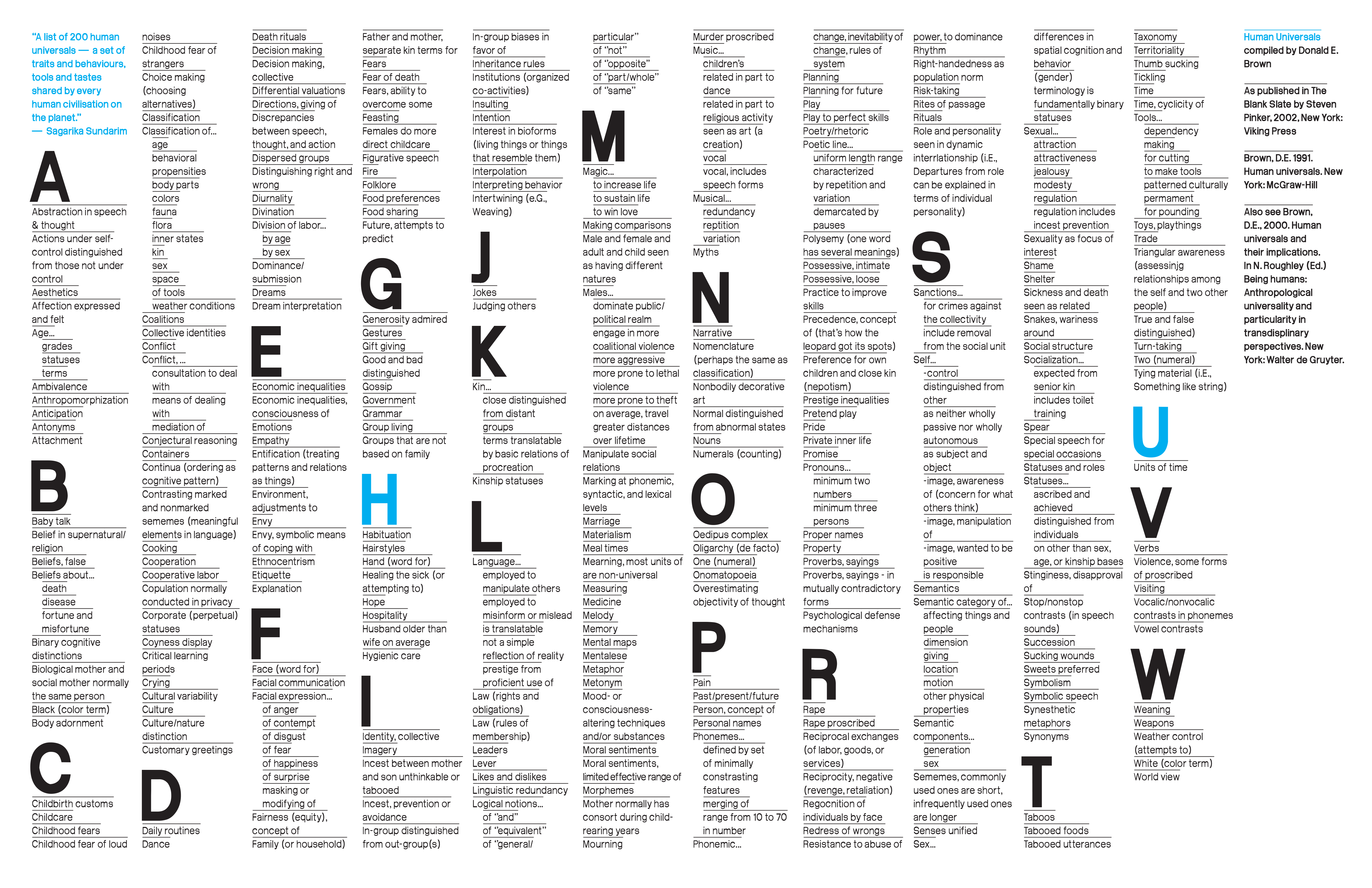
Human Universals
‘Human Universals‘ is a 1991 nonfiction book by Donald Brown, an American professor of anthropology (emeritus) at UC, Santa Barbara. Brown says human universals, ‘comprise those features of culture, society, language, behavior, and psyche for which there are no known exception.’
Universals include: age-grading, athletic sports, bodily adornment, calendar, cleanliness training, community organization, cooking, cooperative labor, cosmology, courtship, dancing, decorative art, divination, division of labor, dream interpretation, education, eschatology, ethics, ethno-botany, etiquette, faith healing, family feasting, fire-making, folklore, food taboos, funeral rites, games, gestures, gift-giving, government, greetings, hair styles, hospitality, housing, hygiene, incest taboos, inheritance rules, joking, kin groups, kinship nomenclature, language, law, luck superstitions, magic, marriage, mealtimes, medicine, obstetrics, penal sanctions, personal names, population policy, postnatal care, pregnancy usages, property rights, propitiation of supernatural beings, puberty customs, religious ritual, residence rules, sexual restrictions, soul concepts, status differentiation, surgery, tool-making, trade, visiting, weather control, weaving.
Soundscape Conservation
Soundscape ecology is the study of sound within a landscape and its effect on organisms. The discipline of conservation biology has traditionally been concerned with the preservation of biodiversity and the habitats that organisms are dependent upon. However, soundscape ecology encourages biologists to consider natural soundscapes as resources worthy of conservation efforts. Unaltered soundscapes have value for wildlife as demonstrated by the numerous negative effects of anthropogenic (human created) noise on various species.
Organisms that use acoustic cues generated by their prey may be particularly impacted by human-altered soundscapes. In this situation, the (unintentional) senders of the acoustic signals will have no incentive to compensate for masking imposed by anthropogenic sound. In addition, natural soundscapes can have benefits for human wellbeing and may help generate a distinct sense of place, connecting people to the environment and providing unique aesthetic experiences. Because of the various values inherent in natural soundscapes, they may be considered ecosystem services that are provisioned by intact, functioning ecosystems.
Visiting Card
A visiting card, also known as a calling card, is a small paper card with one’s name printed on it, and often bearing an artistic design. In 18th century Europe the footmen of aristocrats and royalty would deliver these first European visiting cards to the servants of their prospective hosts solemnly introducing the arrival of their owners.
Visiting cards became an indispensable tool of etiquette, with sophisticated rules governing their use. The essential convention was that one person would not expect to see another person in her own home (unless invited or introduced) without first leaving his visiting card for the person at her home. Upon leaving the card, he would not expect to be admitted at first, but might receive a card at his own home in response. This would serve as a signal that a personal visit and meeting at home would be welcome. On the other hand, if no card were forthcoming, or if a card were sent in an envelope, a personal visit was thereby discouraged.
read more »
Hendiatris
Hendiatris [hen-die-uh-tris] (from the Greek: ‘one through three’) is a figure of speech used for emphasis, in which three words are used to express one idea (e.g. ‘sex, drugs and rock and roll’ to capture the life of a rock star). It is an isocolon, a sentence composed of two or more parts (cola) perfectly equivalent in structure, length and rhythm (called a bicolon, tricolon, or tetracolon depending on whether they are two, three, or four parts).
A well-known example of tricolon is Julius Caesar’s ‘Veni, vidi, vici’ (‘I came; I saw; I conquered’), which is also a hendiatris and known in English as a ‘tripartite motto.’ If the units involved are not single words, and if they are not in any way synonyms but rather circumnavigate the one idea expressed, the figure may be described more correctly, precisely, and succinctly as a ‘triad.’
read more »
Edible Bird’s Nest
Edible bird’s nests are among the most expensive animal products consumed by humans, with an average nest selling for $2,500 per kilo for end-consumers in Asia. The nests have been used in Chinese cooking for over 400 years, most often as bird’s nest soup. Legend has it that shipwrecked sailors scavenging for food cleaned and cooked the nests and found the resulting stew so invigorating they were able to sail home to inform the emperor of their new discovery.
The Chinese name for edible bird’s nest, ‘yàn wō,’ translates literally as ‘swiftlet nest’ (swiftlets, common to asia, are superficially similar to swallows and known for building nests of solidified saliva). The most famous use for the nests is bird’s nest soup, a delicacy in Chinese cuisine. When dissolved in water, the swiftlet nests have a gelatinous texture used for soup or sweet tong sui (a Cantonese custard).
read more »
Right To Be Forgotten
The right to be forgotten is a nascent legal concept arising from the need to ‘determine the development of [one’s] life in an autonomous way, without being perpetually or periodically stigmatized as a consequence of a specific action performed in the past.’ France law began recognizing this new right in 2010. Critics claim the laws are vague, unenforceable, and potentially a threat to open access to information, which is an existing legal right in many countries. There are also concerns about its interaction with the right to privacy and whether it would decrease the quality of the Internet through censorship and a rewriting of history.
Many nations have very strong domestic freedom of speech laws, which would be challenging to reconcile with the right to be forgotten. Some academics see that only a limited form of the right to be forgotten would be reconcilable with US constitutional law; the right of an individual to delete data that he or she has personally submitted. In this limited form, individuals could not have material removed that has been uploaded by others, as demanding the removal of information could constitute censorship and a reduction in the freedom of expression.
read more »
Imelda Marcos
Imelda Marcos (b. 1929) is the widow of former Philippine President Ferdinand Marcos. In popular culture, she is remembered for her collection of more than a thousand pairs of shoes. She began her career as a local singer and model in Manila before meeting her husband. After the declaration of martial law in 1972, Imelda began holding positions in the national government that allowed her to travel the world and accumulate artwork and real estate. The couple consolidated their power allowing them to transport funds from the Philippine treasury into offshore accounts, such as banks in Switzerland.
President Marcos was accused of the assassination of Benigno Aquino, Jr., leading to the People Power Revolution which forced the Marcoses out of office and into exile in Hawaii. After the death of Ferdinand, Imelda and her family were given amnesty by then President Corazon Aquino, Benigno Jr’s widow. Her return to the Philippines has since allowed her to restore her political dynasty. Despite numerous cases involving alleged corruption, she has not been imprisoned and continues to wield influence. Her ability to survive upheavals in her life has led her to be called the ‘Steel Butterfly.’
read more »
Monobloc
The Monobloc [mon-uh-blok] chair is a lightweight stackable polypropylene chair, often described as the world’s most common plastic chair. Based on original designs by the Italian designer Vico Magistretti in 1967, variants of the one-piece plastic chair went into production with Allibert Group and Grossfillex Group in the 1970s. Since then, millions have been manufactured globally. Many design variants of the basic idea exist.
The Monobloc chair is so named because it is injection molded from thermoplastic polypropylene, the granules being heated to about 220 degrees Celsius, and the melt injected into a mold. The gate of the mold is usually located in the seat to ensure smooth flow to all parts of the tool. The chairs cost approximately $3 to produce, making them affordable across the world. Social theorist Ethan Zuckerman describes them as having achieved a global ubiquity: ‘The Monobloc is one of the few objects I can think of that is free of any specific context. Seeing a white plastic chair in a photograph offers you no clues about where or when you are.’
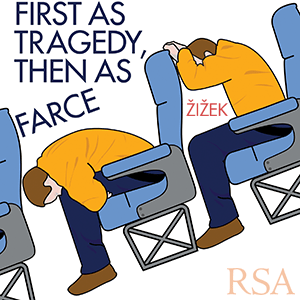
Historic Recurrence
Historic recurrence is the repetition of similar events in history. The concept has been used to analyze the overall history of the world (e.g., the rise and fall of empires), repetitive patterns in the history of a given polity, and generally to any two specific events which bear a striking similarity. Professor of religious history Garry W. Trompf, in his book ‘The Idea of Historical Recurrence in Western Thought,’ traces historically recurring patterns of political thought and behavior in the west since antiquity. Historic recurrences can sometimes induce a sense of ‘convergence,’ ‘resonance,’ or déjà vu.
In the extreme, the concept assumes the form of the doctrine of Eternal Return (the belief that universe has been recurring, and will continue to recur, in a self-similar form an infinite number of times across infinite time or space), found in Indian philosophy and in ancient Egypt and was subsequently taken up by the Pythagoreans and Stoics (with the decline of antiquity and the spread of Christianity, the concept fell into disuse in the Western world, with the exception of existentialist philosopher Friedrich Nietzsche, who connected the thought to many of his other concepts, including ‘amor fati,’ love of one’s fate).
read more »
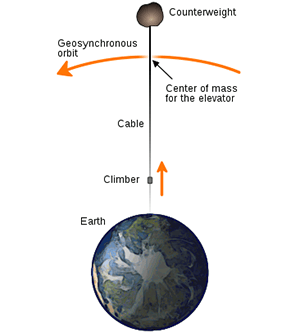
Megastructure
Megastructures are very large man made objects, ranging from ziggurats, to skyscrapers, to hypothetical, star-sized artificial constructs. One requirement of a megastructure is that it is self-supporting; other criteria such as rigidity or contiguousness are sometimes also applied (so large clusters of associated smaller structures may or may not qualify). Megastructures are the products of megascale engineering (building things larger than 1000 km, e.g. the Great Wall of China) or astroengineering (building in outer space, e.g. the International Space Station).
Most megastructure designs could not be constructed with today’s level of industrial technology. This makes their design examples of speculative (or exploratory) engineering. Those that could be constructed easily qualify as megaprojects (construction projects in the billion dollar range).
read more »