March 25, 2014

Ietsism [eets-iz-uhm] (Dutch: ‘somethingism’) is an unspecified belief in some higher force. In some Eastern European censuses (Albanian, for example), those having ietsistic beliefs are counted as believers without religion. An opinion poll conducted by the Dutch daily newspaper ‘Trouw’ in 2004 indicated that some 40% of its readership felt broadly this way.
It indicates a range of beliefs held by people who, on the one hand, inwardly suspect – or indeed believe – that there is ‘More between Heaven and Earth’ than we know about, but on the other hand do not necessarily accept or subscribe to the established belief system, dogma or view of the nature of God offered by any particular religion. Some of the English language equivalent terms are agnostic theism (the belief that one or more gods exist, but that a person cannot know that god or those gods) and deism (the belief that while a higher being exists, people should rely on logic and reason and not religious traditions).
read more »
Posted in Language, Philosophy, World |
Leave a Comment »
March 22, 2014
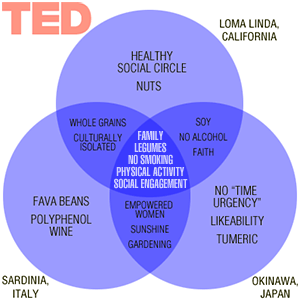
Blue Zone is a concept used to identify a demographic and/or geographic area of the world where people live measurably longer lives, as described in Dan Buettner’s book, ‘The Blue Zones: Lessons for Living Longer from people who lived the longest.’ The concept grew out of demographic work done by Gianni Pes and Michel Poulain, who identified Sardinia’s Nuoro province as the region with the highest concentration of male centenarians.
As the two men zeroed in on the cluster of villages with the highest longevity, they drew concentric blue circles on the map and began referring to the area inside the circle as the Blue Zone. Buettner identifies other zones in Okinawa, Japan; Nicoya, Costa Rica; Icaria, Greece; Vilcabamba, Ecuador; and among the Seventh-day Adventists in Loma Linda, California.
read more »
Posted in Death, Health, World |
1 Comment »
March 21, 2014
Ikigai [ee-key-guy] is a Japanese term for one’s reason for being, discovery of which brings satisfaction and meaning to life. Everyone, according to the Japanese, has an ikigai. Finding it requires a deep and often lengthy search of self. Such a search is regarded as being very important, since it is believed that discovery of one’s ikigai brings satisfaction and meaning to life.
In the culture of Okinawa, ikigai is thought of as ‘a reason to get up in the morning’; that is, a reason to enjoy life. In a TED Talk, author Dan Buettner offered ikigai as one of the reasons people in the area had such long lives.
Posted in World |
Leave a Comment »
March 18, 2014
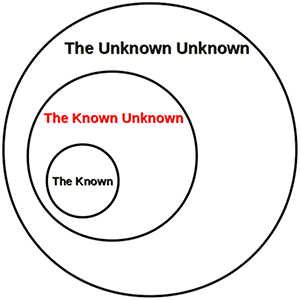
‘Here be dragons‘ means dangerous or unexplored territories, in imitation of the medieval practice of putting dragons, sea serpents and other mythological creatures in uncharted areas of maps. There are just two known historical use of this phrase in the Latin form ‘HC SVNT DRACONES.’ The term appeared on the 16th century Lenox Globe around the east coast of Asia, and might be related to the Komodo dragons in the Indonesian islands, tales of which were quite common throughout East Asia.
It also appeared on another globe of that era engraved on two conjoined halves of ostrich eggs. Earlier maps contain a variety of references to mythical and real creatures, but the Lenox Globe and the egg globe are the only known surviving maps to bear this phrase. An investigation of the egg globe performed by collector Stefaan Missinne concluded that the Hunt-Lenox Globe is a cast of the egg globe.
read more »
Posted in Language, Philosophy, World |
Leave a Comment »
March 11, 2014

Florentijn Hofman (b. 1977) is a Dutch artist known for playful urban installations such as the ‘Rubber Duck’ (a giant floating sculpture). They were built in various sizes, including one created in 2007 that is the largest rubber duck in the world at 105 feet long. Hofman’s tour was named ‘Spreading joy around the world.’ He aimed to recall everyone’s childhood memories by exhibiting the duck in 14 cities. The ducks are constructed with more than 200 pieces of PVC. There is an opening at the back of the body so that staff can perform maintenance. In addition, there is an electric fan in its body so that it can be inflated at any time, in either good or bad weather.
Since 2007, the ducks have been on display in Amsterdam, Belgium, Osaka, Sydney, Sao Paulo, Hong Kong, and Pittsburg. In 2009, while it was on display in Belgium, vandals stabbed the duck 42 times. The duck on display in Hong Kong was damaged and deflated in Taiwan after an earthquake, before bursting a few weeks later. In 2013, Sina Weibo, China’s most popular microblog, blocked the terms ‘Big Yellow Duck.’ The censorship occurred because a photoshopped version of ‘Tank Man’ (the Tiananmen Square protester), which swapped all tanks with this sculpture, had been circulating.
Posted in Art, Humor, World |
Leave a Comment »
March 7, 2014
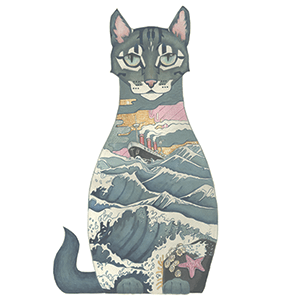
The ship’s cat has been a common feature on many trading, exploration, and naval ships, and dates back to ancient times. Cats have been carried on ships for many reasons, the most important being to catch mice and rats. These rodents aboard a ship can cause damage to ropes and woodwork. Also, rodents threatened the stores the ship carried and were a source of disease, which is dangerous for ships that are at sea for long periods of time.
The natural ability of cats to adapt to new surroundings made them suitable for service on a ship. They also offered companionship and a sense of home, security and camaraderie to sailors who could be away from port for long periods, especially in times of war.
read more »
Posted in War, World |
1 Comment »
February 26, 2014

The Discreet Charm of the Bourgeoisie (‘Le Charme discret de la bourgeoisie’) is a 1972 surrealist film directed by Luis Buñuel and written by Jean-Claude Carrière in collaboration with the director. The narrative concerns a group of upper-middle-class people attempting — despite continual interruptions — to dine together.
The film consists of several thematically linked scenes: five gatherings of a group of bourgeois friends, and the four dreams of different characters. The beginning of the film focuses on the gatherings, while the latter part focuses on the dreams, but both types of scenes are intertwined. There are also scenes involving other characters, such as two involving a Latin American female terrorist from the fictitious Republic of Miranda. The film’s world is not logical: the bizarre events are accepted by the characters, even if they are impossible or contradictory.
read more »
Posted in Art, Money, World |
Leave a Comment »
February 22, 2014

Itasha [ee-tah-sha] (literally ‘painful car’) is a Japanese term for a fashion of individuals decorating the bodies of their cars with fictional characters of anime, manga, or video games (especially ‘bishojo game’ and ‘eroge’ – dating and porn games). These characters are predominantly ‘cute’ females. The decorations usually involve paint schemes and stickers. Automobiles are called ‘itasha,’ while similar motorcycles and bicycles are called ‘itansha’ and ‘itachari,’ respectively.
In the 1980s, when Japan was at the zenith of its economic might, Tokyo’s streets were a parade of luxury import cars. Among them, the ‘itasha’—originally Japanese slang meaning an imported Italian car—was the most desired. Since then, ‘itasha’ (as the decorated vehicle) was derived from combining the Japanese words for ‘itai’ (‘painful’) and ‘sha’ (‘vehicle’). ‘Painful’ can be interpreted as ‘painfully embarrassing’ or ‘painful for the wallet’ due to the high costs involved.
Posted in Art, Technology, World |
Leave a Comment »
February 18, 2014

‘Battle Hymn of the Tiger Mother‘ is a 2011 book by Yale law professor Amy Chua. The complete subtitle of the book is: ‘This is a story about a mother, two daughters, and two dogs. This was supposed to be a story of how Chinese parents are better at raising kids than Western ones. But instead, it’s about a bitter clash of cultures, a fleeting taste of glory, and how I was humbled by a thirteen-year-old.’
Chua reported that in one study of 48 Chinese immigrant mothers, the vast majority ‘said that they believe their children can be ‘the best’ students, that ‘academic achievement reflects successful parenting,’ and that if children did not excel at school then there was ‘a problem’ and parents ‘were not doing their job.” Chua contrasts them with the view she labels ‘Western’ – that a child’s self-esteem is paramount.
read more »
Posted in Education, Language, World |
Leave a Comment »
February 17, 2014
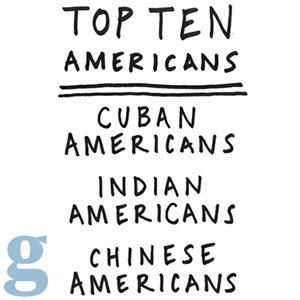
Middleman minority (also known as market-dominant minorities) is any minority population that, while subject to discrimination, does not hold an ‘extreme subordinate’ status in society. There are numerous examples of such groups gaining eventual prosperity in their adopted country despite discrimination. Often, they will take on roles between producer and consumer, such as trading and moneylending.
Famous examples such as Jews throughout Europe even at times when the discrimination against them was at their peak such as during World War II they still had great success in some parts of Europe, Chinese throughout Southeast Asia, Parsis in India, Igbos in Nigeria, Indians in East Africa, people from the Soviet Blocs in the USA during the Cold War, and many others.
read more »
Posted in Money, Politics, World |
Leave a Comment »
February 13, 2014

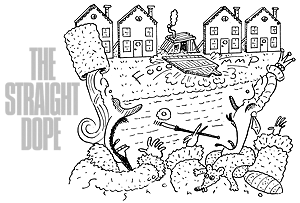
The phrase Potemkin [poh-tem-kin] villages was originally used to describe a fake village, built only to impress. According to the story, Russian statesman Grigory Potemkin erected fake settlements along the banks of the Dnieper River in order to fool Empress Catherine II during her visit to Crimea in 1787.
The phrase is now used, typically in politics and economics, to describe any construction (literal or figurative) built solely to deceive others into thinking that some situation is better than it really is. Some modern historians claim the original story is exaggerated.
read more »
Posted in Money, Politics, World |
Leave a Comment »
February 12, 2014


The mola [moh-luh] forms part of the traditional woman’s attire for the Kuna (an indigenous people of Panama and Colombia), two mola panels being incorporated as front and back panels in a blouse. The full costume traditionally includes a patterned wrapped skirt (saburet), a red and yellow headscarf (musue), arm and leg beads (wini), a gold nose ring (olasu), and earrings in addition to the mola blouse (dulemor).
In Dulegaya, the Kuna’s native language, ‘mola’ means ‘shirt’ or ‘clothing.’ The mola originated with the tradition of Kuna women painting their bodies with geometrical designs, using available natural colors; in later years these same designs were woven in cotton, and later still, sewn using cloth bought from the European settlers of Panamá.
read more »
Posted in Art, World |
Leave a Comment »




 The Daily Omnivore