April 30, 2013

Outside the United States, Americanization is a term for the influence the United States has on the culture of other countries, such as their popular culture, cuisine, technology, business practices, or political techniques.
The term has been used since at least 1907. Within the US, it refers to the process of acculturation by immigrants or annexed populations (e.g. the Californios) to American customs and values.
read more »
Posted in Money, Politics, World |
Leave a Comment »
April 29, 2013

First World privilege, similar to white privilege and male privilege, is the unearned advantages accrued by an individual by virtue of being a national of a First World country.
The concept is important for those considering advantages gained, due to institutional beliefs, prejudice and legal barriers, because of one’s nationality rather than one’s race or sex. Countries included in the first world class include Australia, Britain, Canada, New Zealand, United States, Japan and Western Europe.
read more »
Posted in Money, Politics, World |
Leave a Comment »
April 29, 2013
Reverse racism is a term which refers to racial prejudice or discrimination directed against members of one’s own race. The term came into use as the struggle for African-American rights divided the white community.
In 1966, Hosea Williams of the Southern Christian Leadership Conference (SCLC), publicly accused members of the Student Nonviolent Coordinating Committee (SNCC) of reverse racism in their efforts to exclude or expel whites from local government in Alabama to make room for blacks. Williams argued that SNCC’s (unsuccessful) ‘all-black’ campaign in Alabama would drive white moderates out of the civil rights movement. ‘Black racism’ was a more common term in this era, used to describe SNCC and groups like the Black Panthers.
read more »
Posted in Language, Politics, World |
2 Comments »
April 29, 2013

Whiteness studies is an interdisciplinary arena of academic inquiry focused on the cultural, historical and sociological aspects of people identified as ‘white,’ and the social construction of ‘whiteness’ as an ideology tied to social status. By the mid-1990s, numerous works across many disciplines analyzed whiteness, and it has since become a topic for academic courses, research and anthologies.
Pioneers in the field include W. E. B. Du Bois (‘Jefferson Davis as a Representative of Civilization,’ 1890), James Baldwin (‘The Fire Next Time,’ 1963), Ruth Frankenberg (‘White Women, Race Matters: The Social Construction of Whiteness,’ 1993), author and literary critic Toni Morrison (‘Playing in the Dark: Whiteness and the Literary Imagination,’ 1992) and historian David Roediger (‘The Wages of Whiteness,’ 1991).
read more »
Posted in Education, Politics, World |
Leave a Comment »
April 29, 2013
White guilt is the individual or collective guilt felt by white people for the racist treatment of people of color by whites both historically and presently. The term is generally used in a pejorative way (and in a partisan fashion within American political circles).
White guilt has been cited by some conservatives and libertarians as a way for liberals and others to induce white Americans to support the policies of affirmative action and redistribution of wealth. White guilt has been described as one of several psychosocial costs of racism for white individuals along with the ability to have empathic reactions towards racism, and fear of non-whites.
read more »
Posted in Politics, World |
Leave a Comment »
April 18, 2013

Perennialism [puh-ren-ee-uhl-iz-uhm] is a perspective within the philosophy of religion which views each of the world’s religious traditions as sharing a single, universal truth on which foundation all religious knowledge and doctrine has grown.
The idea of a perennial philosophy has great antiquity. It can be found in many of the world’s religions and philosophies. The term ‘philosophia perennis’ was first used during the Renaissance by Italian humanist Agostino Steuco, drawing on an already existing philosophical tradition, the most direct predecessors of which were Marsilio Ficino and Giovanni Pico della Mirandola.
read more »
Posted in Philosophy, World |
Leave a Comment »
April 16, 2013
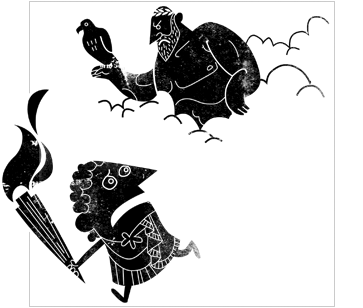
A culture hero is a mythological hero specific to some group (cultural, ethnic, religious, etc.) who changes the world through invention or discovery. A typical culture hero might be credited as the discoverer of fire, or agriculture, songs, tradition, law or religion, and is usually the most important legendary figure of a people, sometimes as the founder of its ruling dynasty. In some cultures, there are dualistic myths, featuring two culture heroes arranging the world in a complementary manner. Dualistic cosmologies are present in all inhabited continents and show great diversity: they may feature culture heroes, but also demiurges (artisan-like figures responsible for the fashioning and maintenance of the physical universe), or other beings; the two heroes may compete or collaborate; they may be conceived as neutral or contrasted as good versus evil; be of the same importance or distinguished as powerful versus weak; be brothers (even twins) or be not relatives at all.
In many cultures, the mythical figure of the trickster and the culture hero are combined. To illustrate, Prometheus, in Greek mythology, stole fire from the gods to give it to humans. In many Native American mythologies and beliefs, the coyote spirit stole fire from the gods (or stars or sun) and is more of a trickster than a culture hero. Natives from the Southeastern US typically saw a rabbit trickster/culture hero, and Pacific Northwest native stories often feature a raven in this role: in some stories, Raven steals fire from his uncle Beaver and eventually gives it to humans. The Western African trickster spider Ananse is also widely disseminated.
Posted in Philosophy, World |
Leave a Comment »
April 15, 2013

In mythology, and in the study of folklore and religion, a trickster is a god, goddess, spirit, man, woman, or anthropomorphic animal who plays tricks or otherwise disobeys normal rules and conventional behavior. The term was probably first used in this context by American ethnologist Daniel G. Brinton in 1885.
The trickster deity breaks the rules of the gods or nature, sometimes maliciously (for example, Loki) but usually with ultimately positive effects (though the trickster’s initial intentions may have been either positive or negative). Often, the bending/breaking of rules takes the form of tricks (e.g. Eris, Greek goddess of chaos) or thievery. Tricksters can be cunning or foolish or both; they are often funny even when considered sacred or performing important cultural tasks. An example of this is the sacred Iktomi of the Lakota, whose role is to play tricks and games and by doing so raises awareness and acts as an equalizer.
read more »
Posted in Humor, Philosophy, World |
Leave a Comment »
April 15, 2013

Ritual clowns, also called sacred clowns, are a characteristic feature of the ritual life of many traditional religions, and they typically employ scatology and sexual obscenities. Ritual clowning is where comedy and satire originated; in Ancient Greece, ritual clowning, phallic processions (or penis parades) and aischrologia (ritual insults) found their literary form in the plays of Aristophanes.
Two famous examples of ritual clowns in North America are the Koyemshis (also known as Koyemshi, Koyemci or Mudheads) and the Newekwe (also spelled Ne’wekwe or Neweekwe). French sociologist Jean Cazeneuve is particularly renowned for elucidating the role of ritual clowns; reprising Ruth Benedict’s famous distinction of societies into Apollonian and Dionysian, he said that precisely because of the strictly repressive (apollonian) nature of the Zuñi society, the ritual clowns are needed as a dionysian element, a safety valve through which the community can give symbolic satisfaction to the antisocial tendencies. The Koyemshis clowns are characterized by a saturnalian (riotously merry) symbolism.
Posted in Humor, Philosophy, World |
3 Comments »
April 9, 2013

Earth sheltering is the architectural practice of using earth against building walls for external thermal mass, to reduce heat loss, and to easily maintain a steady indoor air temperature. Earth sheltering is popular in modern times among advocates of passive solar and sustainable architecture, but has been around for nearly as long as humans have been constructing their own shelter.
The expression ‘earth-sheltering’ is a generic term, with the general meaning: building design in which soil plays an integral part. More specifically, a building can be described as earth-sheltered if its external envelope is in contact with a thermally significant volume of soil or substrate (where ‘thermally significant’ means making a functional contribution to the thermal effectiveness of the building in question).
read more »
Posted in Technology, World |
Leave a Comment »
April 8, 2013

The Shouting Hill is a hill in the Israeli controlled portion of the Golan Heights. During the Six Day War, Israel captured the majority of the heights. The Shouting Hill is located close to the ceasefire line that separates Syrian controlled territory and the territory occupied by Israel. The hill is situated near the Druze village of Majdal Shams; community members were separated after the war.
Very few visits were allowed between the families from both sides of the ceasefire line. Israel and Syria are still in an official state of war. There is also no telecommunications or mail allowed between the sides. As a result families come to the hill from both sides of the border to see and talk (actually shout into megaphones) to their relatives on the other side. However, with the advent of mobile phones, people don’t do this as often, except on special occasions like weddings or when they want to see each other and they use binoculars.
Posted in Politics, War, World |
1 Comment »
April 8, 2013

A black bloc is a tactic for protests and marches where individuals wear black clothing, scarves, sunglasses, ski masks, motorcycle helmets with padding, or other face-concealing and face-protecting items. The clothing is used to conceal marchers’ identities, allow them to appear as one large unified mass, and promote solidarity.
The tactic was developed in the 1980s in the European autonomist movement’s protests against squatter evictions, nuclear power, and restrictions on abortion among other things. Black blocs gained broader media attention outside Europe during the 1999 Seattle WTO protests, when a black bloc damaged property of GAP, Starbucks, Old Navy, and other multinational retail locations in downtown Seattle.
read more »
Posted in Money, Politics, World |
Leave a Comment »


 The Daily Omnivore