January 24, 2013

Animutation is a form of web-based computer animation, typically created in Adobe Flash and characterized by unpredictable montages of pop-culture images set to music, often in a language foreign to the intended viewers. It is not to be confused with manual collage animation (e.g., the work of Stan Vanderbeek and Terry Gilliam) which predates the Internet.
Animutation was ‘invented’ by American comedian Neil Cicierega. Cicierega claims to have been inspired by several sources, notably bizarre Japanese commercials (parodied, for example, by the Simpsons’ Mr. Sparkle), and Martin Holmström’s ‘Hatten är din’ Soramimi video (interpreting lyrics in one language as similar-sounding lyrics in another language) made for the ‘Habbeetik’ song by Azar Habib.
read more »
Posted in Humor, Language, World |
Leave a Comment »
January 23, 2013

Soramimi (‘mishearing’; [feigned] ‘deafness’) and Soramimi kashi (‘misheard lyrics’) are Japanese terms for homophonic translation of song lyrics, that is, interpreting lyrics in one language as similar-sounding lyrics in another language. A bilingual soramimi word play contrasts with a monolingual mondegreen (mishearing a phrase as a result of near-homophony, in a way that gives it a new meaning).
And example of Soramimi kashi is the Moldovan band O-Zone’s song ‘Dragostea din tei’ (named from the words in the opening of the song), known on the web as the ‘Numa Numa’ song. The refrain of the original song (in Romanian) is: ‘Vrei să pleci dar nu mă, nu mă iei…’ (‘You want to leave but you don’t want, don’t want to take me…’) A soramimi version, from the Japanese flash animation ‘Maiyahi,’ translates these words as: ‘Bei sa, beishu ka, nomanoma-yei!’ (‘Rice, is it, rice wine, drink it drink it yeah!’)
read more »
Posted in Humor, Language, World |
Leave a Comment »
January 9, 2013

Mr. Freedom is a 1969 film by the expatriate American photographer and filmmaker William Klein. Starring the popular French actor Delphine Seyrig, this anti-imperialist satirical farce has cameos by the well-known actors Donald Pleasence and Philippe Noiret, as well as the musician Serge Gainsbourg. Under the command of Dr. Freedom, the crass superhero Mr. Freedom (John Abbey) goes to France to stave off the advances of the mysterious French Anti-Freedom (FAF) organization.
He joins forces with the femme fatale Marie-Madeleine to lead his own anti-communist Freedom organization. The Freedom mission is complicated by the machinations of communist foes — the Stalinist Moujik Man and the ferocious Maoist Red China Man (portrayed as a giant inflatable dragon). France, refusing to see the FAF as a threat, rebuffs Freedom, leading to an escalation of Cold War tactics. In the end, betrayed, Mr. Freedom destroys himself trying to save the ‘unappreciative’ nation.
read more »
Posted in Humor, Politics, World |
Leave a Comment »
January 8, 2013

Mottainai is a Japanese term meaning ‘a sense of regret concerning waste when the intrinsic value of an object or resource is not properly utilized.’
The expression can be uttered alone as an exclamation when something useful, such as food or time, is wasted, meaning roughly ‘Oh, what a waste!’ In addition to its primary sense of ‘wasteful,’ the word is also used to mean ‘impious; irreverent’ or ‘more than one deserves.’
read more »
Posted in Language, Money, World |
1 Comment »
January 7, 2013

San Francisco burrito is an Urban Food Log that first became popular during the 1960s in the Mission District of San Francisco. Author Gustavo Arellano classifies the Mission-style burrito as one of three major styles of burritos in the United States, following the earlier, simple burrito consisting of beans, rice, and meat and preceding the California burrito containing cheese and potatoes that was developed in the 1980s.
Originally a Mexican-American food, the San Francisco burrito is distinguished from a regular burrito partly by the amount of rice and other side dishes included in the package, and also by its sheer size. Many taquerias in the Mission and in the greater San Francisco Bay Area specialize in San Francisco burritos. It is typically served in a piece of aluminum foil around a large flour tortilla which is wrapped and folded around a variety of ingredients.
read more »
Posted in Food, World |
Leave a Comment »
January 7, 2013

Nunchi refers to a concept in Korean culture that describes the subtle art and ability to listen and gauge others’ moods. In Western culture, nunchi could be described as the concept of emotional intelligence. In Korea, it is the person’s ‘kibun’ being read, which is his or her pride, mood, or state of mind. It is of central importance to the dynamics of interpersonal relationships in Korean culture.
Nunchi is literally translated as ‘eye-measure.’ It is closely related to the broader concept of paralanguage (non-verbal elements of communication used to modify meaning and convey emotion), however nunchi also relies on an understanding of one’s status relative to the person with whom they’re interacting. It can be seen as the embodiment of skills necessary to communicate effectively in Korea’s high context culture. The concept of nunchi, and one’s abundance or lack thereof, forms the basis of many common expressions and idioms. For example, a socially clumsy person can be described as ‘nunchi eoptta,’ meaning ‘absence of nunchi.’
Posted in Health, Language, World |
Leave a Comment »
January 6, 2013

Cosmicism [koz-mih-siz-uhm] is the literary philosophy developed and used by the American writer H. P. Lovecraft in his fiction. Lovecraft was a writer of philosophically intense horror stories that involve occult phenomena like astral possession and alien miscegenation, and the themes of his fiction over time contributed to the development of this philosophy.
The philosophy of cosmicism states that there is no recognizable divine presence, such as a god, in the universe, and that humans are particularly insignificant in the larger scheme of intergalactic existence, and perhaps are just a small species projecting their own mental idolatries onto the vast cosmos, ever susceptible to being wiped from existence at any moment. This also suggested that the majority of undiscerning humanity are creatures with the same significance as insects and plants in a much greater struggle between greater forces which, due to humanity’s small, visionless and unimportant nature, it does not recognize.
read more »
Posted in Language, Philosophy, World |
1 Comment »
January 3, 2013

Diffusion of Innovations is a theory that seeks to explain how, why, and at what rate new ideas and technology spread through cultures. Everett Rogers, a professor of rural sociology, popularized the theory in his 1962 book ‘Diffusion of Innovations.’ He said diffusion is the process by which an innovation is communicated through certain channels over time among the members of a social system.
The origins of the diffusion of innovations theory are varied and span multiple disciplines. Rogers espoused four main elements that influence the spread of a new idea: the innovation, communication channels, time, and a social system.
read more »
Posted in Language, Science, World |
Leave a Comment »
January 3, 2013

Espresso [e-spres-oh] is a type of Italian coffee that is concentrated. It is brewed by forcing a small amount of nearly boiling water under pressure through finely ground coffee beans.
Espresso often has a thicker consistency than coffee brewed by other methods, a higher concentration of suspended and dissolved solids, and crema (meaning cream, but being a reference to the foam with a creamy texture that forms as a result of the pressure). Because espresso is so strong, it is usually mixed with with milk (steamed, wet foamed, or dry foamed) or hot water (e.g. latte, cappuccino, macchiato, mocha, or americano).
read more »
Posted in Food, World |
Leave a Comment »
January 1, 2013
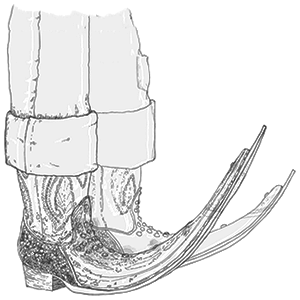
Mexican pointy boots (botas picudas mexicanas) are a style of pointed fashion boots made with elongated toes. The boots are said to have originated in Matehuala in the Mexican state of San Luis Potosí. The came to popularity at the same time as ‘tribal guarachero’ music (‘a mixture of Pre-Columbian and African sounds mixed with fast cumbia bass and electro-house beats’). and the boots have become a preferred footwear for the all-male troupes that dance to the tribal music. They are made by elongating normal boots by as much as 5 feet (1.5 m), causing the toes to curl up toward the knees. Decorative alterations incorporate paint and sequins and can go as far as adding flashing LED lights, disco balls and even mirrors.
Boys and men that wear the pointy boots have formed all-male troupes to compete in danceoffs at local nightclubs to tribal music. Participants in the contests spend weeks choreographing their dance moves and fabricating their outfits which commonly include ‘matching western shirts and skinny jeans to accentuate their footwear.’ In Matehuala, prize money ranges from $100 to $500. The prize often includes a bottle of whiskey. The dance troupes have reportedly become so popular that they are being ‘hired to dance at weddings, for quinceañeras, celebrations of the Virgin of Guadalupe, bachelorette parties, and even rosary ceremonies for the dead.’
Posted in Art, Humor, World |
Leave a Comment »
December 29, 2012

Ithkuil is a constructed language marked by outstanding grammatical complexity, expressed with a rich phonemic inventory or through an original, graphically structured, system of writing. The language’s author, John Quijada, presents Ithkuil as a cross between an a priori philosophical and a logical language designed to express deeper levels of human cognition overtly and clearly, particularly in regard to human categorization, yet briefly. It also strives to minimize the ambiguities and semantic vagueness found in natural human languages.
The many examples from the original grammar book show that a message, like a meaningful phrase or a sentence, can usually be expressed in Ithkuil with fewer sounds, or lexically distinct speech-elements, than in natural human languages. Quijada deems his creation too complex and strictly regular a language to have developed ‘naturally,’ but nonetheless a language suited for human conversation. No person is hitherto known to be able to speak Ithkuil fluently; Quijada, for one, does not.
read more »
Posted in Language, Philosophy, World |
Leave a Comment »
December 22, 2012

A bandwidth cap, also known as a bit cap, limits the transfer of a specified amount of data over a period of time. Internet service providers commonly apply a cap when a channel intended to be shared by many users becomes overloaded, or may be overloaded, by a few users. Implementation of a bandwidth cap is sometimes termed a Fair Access Policy or Usage-based billing. In many situations, each user of a network is expected to use high speed transmission for only a short time, for example to download a megabyte web page in less than a second.
When use is continuous, as it might be in the case of file sharing, Internet radio or streaming video, a few users who use the connection at high rates for hours at a time may seriously impair the service of others. The concept is more relevant in cable internet where both the core network and the access network are shared, than in DSL where the core network is shared but the access network is not. It is most relevant in wireless internet, particularly satellite internet, where both the core network and the access network are shared and total network bandwidth is relatively narrow.
read more »
Posted in Money, Technology, World |
Leave a Comment »


 The Daily Omnivore