December 10, 2012

Project Iceworm was the code name for a US Army Top Secret proposal during the Cold War (a study was started in 1958), to build a network of mobile nuclear missile launch sites under the Greenland ice sheet. The ultimate objective of placing medium-range missiles under the ice – close enough to Moscow to strike targets within the Soviet Union – was kept secret from the Danish government.
To study the feasibility of working under the ice, a highly publicized ‘cover’ project, known as ‘Camp Century’ was launched in 1960. However, unsteady ice conditions within the ice sheet caused the project to be cancelled in 1966. Details of the missile base project were classified for decades, and first came light in 1997, when the Danish Foreign Policy Institute (DUPI) was asked by the Danish Parliament to research the history of nuclear weapons in Greenland during the Thulegate scandal.
read more »
Posted in Politics, War, World |
Leave a Comment »
December 6, 2012

The Jewish Autonomous Oblast is a federal subject of Russia (an autonomous oblast) situated in the Russian Far East, bordering China. Its administrative center is the town of Birobidzhan. Soviet authorities established the autonomous oblast in 1934. It was the result of Joseph Stalin’s nationality policy, which provided the Jewish population of the Soviet Union with a large territory in which to pursue Yiddish cultural heritage.
According to the 1939 population census, 17,695 Jews lived in the region (16% of the total population). The Jewish population peaked in 1948 at around 30,000, about one-quarter of the region’s population. The census of 1959, taken six years after Stalin’s death, revealed that the Jewish population of the JAO declined to 14,269 persons. As of 2002, 2,327 Jews were living in the JAO (1.2% of the total population), while ethnic Russians made up 90% of the population.
read more »
Posted in Philosophy, World |
Leave a Comment »
December 4, 2012

In economic theory, a moral hazard is a situation where the costs that could incur from a decision will not be felt by the party taking the risk. Knowing that the potential costs and/or burdens of taking such risk will be borne, in whole or in part, by others creates a moral hazard and invites high risk behavior.
For example, with respect to the originators of subprime loans, many may have suspected that the borrowers would not be able to maintain payments and that, for this reason, the loans were not, in the long run, going to be worth much. Still, because there were many buyers of these loans (or of pools of these loans) willing to take on that risk, the originators did not concern themselves with the potential long-term consequences of making these loans.
read more »
Posted in Money, Politics, World |
Leave a Comment »
November 29, 2012

In economics, the tragedy of the commons is the depletion of a shared resource by individuals, acting independently and rationally according to each one’s self-interest, despite their understanding that depleting the common resource is contrary to their long-term best interests.
In 1968, ecologist Garrett Hardin explored this social dilemma in ‘The Tragedy of the Commons,’ published in the journal ‘Science.’ Central to Hardin’s article is an example (first sketched in an 1833 pamphlet by William Forster Lloyd) involving medieval land tenure in Europe, of herders sharing a common parcel of land, on which they are each entitled to let their cows graze.
read more »
Posted in Money, Politics, World |
Leave a Comment »
November 29, 2012

Cyborg anthropology is the discipline that studies the interaction between humanity and technology from an anthropological perspective. The topic originated as a sub-focus group within the American Anthropological Association’s annual meeting in 1993. The sub-group was very closely related to two other academic disciplines, STS (Science, technology and society) and the Society for the Social Studies of Science.
Historian and feminist Donna Haraway’s 1985 ‘Cyborg Manifesto’ could be considered the founding document of cyborg anthropology by first exploring the philosophical and sociological ramifications of the term. More recently, Amber Case has been responsible for setting up the Cyborg Anthropology Wiki.
read more »
Posted in Philosophy, Technology, World |
1 Comment »
November 28, 2012

Sergei Eisenstein (1898 – 1948) was a pioneering Soviet Russian film director and film theorist, often considered to be the ‘Father of Montage.’
He is noted in particular for his silent films ‘Strike’ (1924), ‘Battleship Potemkin’ (1925), and ‘October’ (1927), as well as the historical epics ‘Alexander Nevsky’ (1938) and ‘Ivan the Terrible’ (1944).
read more »
Posted in Art, Politics, World |
Leave a Comment »
November 26, 2012

Collective intelligence is a shared or group intelligence that emerges from the collaboration and competition of many individuals and appears in consensus decision making in organisms (including some bacteria) and computer networks. The term appears in sociobiology, political science, and in context of mass peer review and crowdsourcing web applications (e.g. Wikipedia). This broader definition involves consensus, social capital, and formalism such as voting systems, social media and other means of quantifying mass activity.
Everything from a political party to a public wiki can reasonably be described as this loose form of collective intelligence. The notion of collective intelligence has also been called ‘Symbiotic intelligence.’ A precursor of the concept is found in entomologist William Morton Wheeler’s observation that seemingly independent individuals can cooperate so closely as to become indistinguishable from a single organism. Wheeler saw this collaborative process at work in ants that acted like the cells of a single beast he called a ‘superorganism.’
read more »
Posted in Education, Technology, World |
Leave a Comment »
November 26, 2012
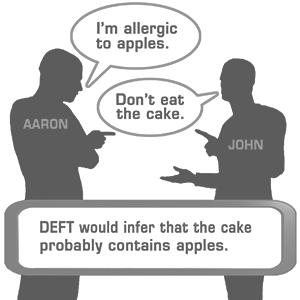
Natural language processing (NLP) is a field of computer science, artificial intelligence, and linguistics concerned with the interactions between computers and human (natural) languages.
As such, NLP is related to the area of human–computer interaction. Many challenges in NLP involve natural language understanding — that is, enabling computers to derive meaning from human or natural language input. An automated online assistant providing customer service on a web page, an example of an application where natural language processing is a major component.
read more »
Posted in Language, Technology, World |
Leave a Comment »
November 20, 2012

A cargo cult is a religious practice that has appeared in many traditional pre-industrial tribal societies in the wake of interaction with technologically advanced cultures. The cults focus on obtaining the material wealth (the ‘cargo’) of the advanced culture through magic and religious rituals and practices.
Cult members believe that the wealth was intended for them by their deities and ancestors. Cargo cults developed primarily in remote parts of New Guinea and other Melanesian and Micronesian societies in the southwest Pacific Ocean, beginning with the first significant arrivals of Westerners in the 19th century.
read more »
Posted in Philosophy, Technology, World |
Leave a Comment »
November 19, 2012

Alterity [all-ter-eh-tee] is a philosophical term meaning ‘otherness,’ strictly being in the sense of the other of two. In the phenomenological tradition it is usually understood as the entity in contrast to which an identity is constructed, and it implies the ability to distinguish between self and not-self, and consequently to assume the existence of an alternative viewpoint. The concept was established by French philosopher Emmanuel Lévinas in a series of essays, collected under the title ‘Alterity and Transcendence.’
The term is also deployed outside of philosophy, notably in anthropology by scholars such as Nicholas Dirks, Johannes Fabian, Michael Taussig, and Pauline Turner Strong to refer to the construction of ‘cultural others.’ The term has gained further use in seemingly somewhat remote disciplines, e.g. historical musicology where it is effectively employed by John Michael Cooper in a study of Goethe and Mendelssohn.
Posted in Language, Philosophy, World |
1 Comment »
November 15, 2012


An entheogen [en-theo-gen] (‘generating the divine within’) is a psychoactive substance used in a religious, shamanic, or spiritual context. Historically, entheogens were mostly derived from plant sources and have been used in a variety of traditional religious contexts.
Entheogens can supplement many diverse practices for healing, transcendence, and revelation, including: meditation, psychonautics, art projects, and psychedelic therapy. Entheogens have been used in a ritualized context for thousands of years. Examples of traditional entheogens include: peyote, psilocybin mushrooms, uncured tobacco, cannabis, ayahuasca, salvia, iboga, morning glory, and Amanita muscaria mushrooms.
read more »
Posted in Drugs, Philosophy, World |
Leave a Comment »
November 9, 2012


Founded in 2001 by a team of MIT students, Design that Matters (DtM), is a nonprofit design company that partners with social entrepreneurs to design products that address basic needs in developing countries. DtM’s core competencies include ethnography, design, and engineering. DtM manages a collaborative design process through which hundreds of students and professional volunteers contribute to the design of new product and services for the poor in developing countries. DtM has completed projects in in healthcare, education, microfinance, and renewable energy.
DtM partners include the East Meets West Foundation, Solar Ear, World Education, the Center for Integration of Medicine and Innovative Technology’s Global Health Initiative (CIMIT GHI), the Centre for Mass Education in Science (CMES) in Bangladesh and the Mann Deshi Mahila Sahakari Bank in India.
read more »
Posted in Health, Technology, World |
Leave a Comment »



 The Daily Omnivore