October 30, 2012

Day of the Dead (‘Día de los Muertos’) is a Mexican holiday where people gather to pray for and remember friends and family members who have died. The celebration takes place on November 1, in connection with the Catholic holidays of All Saints’ Day and All Souls’ Day (November 2).
Traditions connected with the holiday include building private altars honoring the deceased using edible sugar skulls, marigolds, and the favorite foods and beverages of the departed and visiting graves with these as gifts. They also leave possessions of the deceased. Scholars trace the origins of the modern Mexican holiday to indigenous observances dating back hundreds of years and to an Aztec festival dedicated to the goddess Mictecacihuatl (Queen of the Underworld).
read more »
Posted in Death, Philosophy, World |
2 Comments »
October 29, 2012

Game brain is a term coined by Japanese physiologist Akio Mori referring to the long term effects of video games on the human brain. Mori originally coined the term and presented the concept in his 2002 book ‘The Terror of Game Brain.’ Mori performed an experiment at Tokyo’s Nihon University designed to measure the effect of video games on human brain activity by examining beta waves (brainwaves associated with normal waking consciousness).
Mori claims his study revealed that people who spend long periods playing video games have reduced activity in the brain’s pre-frontal region, which governs emotion and creativity. Mori asserts that side effects can include loss of concentration, an inability to control temper, and problems socializing or associating with others. His theory has gained some recognition in popular culture, especially among parents who believe that video gaming can have detrimental effects on child development.
read more »
Posted in Games, Health, World |
Leave a Comment »
October 28, 2012

Global Village is a term closely associated with Marshall McLuhan, popularized in his books ‘The Gutenberg Galaxy: The Making of Typographic Man’ (1962) and ‘Understanding Media’ (1964). McLuhan described how the globe has been contracted into a village by electric technology and the instantaneous movement of information from every quarter to every point at the same time. In bringing all social and political functions together in a sudden implosion, electric speed heightened human awareness of responsibility to an intense degree.
The Hindu concept of Vasudhaiva Kutumbakam (the whole world is one single family) is a similar thought, according to which: ‘Only small men discriminate saying: One is a relative; the other is a stranger. For those who live magnanimously the entire world constitutes but a family.’ The same concept is to be found in an ancient Tamil poem as, ‘every country is my own and all the people are my kinsmen.’
read more »
Posted in Language, Technology, World |
Leave a Comment »
October 28, 2012

‘The Gutenberg Galaxy: The Making of Typographic Man’ is a book by Marshall McLuhan, in which he analyzes the effects of mass media, especially the printing press, on European culture and human consciousness.
It popularized the term ‘global village,’ which refers to the idea that mass communication allows a village-like mindset to apply to the entire world; and ‘Gutenberg Galaxy,’ which we may regard today to refer to the accumulated body of recorded works of human art and knowledge, especially books. McLuhan studies the emergence of what he calls ‘Gutenberg Man,’ the subject produced by the change of consciousness wrought by the advent of the printed book.
read more »
Posted in Language, Technology, World |
Leave a Comment »
October 25, 2012

Generation Z (also known as iGeneration) is a common name for the group of people born from a currently undefined point, defined variously as between 1989 and 2010, through to recent years, as distinct from the preceding ‘Generation Y’ (also referred to as ‘Millennials’). Generation Z is also known as the ‘Pluralist Generation.’ If Generation Z is considered to begin in 1989, it would make Gen Y a very brief generation born from 1977-1988. This flies in the face of the traditional definition of Generation Y beginning at some point in the 1980s and ending in the late 1990s or early 2000s.
However, due to recent cultural developments such as the rise of social networking and the differences in attitudes created by the Great Recession a divide has appeared which suggests an earlier cutoff date between 1989 and 1994 might be warranted. For example, as of 2012 half the users of Facebook are 22 years old or younger, compared to 2008 when the median age peaked at 26 years old. If the traditional definition of Generation Z beginning in the early 2000s is used, Generation Y is a group larger than the baby boomers and spanning a full 20 years.
read more »
Posted in Technology, World |
1 Comment »
October 24, 2012
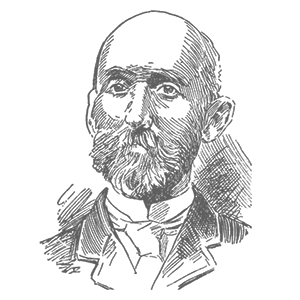
‘The Influence of Sea Power Upon History: 1660-1783′ is a history of naval warfare written in 1890 by US Navy flag officer Alfred Thayer Mahan. It details the role of sea power throughout history and discusses the various factors needed to support and achieve sea power, with emphasis on having the largest and most powerful fleet.
Scholars consider it the single most influential book in naval strategy; its policies were quickly adopted by most major navies, ultimately causing the World War I naval arms race. Mahan formulated his concept of sea power while reading a history book in Lima, Peru. The book was published by Mahan while he was President of the US Naval War College, and was a culmination of his ideas regarding naval warfare.
read more »
Posted in War, World |
Leave a Comment »
October 22, 2012
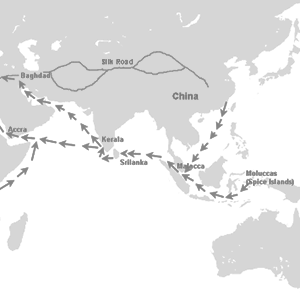
The Spice trade refers to the trade between historic civilizations in Asia, Northeast Africa, and Europe; spices such as cinnamon, cassia, cardamom, ginger, and turmeric were known, and used for commerce, in the Eastern World well into antiquity.
These spices found their way into the Middle East before the beginning of the Christian Era, where the true sources of these spices was withheld by the traders, and associated with fantastic tales.
read more »
Posted in Food, Money, World |
Leave a Comment »
October 22, 2012

A spice is a dried seed, fruit, root, bark, or vegetative substance primarily used for flavoring coloring or preserving food. Sometimes a spice is used to hide other flavors. Spices are distinguished from herbs, which are parts of leafy green plants also used for flavoring or as garnish.
Many spices have antimicrobial properties. This may explain why spices are more commonly used in warmer climates, which have more infectious disease, and why use of spices is especially prominent in meat, which is particularly susceptible to spoiling. A spice may have an extra use, usually medicinal, religious ritual, cosmetics or perfume production, or as a vegetable. For example, turmeric roots are consumed as a vegetable and garlic as an antibiotic.
read more »
Posted in Food, Money, World |
Leave a Comment »
October 19, 2012
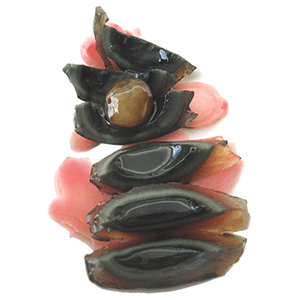
Century egg (‘pidan,’ also known as preserved egg and millennium egg) is a Chinese cuisine ingredient made by preserving fowl eggs in a mixture of clay, ash, salt, quicklime (calcium oxide), and rice hulls for several weeks to several months, depending on the method of processing. Through the process, the yolk becomes a dark green to gray color with a creamy consistency and an odor of sulfur and ammonia, while the white becomes a dark brown, translucent jelly with little flavor.
The transforming agent in the century egg is its alkaline material, which gradually raises the pH of the egg to around 9, 12, or more during the curing process. This chemical process breaks down some of the complex, flavorless proteins and fats, which produces a variety of smaller flavorful compounds. Some eggs have fungal patterns near the surface of the egg white that are likened to pine branches, and that gives rise to one of its Chinese names, the ‘pine-patterned egg.’
read more »
Posted in Food, Science, World |
Leave a Comment »
October 19, 2012

Pickling, also known as ‘brining’ or ‘corning,’ is the process of preserving food with acid. Pickling began 4000 years ago using cucumbers native to India. It is called ‘achar’ in northern India. This was used as a way to preserve food for out-of-season use and for long journeys, especially by sea. Salt pork and salt beef were common staples for sailors before the days of steam engines. Although the process was invented to preserve foods, pickles are also made and eaten because people enjoy the resulting flavors.
Pickling may also improve the nutritional value of food by introducing B vitamins produced by bacteria (when pickled in a process utilizing fermentation). The term ‘pickle’ is derived from the Dutch word ‘pekel,’ meaning ‘brine’ (salt water). In the U.S. Canada, and Australia the word ‘pickle’ alone almost always refers to a pickled cucumber (other types of pickles will be described as ‘pickled onion,’ ‘pickled cauliflower,’ etc.), except when it is used figuratively. In the UK, ‘pickle’ refers to Ploughman’s pickle, a kind of chutney; a pickled cucumber is referred to as a ‘gherkin.’
read more »
Posted in Food, Science, World |
2 Comments »
October 16, 2012


Anti-nationalism denotes the sentiments associated with the opposition to nationalism, arguing that it is undesirable or dangerous. Some anti-nationalists are humanitarians or humanists who pursue an idealist form of world community, and self-identify as world citizens.
They reject chauvinism, jingoism, and militarism, and want humans to live in peace rather than perpetual conflict. They do not necessarily oppose the concepts of countries, nation states, national boundaries, cultural preservation or identity politics.
read more »
Posted in Money, Politics, World |
Leave a Comment »
October 15, 2012

The Eastern Front was a theater of WWII between the European Axis powers and co-belligerent Finland against the Soviet Union, Poland, and some other Allies (though never engaged in military action in the Eastern Front, the UK and the US both provided substantial material aid to the Soviet Union).
It was known by many different names depending on the nation, notably the ‘Great Patriotic War’ in the former Soviet Union. The conflict began in the summer of 1941 with the ‘Operation Barbarossa Offensive,’ when Axis forces crossed the borders described in the 1939 ‘German-Soviet Nonaggression Pact,’ thereby invading the Soviet Union. The war ended in the spring of 1945, when Germany’s armed forces surrendered unconditionally following the ‘Battle of Berlin,’ a strategic operation executed by the Red Army.
read more »
Posted in Death, War, World |
Leave a Comment »



