August 13, 2012

Pussy Riot is a Russian feminist punk-rock collective that stages politically provocative impromptu performances in Moscow on Russia’s current political life. In March 2012, during an improvised and unauthorized concert in Moscow’s Cathedral of Christ the Savior, three women from the band were arrested and charged with ‘hooliganism’ and their trial began in late July.
The band members have gained sympathy both within Russia and internationally due to allegations of harsh treatment while in custody and a risk of a possible seven-year jail sentence, and have also been criticized in Russia for offending the feelings of religious people. Alexei Nikiforov, a federal prosecutor, has demanded prison for the trio because they ‘abused God.’ Pussy Riot’s lawyers said that the circumstances of the case have revived the Soviet-era tradition of the ‘show trial.’
read more »
Posted in Politics, Sex, World |
Leave a Comment »
August 10, 2012

A Swadesh [sway-desh] list is a compilation of concepts for which words are deemed to exist in the largest number of languages. Translations of a Swadesh list into a set of languages allows researchers to quantify the interrelatedness of those languages.
Swadesh lists are named after the U.S. linguist Morris Swadesh. They are used in lexicostatistics (the quantitative assessment of the relatedness of languages) and glottochronology (the dating of language divergence).
read more »
Posted in Language, Science, World |
Leave a Comment »
August 9, 2012

Banchan [ban-chuhn] refers to small dishes of food served along with cooked rice in Korean cuisine. This word is used both in the singular and plural. The basic table setting for a meal called ‘bansang’ (usually consists of bap (cooked rice), guk or tang (soup), gochujang or ganjang (fermented condiments), jjigae (tofu stew), and kimchi (fermented cabbage). Kimchi is the essential banchan of a standard Korean meal. Some Koreans do not consider a meal complete without kimchi.
According to the number of banchan that is added, the table setting is called as 3 cheop, 5 cheop, 7 cheop, 9 cheop, or 12 cheop bansang, with the 12 cheop used in Korean royal cuisine. Banchan are set in the middle of the table to be shared. At the center of the table is the secondary main course, such as galbi or bulgogi (grilled meats), and a shared pot of jjigae. Bowls of cooked rice and guk (soup) are set individually. Banchan are served in small portions, meant to be finished at each meal and are replenished during the meal if not enough. Usually, the more formal the meals are, the more banchan there will be. Jeolla province is particularly famous for serving many different varieties of banchan in a single meal.
Posted in Food, World |
1 Comment »
August 6, 2012

The Curiosity rover is a nuclear-powered exploration vehicle that is part of NASA’s Mars Science Laboratory (MSL) mission. The MSL spacecraft was launched in late 2011 and successfully landed on Aeolis Palus in Gale Crater in the summer of 2012. The approximately 2 billion-year-old impact crater is hypothesized to have gradually been filled in, first by water-deposited, and then by wind-deposited sediments, possibly until it was completely covered, before wind erosion scoured out the sediments, leaving an isolated 5.5 km (3.4 mile) high mountain, Aeolis Mons, at the center of the 154 km (96 mi) wide crater.
Thus, it is believed that the rover may have the opportunity to study two billion years of Martian history in the sediments exposed in the mountain. Additionally, its landing site should be on or near an alluvial fan, which is hypothesized to be the result of a flow of ground water, either before the deposition of the eroded sediments or else in relatively recent geologic history.
read more »
Posted in Science, Technology, World |
Leave a Comment »
August 6, 2012

The Wilson Quarterly is a magazine published by the Woodrow Wilson International Center for Scholars in Washington, D.C. The magazine was founded in 1976 by journalist Peter Braestrup and James H. Billington, the thirteenth Librarian of the United States Congress. The ‘Quarterly’ is noted for its nonpartisan, nonideological approach to current issues, with articles written from various perspectives.
Designed to make the research and debates of scholars and intellectuals accessible to a general audience, it covers a wide range of topics, from science policy and literature to foreign affairs. In 2012, the ‘Quarterly’ changed to a digital-only publishing model.
read more »
Posted in Language, Politics, World |
Leave a Comment »
August 3, 2012
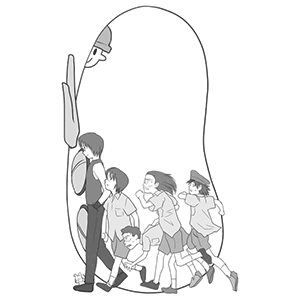
Dennō Coil (literally ‘Electric Brain Coil’) is a Japanese anime television series depicting a near future where semi-immersive augmented reality (AR) technology has just begun to enter the mainstream. The series takes place in the fictional city of Daikoku, a hotbed of AR development with an emerging city-wide virtual infrastructure.
It follows a group of children as they use AR glasses to unravel the mysteries of the half real, half Internet city, using a variety of illegal software tools, techniques, and virtual pets to manipulate the digital landscape. The show was in development for over a decade, and was the directorial debut of Japanese animator Mitsuo Iso. It premiered on NHK Educational TV in 2007.
read more »
Posted in Art, Technology, World |
Leave a Comment »
July 30, 2012

Monosodium [mon-uh-soh-dee-uhm] glutamate [gloo-tuh-meyt] (MSG) is a seasoning salt and one of the most abundant naturally occurring non-essential amino acids. The glutamate of MSG confers the same umami (savory) taste of glutamate from other foods (e.g. meats, poultry, fish, eggs, dairy products, and kombu seaweed), being chemically identical.
Industrial food manufacturers market and use MSG as a flavor enhancer because it balances, blends and rounds the total perception of other tastes. Professor Kikunae Ikeda from the Tokyo Imperial University isolated glutamic acid as a new taste substance in 1908 from kombu, and named its taste ‘umami.’
read more »
Posted in Food, Health, World |
Leave a Comment »
July 30, 2012

Si vis pacem, para bellum is a Latin adage translated as, ‘If you wish for peace, prepare for war’ (usually interpreted as meaning peace through strength—a strong society being less likely to be attacked by enemies). The adage was adapted from a statement in ‘De Re Militari’ (‘Concerning Military Matters’) by Publius Flavius Vegetius Renatus, although the idea it conveys is also present in earlier works, such as Plato’s ‘Nomoi’ (‘Laws’).
With reference to the foreign policy of Napoleon Bonaparte, the historian, de Bourrienne, said: ‘Everyone knows the adage… Had Bonaparte been a Latin scholar he would probably have reversed it and said, ‘Si vis bellum para pacem.” Meaning that if you are planning a war, you should put other nations off guard by cultivating peace. Conversely, another interpretation could be that preparing for peace may lead another party to wage war on you.
read more »
Posted in Politics, War, World |
1 Comment »
July 30, 2012

‘Peace through strength‘ is a conservative slogan supporting military strength for the purpose of creating peaceful international relations. For supporters of the MX missile in the 1970s, the missile symbolized ‘peace through strength.’ The phrase was popular in political rallies during 1988.
The idea is a major justification cited for large militaries, and also served as the primary motivation behind the Cold War doctrine of mutually assured destruction. The logic here is that a strong military deters aggression and coercion (blackmail), and that no potential aggressor in his right mind would dare to attack or blackmail someone stronger than he is, because he knows he would be swiftly defeated if he tried to. Conservatives and neoconservatives argue that if an aggressor is irrational and cannot be deterred, he can be swiftly defeated by a large and strong standing military.
read more »
Posted in Politics, War, World |
Leave a Comment »
July 30, 2012

A self-serving bias is attributing successes to internal factors and failures to external factors. This bias is a mechanism for individuals to protect or enhance their own self-esteem.
A student who attributes a good grade on an exam to his or her own intelligence and hours of studying but a poor grade to the professor’s poor teaching ability and unfair test questions is exhibiting the self-serving bias. Studies have shown that similar attributions are made in various situations, such as the workplace, interpersonal relationships, sports, and consumer decisions.
read more »
Posted in Health, Science, World |
1 Comment »
July 30, 2012

Basketball is the most popular and successful team sport in Lithuania. Luke Winn wrote in ‘Sports Illustrated,’ ‘Basketball is the only sport the 3.2 million Lithuanians truly care about—it’s their second religion, after Catholicism—and their success is proportionately stunning.’ The Lithuanian national basketball team won the European Basketball Championship in 1937, 1939 (led by Frank Lubin, the ‘Grandfather of Lithuanian Basketball’), and 2003.
They won a silver medal in 1995, and bronze in 2007, and again hosted EuroBasket 2011. Having been part of the Soviet Union, Lithuanian players frequently formed the core of the Soviet national team. This was especially so for the 1988 Olympic basketball gold medal-winning team. After the restoration of Lithuanian independence in 1990, the national team was resurrected. Lithuania won bronze medals in the first three Olympics to include NBA players – 1992, 1996, and 2000, finished fourth in 2004 and 2008, and qualified to play at London 2012 Olympics.
Posted in Games, World |
Leave a Comment »
July 27, 2012

Participatory culture is a neologism in reference of, but opposite to a Consumer culture — in other words a culture in which private persons (the public) do not act as consumers only, but also as contributors or producers (‘prosumers’). The term is most often applied to the production or creation of some type of published media.
This new culture as it relates to the Internet has been described as ‘Web 2.0.’ In participatory culture ‘young people creatively respond to a plethora of electronic signals and cultural commodities in ways that surprise their makers, finding meanings and identities never meant to be there and defying simple nostrums that bewail the manipulation or passivity of ‘consumers.”
read more »
Posted in Money, Technology, World |
Leave a Comment »


 The Daily Omnivore
