December 15, 2020

In Japanese cuisine, yoshoku [yoh-shoo-koo] (‘western food’) refers to a style of Western-influenced cooking which originated during the Meiji Restoration (1868, a period of rapid industrialization and Westernization). These are primarily Japanized forms of European dishes, often featuring Western names, and usually written in Japanese. It is an example of fusion cuisine. Another, more contemporary, term in Japan for the Western food is ‘mukokuseki’ (‘no-nationality’ cuisine).
At the beginning of the Meiji Restoration, national seclusion was eliminated and the Meiji Emperor declared Western ideas helpful for Japan’s future progress. As part of the reforms, the Emperor lifted the ban on red meat and promoted Western cuisine, which was viewed as the cause of the Westerners’ greater physical size. Yōshoku thus relies on meat as an ingredient, unlike the typical Japanese cuisine at the time. Additionally, many of the Westerners who started to live in Japan at that time refused to touch traditional Japanese food, and so their private Japanese chefs learned how to cook them Western-style cuisine, often with a Japanese spin.
read more »
Posted in Food, World |
1 Comment »
December 1, 2020

Jewish nose is a caricature of Jews with hooked noses with a convex nasal bridge and a downward turn of the tip of the nose that emerged in 13th century Europe. The stereotype persists despite the fact that this nose type is as common in the general population as it is among Jews in countries where it is prevalent, such as in the Mediterranean.
Around the middle of the 19th century, and lasting for more than a century, the term ‘Jewish nose’ was commonly used in scientific literature to describe a particular shape of nose which thought to be a race-based deformity characteristic of people with Jewish ancestry (which by unwitting efforts of plastic surgeons of early 20th century started to be viewed as a pathology to be corrected).
read more »
Posted in Philosophy, Politics, World |
Leave a Comment »
November 19, 2020

Russian political jokes can be grouped into the major time periods: Imperial Russia, Soviet Union, post-Soviet Russia. Quite a few political themes can be found among other standard categories of Russian joke, most notably Rabinovich jokes (short fictional Russian stories or dialogs with a punch line) and Radio Yerevan, also known as the Armenian Radio jokes, which mocked the ‘Question & Answer’ series of the Armenian Radio.
A typical format of a joke was: ‘Radio Yerevan was asked,’ and ‘Radio Yerevan answered.’ For example: Radio Yerevan was asked: ‘Comrades, will there be war?’ Radio Yerevan answered: ‘No, but there will be such a struggle for peace that everything will be razed to the ground.’
read more »
Posted in Humor, Politics, World |
Leave a Comment »
October 28, 2020

Havana syndrome is a set of medical signs and symptoms experienced by U.S. and Canadian embassy staff in Cuba. Beginning in August 2017, reports surfaced that American and Canadian diplomatic personnel in Cuba had suffered a variety of health problems, dating back to late 2016.
A 2018 study published in the journal Neural Computation identified pulsed radiofrequency/microwave radiation (RF/MW) exposure via the Frey effect as source of injury, and noted that a microwave attack against the U.S. embassy in Moscow had been documented. Other possible causes for the injuries offered include ultrasound via intermodulation distortion caused by malfunctioning or improperly placed Cuban surveillance equipment, cricket noises, mass psychogenic illness, and exposure to neurotoxic pesticides.
read more »
Posted in Health, War, World |
1 Comment »
October 25, 2020

Nanny state is a term of British origin that conveys a view that a government or its policies are overprotective or interfering unduly with personal choice. The term likens government to the role that a nanny has in child rearing. An early use of the term comes from Conservative British Member of Parliament Iain Macleod in 1965 edition.
The term was popularized by the British and American tobacco industry – especially by their touring celebrity-lobbyists Bernard Levin and Auberon Waugh – and later by PM Margaret Thatcher. Some laws considered nannying at the time, such as mandatory seatbelts and smoking bans, were later accepted as common sense.
read more »
Posted in Politics, World |
Leave a Comment »
October 16, 2020
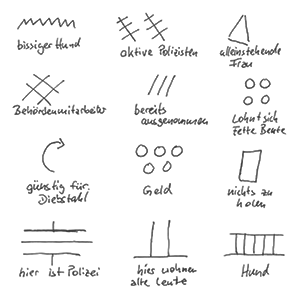
Rotwelsch [rut-velsh] (German: ‘beggar’s foreign language’) or Gaunersprache (German: ‘crook’s language’) is a secret language, a cant or thieves’ argot, spoken by groups (primarily marginalized groups) in southern Germany and Switzerland. The language is based primarily on German.
Rotwelsch was formerly common among travelling craftspeople and vagrants. The language is built on a strong substratum of German, but contains numerous words from other languages, notably from various German dialects, including Yiddish, as well as from Romany languages, notably Sintitikes. There are also significant influences from Judeo-Latin, the ancient Jewish language spoken in the Roman Empire.
read more »
Posted in Language, Politics, World |
Leave a Comment »
October 4, 2020

Jeitinho [jay-cheen-yo] (Portuguese: ‘little way’) is finding a way to accomplish something by circumventing or bending the rules or social conventions. Most times it is harmless, made for basic ordinary opportunistic advantages, as gatecrashing a party just to get free food and beverage.
But sometimes it is used for questionable, serious violations, where an individual can use emotional resources, blackmail, family ties, promises, rewards or money to obtain (sometimes illegal) favors or to get advantage. Some claim it is a typically Brazilian method of social navigation that may derive from a general lack of resources and help. Most Brazilians have to be creative and invent new simpler ways to do things.
read more »
Posted in Language, Money, World |
Leave a Comment »
September 27, 2020

The Mariko Aoki phenomenon is a Japanese expression referring to an urge to defecate that is suddenly felt after entering bookstores. The phenomenon’s name derives from the name of the woman who mentioned the phenomenon in a magazine article in 1985.
According to Japanese social psychologist Shozo Shibuya, the specific causes that trigger a defecation urge in bookstores are not yet clearly understood, and it is sometimes discussed as one type of urban myth or a mild form of mass psychogenic illness.
read more »
Posted in Health, Science, World |
1 Comment »
September 4, 2020

First Growth (French: ‘Premier Cru’) status is a classification of wines primarily from the Bordeaux region of France.
The need for a classification of the best Bordeaux wines arose from the 1855 World’s Fair, the ‘Exposition Universelle de Paris.’ The result was the ‘Bordeaux Wine Official Classification,’ a list of the top ranked wines, named the ‘Grand Crus Classés’ (Great Classified Growths). With several thousand Chateaux producing their wines in Bordeaux, to be classified was to carry a mark of high prestige.
read more »
Posted in Food, World |
1 Comment »
September 1, 2020
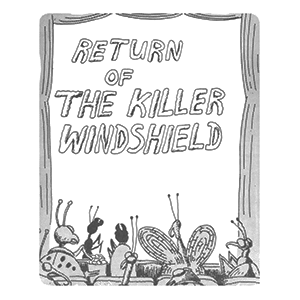
The windshield phenomenon is a recent observation that fewer dead insects accumulate on the windshields of people’s cars. It has been attributed to a global decline in insect populations caused by human activity.
As early as the 2000s, it became a commonplace observation among drivers that windscreens after a long drive no longer had to be cleaned of a myriad of insects. In 2016, Canadian naturalist John Acorn noted that the phenomenon had recently become a meme but questioned whether it is ‘reasonable to assume that windshields can tell us something about the overall numbers of insects’ and also that ‘humans are notoriously bad at detecting trends.’
read more »
Posted in Science, World |
1 Comment »
August 2, 2020

Dead Birds is a 1963 American documentary film by American anthropologist Robert Gardner (1925-2014) about the ritual warfare cycle of the Dugum Dani tribe in New Guinea. The film presents footage of battles between the Willihiman-Wallalua clan and the Wittaia clan with scenes of the funeral of a small boy killed by a raiding party, the women’s work that goes on while battles continue, and the wait for enemy to appear.
The film’s theme is the encounter that all people must have with death, as told in a Dugum Dani myth of the origins of death that bookends the film. The film uses a nonlinear narrative structure of parallel or braided narrative that traces three individuals through a season of three deaths and one near-death as relayed by an expository voiceover that describes scenes and the thoughts of the film’s protagonists.
read more »
Posted in Death, Science, War, World |
Leave a Comment »
June 26, 2020

Bōsōzoku (literally ‘running-out-of-control (as of a vehicle) tribe’) is a Japanese youth subculture associated with customized motorcycles. The first appearance of these types of biker gangs was in the 1950s. Popularity climbed throughout the 1980s and 1990s, peaking at an estimated 42,510 members in 1982. Their numbers dropped dramatically in the 2000s with a reported number of under 7,297 members in 2012.
Bōsōzoku are known to modify their motorcycles in peculiar and showy ways, which are called ‘Kaizōsha’ (‘Modified Vehicles’). The general style of bōsōzoku bike modification appears to combine elements of an American chopper bike and a British café racer. Examples of modifications that are taken from these styles are raised handle bars like those on a chopper or over-sized fairings like those found on café racers (though bōsōzoku usually fit them much higher on the bike than their original position, and angled upwards at the front).
read more »
Posted in World |
1 Comment »


 The Daily Omnivore