August 11, 2011

Ferdinand Cheval (1836 – 1924) was a French postman who spent thirty-three years of his life building Le Palais Idéal (‘The Ideal Palace’) in Hauterives. The structure is regarded as an extraordinary example of naïve art architecture. Cheval began the building in April 1879. He claimed that he had tripped on a stone and was inspired by its shape. He returned to the same spot the next day and started collecting stones. For the next thirty-three years, Cheval picked up stones during his daily mail round and carried them home to build with. He spent the first twenty years building the outer walls. At first, he carried the stones in his pockets, then switched to a basket. Eventually, he used a wheelbarrow. He often worked at night, by the light of an oil lamp.
The Palais is a mix of different styles with inspirations from Christianity to Hinduism. Cheval bound the stones together with lime, mortar and cement. He also wanted to be buried in his palace. However, since that is illegal in France, he proceeded to spend eight more years building a mausoleum for himself in the Hauterives cemetery. He died one year after he had finished building it, and is buried there. Just prior to his death, Cheval began to receive some recognition from luminaries like André Breton and Pablo Picasso. His work is commemorated in an essay by Anaïs Nin. In 1932, the German artist Max Ernst created a collage titled ‘The Postman Cheval.’ The work belongs to the Peggy Guggenheim Collection and is on display there.
Posted in Art, Humor, World |
Leave a Comment »
August 2, 2011

Sky lanterns, also known as Kongming Lantern are airborne paper lanterns found in some Asian cultures. They are constructed from oiled rice paper on a bamboo frame, and contain a small candle or fuel cell composed of a waxy flammable material. When lit, the flame heats the air inside the lantern, thus lowering its density causing the lantern to rise into the air. The sky lantern is only airborne for as long as the flame stays alight, after which the lantern floats back to the ground.
According to popular lore, the Kongming Lantern was the first hot air balloon, said to be invented by the Chinese sage and military strategist Zhuge Liang, whose reverent term of address (i.e. Chinese style name) was Kongming. They were first deployed at the turn of the 3rd century as a type of signaling balloon or, it is claimed, as a type of spy blimp in warfare. Alternatively the name may come from the lantern’s resemblance to the hat Kongming is traditionally shown to be wearing.
read more »
Posted in Games, Technology, World |
Leave a Comment »
July 29, 2011

Grace Jones (b. 1948) is a Jamaican-American singer, model and actress. She secured a record deal with Island Records in 1977, which resulted in a string of dance-club hits. In the late 1970s, she adapted the emerging electronic music style and adopted a severe, androgynous look with square-cut hair and angular, padded clothes. Jones is a contralto, the deepest female classical singing voice. Although her image became equally as notable as her voice, she is a highly stylized vocalist. She sings in two modes: in her monotone speak-sing as in songs such as and in an almost-soprano mode in songs such as ‘La Vie en rose’ and ‘Slave to the Rhythm.’ Her voice spans two and a half octaves.
In 1981, her ‘Pull Up to the Bumper’ became a Top 5 single on the US R&B chart. Jones is also an actress. Her acting occasionally overshadowed her musical output in America; but not in Europe, where her profile as a recording artist was much higher. She appeared in some low-budget films in the 1970s and early 1980s. Her work as an actress in mainstream film began in the 1984 fantasy-action film ‘Conan the Destroyer’ alongside Arnold Schwarzenegger, and the 1985 James Bond movie ‘A View to a Kill.’
read more »
Posted in Art, World |
Leave a Comment »
July 29, 2011

The Full Moon Party is an all-night beach rave that takes place in Haad Rin on the island of Ko Pha Ngan, Thailand on the night before or after every full moon. The first Full Moon Party was improvised at a wooden disco not far from the beach in 1985 for giving thanks to about 20-30 travelers. They quickly gained fame through word of mouth, and the event now draws a crowd about 20,000-30,000 every full moon evening.
The party carries on until the sun rises the next day. The bars on the sunrise beach of Haad Rin town stay open and play music such as R&B, drum and bass, house, dance and reggae. The modern event is characterized by unruly and potentially dangerous attractions such as fire skipping ropes, wildly variable alcohol strength ‘buckets,’ and a drug culture. It is seen by many as the ‘ultimate party experience,’ although drug laws are still strictly enforced.
Posted in Drugs, World |
Leave a Comment »
July 29, 2011


The Melbourne Shuffle (also known as Rocking ) is a rave and club dance that originated in the late 1980s in the underground rave music scene in Melbourne, Australia. The basic movements in the dance are a fast heel-and-toe action with a style suitable for various types of electronic music. Some variants incorporate arm movements. People who dance the shuffle are often referred to as rockers, due in part to the popularity of shuffling to rock music in the early 1990s.
In the late ’80s, the Melbourne Shuffle began to emerge as a distinct dance, incorporating more hand movement than its predecessor, Stomping, which in turn originated from Celtic and Malaysian folk dances. The clog and sword dance can easily be matched to some earlier experimental rave and club dance moves that evolved into Stomping.
read more »
Posted in Art, Games, World |
Leave a Comment »
July 26, 2011


Dub is a genre of music which grew out of 1960’s reggae. Music in this genre consists predominantly of instrumental remixes of existing recordings which have been manipulated and reshaped, usually by removing the vocals, and emphasizing the drum and bass elements (this stripped down track is sometimes referred to as a ‘riddim’). Other techniques include dynamically adding extensive echo, reverb, panoramic delay, and occasional dubbing of vocal or instrumental snippets from the original version or other works. Dub also sometimes features electronically generated sound effects, or the use of distinctive instruments such as the melodica by artists such as Augustus Pablo.
Dub was pioneered by Osbourne ‘King Tubby’ Ruddock, Lee ‘Scratch’ Perry, Errol Thompson and others in the late 1960s. Similar experiments with recordings at the mixing desk outside of the dancehall environment were also done by producers Clive Chin and Herman Chin Loy. These producers, especially Ruddock and Perry, looked upon the mixing desk as an instrument, manipulating tracks to come up with something new and different. Dub has influenced many genres of music, including punk, hip hop, disco, house, and trip hop, and has become a basis for jungle/drum’n’bass and dubstep music.
read more »
Posted in Art, Language, World |
Leave a Comment »
July 22, 2011
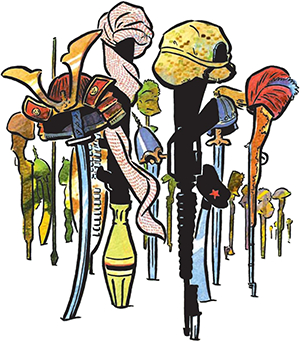

The Clash of Civilizations is a theory, proposed by political scientist Samuel P. Huntington, that people’s cultural and religious identities will be the primary source of conflict in the post-Cold War world. This theory was originally formulated in a 1992 lecture at the American Enterprise Institute, which was then developed in a 1993 ‘Foreign Affairs article’ titled ‘The Clash of Civilizations?,’ in response to Francis Fukuyama’s 1992 book, ‘The End of History and the Last Man.’ Huntington later expanded his thesis in a 1996 book ‘The Clash of Civilizations and the Remaking of World Order.’
The phrase itself was first used by American historian, Bernard Lewis in an article in a 1990 issue of ‘The Atlantic Monthly’ titled ‘The Roots of Muslim Rage.’
read more »
Posted in Politics, War, World |
Leave a Comment »
July 21, 2011

A flood myth or deluge myth is a mythical or religious story of a great flood sent by a deity or deities to destroy civilization as an act of divine retribution. It is a theme widespread among many cultures, though it is perhaps best known in modern times through the biblical and Quranic account of Noah’s Ark, the Hindu puranic story of Manu, through Deucalion in Greek mythology or Utnapishtim in the Epic of Gilgamesh. Parallels are often drawn between the flood waters of these myths and the primeval waters found in some creation myths since the flood waters are seen to cleanse humanity in preparation for rebirth. Most flood myths also contain a culture hero who strives to ensure this rebirth.
Historian, Adrienne Mayor first promoted the hypothesis that flood stories were inspired by ancient observations of seashells and fish fossils inland and on mountains. The ancient Greeks, Egyptians, Romans, and Chinese all wrote about finding such remains in these locations, and the Greeks hypothesized that Earth had been covered by water several times, noting seashells and fish fossils found on mountain tops as evidence. Native Americans also expressed this belief in their early encounters with Europeans. However, Leonardo da Vinci postulated that an immediate deluge could not have caused the neatly ordered strata he found in the Italian Apennines.
Posted in Philosophy, World |
Leave a Comment »
July 20, 2011
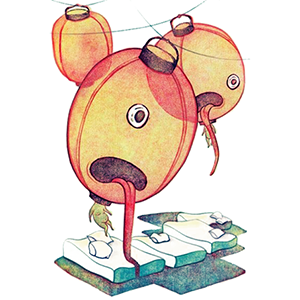
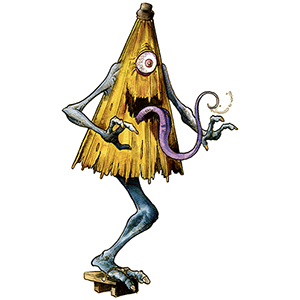
Tsukumogami [sook-oom-oh-gamee] (‘artifact spirit’) are a type of Japanese spirit that originate from items or artifacts that have reached their 100th birthday and thus become alive and aware. Any object of this age, from swords to toys, can become a tsukumogami. Tsukumogami are considered spirits and supernatural beings, as opposed to enchanted items. Tsukumogami vary radically in appearance, depending on the type of item they originated from as well as the condition that item was in. Some, such as tsukumogami originating from paper lanterns or broken sandals, can have tears which become eyes and sharp teeth, thus giving a horrifying visage. Others, such as worn prayer beads or teacups, may merely manifest faces and appendages, giving a warm and friendly appearance.
Though by and large tsukumogami are harmless and at most tend to play occasional pranks on unsuspecting victims, as shown in the Otogizōshi (a collection of 16th century Japanese scrolls) they do have the capacity for anger and will band together to take revenge on those who are wasteful or throw them away thoughtlessly. To prevent this, to this day Shinto ceremonies are performed to console broken and unusable items. It is said that modern items cannot become tsukumogami; the reason for this is that tsukumogami are said to be repelled by electricity. Additionally, few modern items are used for the 100-year-span that it takes for an artifact to gain a soul. Though they are generally considered as mythical or legendary beings, almost all of tsukumogami with names are artistic production created during the Edo period. The most popular artist is Toriyama Sekien, but other numerous artists added their own creatures to the list of tsukumogami.
Posted in Philosophy, World |
1 Comment »
July 19, 2011


The Bristol underground scene is a term used to describe the culture surrounding trip hop, drum and bass and graffiti art that has existed in Bristol from the early 1990s to the present. The city of Bristol in the UK has spawned various musicians and artists, and is typified by its urban culture. While the city is most associated with a group of artists who emerged during the 1990s, especially the ‘Bristol Sound’, the city maintains an active and diverse underground urban scene.
The city has been particularly associated with trip hop. Trip hop was spawned in ‘the bohemian, multi-ethnic city of Bristol, where restlessly inventive DJs had spent years assembling samples of various sounds that were floating around: groove-heavy acid jazz, dub reggae, neo-psychedelia, techno disco music, and the brainy art rap.’
read more »
Posted in Art, Money, World |
Leave a Comment »
July 19, 2011
The Wild Bunch was a sound system based in the St Paul’s district of Bristol, England from 1983 to 1986. The group was renowned for playing sets that drew large crowds from the club scene and had performed shows as far away as London. They performed against other Bristol sound systems in soundclashes, musical competitions where crew members from opposing reggae sound systems pit their skills against each other. The Wild Bunch’s sound incorporated a wide and disparate variety of musical styles – an unusual thing at the time. Their shows included elements of punk, R&B and reggae, with a focus on slower rhythms and ambient electronic atmospheres that would become a cornerstone of the Bristol sound, more popularly known as trip-hop. They were a key member of what became the Bristol underground scene. The first Wild Bunch record was a cover of Burt Bacharach’s ‘The Look of Love,’ featuring Shara Nelson on vocals, and released in 1985.
The Wild Bunch is perhaps best known for having been the first group of several notable British DJs and performers: Robert Del Naja, Grant Marshall and Andrew Vowles, went on to form Massive Attack in 1987. Tricky, also a part-time member of the outfit, performed with Massive Attack on their first and second full-length releases, Blue Lines and Protection respectively, before pursuing a successful solo career. Nellee Hooper, who moved to London after the group’s dissolution and worked as a producer and remixer for a number of major artists, including Madonna, U2, No Doubt, Björk and others. Miles Johnson, aka DJ Milo, who subsequently moved to New York and released deep house records as Natureboy.
Posted in Art, World |
Leave a Comment »
July 19, 2011
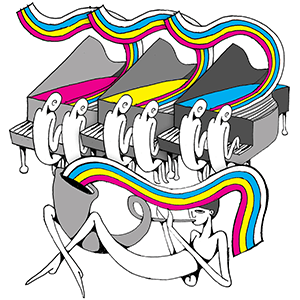
Teknivals (a portmanteau of ‘tekno’ and ‘festival’) are large free parties which take place worldwide. They take place most often in Europe and are often illegal under various national or regional laws. They vary in size from dozens to thousands of people, depending on factors such as accessibility, reputation, weather, and law enforcement.
The parties often take place in venues far away from residential areas such as squatted warehouses, empty military bases, forests or fields. The teknival phenomenon is a grassroots movement which has grown out of the rave, New Age Traveller and Burning Man scenes and spawned an entire subculture. Summer is the usual season for teknivals.
read more »
Posted in Art, Money, World |
Leave a Comment »




 The Daily Omnivore