July 5, 2011

Korean tacos are a fusion dish popular in California, often as street food, consisting of a Korean-style filling, typically bulgogi (marinated barbecued beef), placed on top of small traditional Mexican corn tortillas. Korean burritos are a similarly themed dish, using larger flour tortillas as a wrap.
Although nearly any savory dish can and has been used as filling for a taco, burrito, or sandwich wrap, and other restaurants have occasionally served dishes they called Korean tacos, the present popularity of the dish is generally traced to the use of Twitter by the proprietors of the Kogi Korean BBQ, a food truck in Los Angeles, to announce their schedule and itinerary.
Posted in Food, World |
Leave a Comment »
July 5, 2011

Christopher Mercer (b. 1985), more commonly known as Rusko, is an English dubstep record producer and DJ. He made his production debut in 2006 on Dub Police with the song ‘SNES Dub.’
Steering away from the darker side of Dubstep, Rusko brought an upbeat sound to the scene that appealed to many outside the community. Rusko’s extremely successful hit ‘Cockney Thug’ has appeared on various DJ sets and mixes.
Posted in Art, Technology, World |
2 Comments »
July 4, 2011

La Malinche (c. 1496 – 1529) was an indigenous woman from the Mexican Gulf Coast, who played a role in the Spanish conquest of Mexico, acting as interpreter, advisor, lover and intermediary for Hernán Cortés. She was one of twenty slaves given to Cortés by the natives of Tabasco in 1519. Later she became a mistress to Cortés and gave birth to his first son, Martín, who is considered one of the first Mestizos (people of mixed European and indigenous American ancestry).
The historical figure of Marina has been intermixed with Aztec legends. Her reputation has been altered over the years according to changing social and political perspectives, especially after the Mexican Revolution, when she was portrayed in dramas, novels, and paintings as an evil or scheming temptress. In Mexico today, La Malinche remains iconically potent. She is understood in various and often conflicting aspects, as the embodiment of treachery, the quintessential victim, or simply as symbolic mother of the new Mexican people. Her sexual relationship to Cortés gave rise to the pejorative term La Chingada (‘the fucked one’). The term ‘malinchista’ refers to a disloyal Mexican.
read more »
Posted in Language, Politics, World |
Leave a Comment »
July 4, 2011

Cultural cringe, in cultural studies and social anthropology, is an internalized inferiority complex which causes people in a country to dismiss their own culture as inferior to the cultures of other countries.
It is closely related, although not identical, to the concept of colonial mentality, and is often linked with the display of anti-intellectual attitudes towards thinkers, scientists and artists who originate from a colonial or post-colonial nation. It can also be manifested in individuals in the form of ‘cultural alienation.’ In many cases, cultural cringe, or an equivalent term, is an accusation made by a fellow-national, who decries the inferiority complex and asserts the merits of the national culture.
read more »
Posted in Politics, Science, World |
Leave a Comment »
July 4, 2011


Since the 1970s, cuteness, in Japanese the noun kawaisa (literally, ‘lovability,’ ‘cuteness’ or ‘adorableness’), has become a prominent aspect of Japanese popular culture, entertainment, clothing, food, toys, personal appearance, behavior, and mannerisms. The term kawaii has taken on the secondary meanings of ‘cool,’ ‘groovy,’ ‘charming,’ ‘non-threatening.’ As a cultural phenomenon, cuteness is increasingly accepted in Japan as a part of Japanese culture and national identity.
Japanese women who perform cute behaviors that could be viewed as forced or fake are called ‘burikko’ and this is considered a gender performance. In Japan, cuteness is expected of men and women. There is a trend of men shaving their legs to mimic the ‘asexual’ look. The original definition of kawaii came from Lady Murasaki’s ‘The Tale of Genji’ where it referred to pitiable qualities. During the Shogunate period under the ideology of neo-Confucianism, women came to be included under the term kawaii as the perception of women from being animalistic was replaced with the conception of women as docile.
read more »
Posted in Art, Language, World |
Leave a Comment »
July 4, 2011
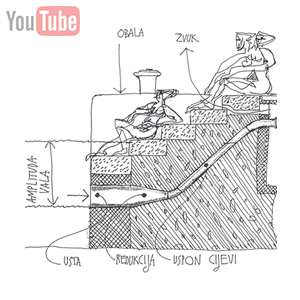
The Sea organ is an architectural object located in Croatia and an experimental musical instrument which plays music by way of sea waves and tubes located underneath a set of large marble steps. The waves create somewhat random but harmonic sounds.
The device was made by the architect Nikola Bašić as part of the project to redesign the new city coast (Nova riva), and the site was opened to the public in 2005. Chaotic reconstruction work undertaken in an attempt to repair the devastation suffered by the city of Zadar in the Second World War turned much of the sea front into an unbroken, monotonous concrete wall. The Sea Organ has drawn tourists and locals alike.
Posted in Art, Technology, World |
Leave a Comment »
July 4, 2011

Enter the Void is a 2009 French film written and directed by Gaspar Noé, labeled by Noé as a ‘psychedelic melodrama. The story is set in Tokyo and focuses on Oscar, a young American drug dealer who gets shot by the police, but continues to watch over his sister Linda and the events which follow during an out-of-body experience, floating above Tokyo’s streets. The film is shot from a first-person view, and occasionally features Oscar staring over his own shoulder as he recalls moments from his past.
Having been Noé’s dream project for many years, the production of ‘Enter the Void’ was made possible due to the commercial success of ‘Irréversible,’ the director’s previous feature film. The film makes heavy use of imagery inspired by experimental cinema and psychedelic drug experiences. Principal photography took place on location in Tokyo and involved many complicated crane shots.
read more »
Posted in Art, Drugs, World |
1 Comment »
July 3, 2011

Manqué [mahng-key] (feminine, manquée) is a term used in reference to a person who has failed to live up to a specific expectation or ambition. It is usually used in combination with a profession: for example, a career civil servant with political prowess who nonetheless never attained political office might be described as a ‘politician manqué.’
It can also be used relative to a specific role model; a second-rate method actor might be referred to as a ‘Marlon Brando manqué.’ The term derives from the past participle of the French verb manquer (‘to miss’). In English, it is used in the manner of a French adjective: coming after the noun it is modifying instead of before.
Posted in Language, Politics, World |
Leave a Comment »
July 3, 2011

Milk kinship, formed during nursing by a non-biological mother, was a form of fostering allegiance with fellow community members. In the early modern period, milk kinship was widely practiced in many Arab countries for both religious and strategic purposes. Like the Christian practice of godparenting, milk kinship established a second family that could take responsibility for a child whose biological parents came to harm. ‘Milk kinship in Islam thus appears to be a culturally distinctive, but by no means unique, institutional form of adoptive kinship.’ A child in one of these societies would be breastfed by a woman of a lower class, enabling the child’s biological mother to maintain her modesty.
The childhood of the prophet Muhammad illustrates the practice of traditional Arab milk kinship. In his early childhood, he was sent away to foster-parents amongst the Bedouin. By nursing him, Halimah bint Abdullah became his ‘milk-mother.’ The rest of her family was drawn into the relationship as well: her husband al-Harith became Muhammad’s ‘milk-father,’ and Muhammad was raised alongside their biological children as a ‘milk-brother.’ This case suggests that it was typical for a child’s wet nurse to be responsible for raising him.
read more »
Posted in Food, Philosophy, World |
Leave a Comment »
June 30, 2011


The Royal Society for the encouragement of Arts, Manufactures and Commerce (RSA) is a British multi-disciplinary institution, based in London. The name Royal Society of Arts is frequently used for brevity. It was founded in 1754 and was granted a Royal Charter in 1847. Notable members have included Benjamin Franklin, Karl Marx, Adam Smith, Stephen Hawking and Charles Dickens. Its founding charter expressed the purpose of the society as being to ’embolden enterprise, enlarge science, refine art, improve our manufactures and extend our commerce,’ but also of the need to alleviate poverty and secure full employment.
In its early years, the Society offered prizes — which it called ‘premiums’ — for people who could successfully achieve one of a number of published challenges. Captain William Bligh suffered the ‘Mutiny on the Bounty’ while attempting to win a premium for shipping breadfruit from the East to the West Indies. He subsequently repeated the voyage and this time succeeded, and the Society awarded him the prize. The Society offered premiums for a very wide range of challenges including devising new forms of machinery and agricultural improvements (which included seeking ways to improve the cultivation of opium poppies).
Posted in Art, Money, World |
Leave a Comment »
June 30, 2011

Yellow Magic Orchestra (YMO) is a Japanese electronic music band consisting of principal members Haruomi Hosono (bass and keyboards), Yukihiro Takahashi (drums and lead vocals) and Ryuichi Sakamoto (keyboards and vocals). The group began under the name ‘Yellow Magic Band’ in 1977, and then renamed itself as ‘Yellow Magic Orchestra’ in 1978.
The band’s former ‘fourth member’ was music programmer Hideki Matsutake. They are regarded as influential innovators of popular electronic music. They helped pioneer synthpop and ambient house, ushered in electronica, anticipated the beats and sounds of electro music, laid the foundations for J-pop, and influenced the house, techno, and hip-hop movements.
read more »
Posted in Art, Technology, World |
Leave a Comment »
June 30, 2011


The Bildungsroman [bil-doongz-roh-mahn] (German: ‘education novel’) is a genre of novel which focuses on the psychological and moral growth of the protagonist from youth to adulthood, and in which character change is thus extremely important. The term was coined by philologist (scholar of language in written historical sources) Karl Morgenstern in 1819, and later famously reprised by German historian Wilhelm Dilthey in 1905. The birth of the genre is normally dated to the publication of Goethe’s ‘The Apprenticeship of Wilhelm Meister’ in 1795 in Germany. A Bildungsroman tells about the growing up or coming of age of a sensitive person who is looking for answers and experience. The genre evolved from folklore tales of a dunce or youngest son going out in the world to seek his fortune.
Typically, in the beginning of the story there is an emotional loss which makes the protagonist leave on his journey. In a Bildungsroman, the goal is maturity, and the protagonist achieves it gradually and with difficulty. The genre often features a main conflict between the character and society. Typically, the values of society are gradually accepted by the protagonist who is in turn welcomed back into the fold. There are many variations and subgenres: An Entwicklungsroman (‘development novel’) is a story of general growth rather than self-cultivation. An Erziehungsroman (‘education novel’) focuses on training and formal schooling, while a Künstlerroman (‘artist novel’) is about the development of an artist and shows a growth of the self.
Posted in Art, Language, World |
Leave a Comment »



 The Daily Omnivore