March 29, 2011
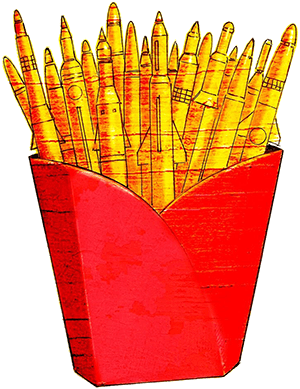
Freedom fries is a political euphemism for French fries used in the US as a result of anti-French sentiment during the controversy over the decision to invade Iraq in 2003. France expressed strong opposition in the UN, leading to boycotts of French goods and the removal of the country’s name from products.
Representatives Robert W. Ney (R-Ohio) and Walter B. Jones, Jr. (R-North Carolina) declared that all references to French fries and French toast on the menus of the restaurants and snack bars run by the House of Representatives would be removed. House cafeterias were ordered to rename French fries ‘freedom fries.’ This action was carried out without a congressional vote, under the authority of Ney’s position as Chairman of the Committee on House Administration, which oversees restaurant operations for the chamber.
read more »
Posted in Humor, Politics, World |
Leave a Comment »
March 29, 2011

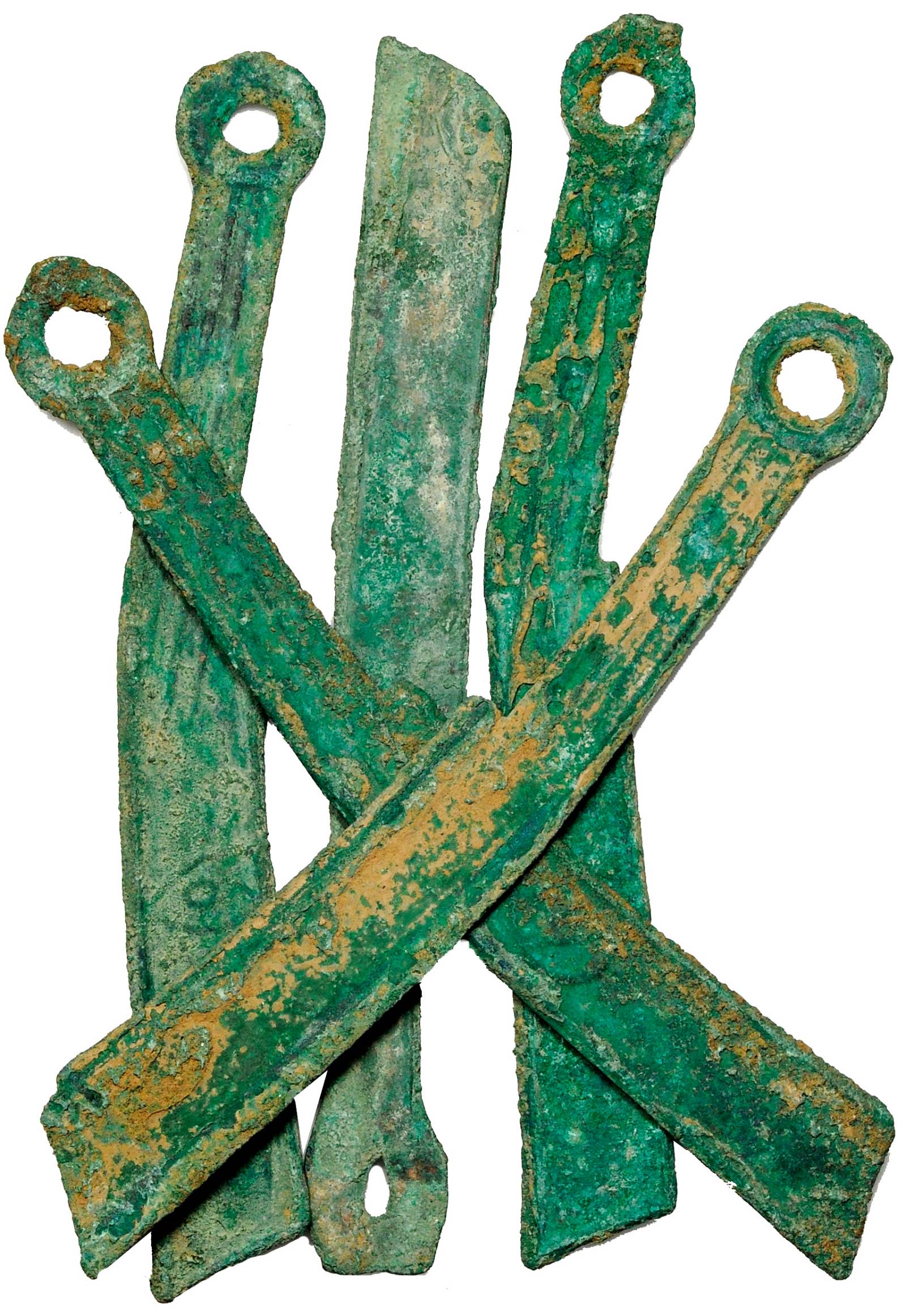
Knife money refers to large, cast, bronze, knife-shaped coins produced by Ancient Chinese governments and kingdoms approximately 2500 years ago. They had holes on the end to be easily strapped onto belts or rings. Known as ‘jin cuo dao’ in Chinese, knife money circulated in China between 600 to 200 BCE during the Zhou dynasty. There are several stories that attempt to explain how knife money was introduced but it is not certain if any or all are true.
In one story a prince who was running low on money to pay his troops allowed them to use their knives as a form of currency to barter with villagers and the medium became so popular that it became generally accepted. In another story, the same prince began accepting knives as payment for small fines in the place of the current legal ring currency. Knife money may also have been brought in by sea traders from the Indian Ocean. Over time, the currency slowly shrank until only the ring of the handle was produced as a symbol of the knife that it represented.
Posted in Money, World |
Leave a Comment »
March 28, 2011

Polymer banknotes were developed by the Reserve Bank of Australia, Commonwealth Scientific and Industrial Research Organization, and The University of Melbourne and were first issued as currency in Australia in 1988. These banknotes are made from the polymer biaxially-oriented polypropylene which greatly enhances durability. They also incorporate many security features not available to paper banknotes, making counterfeiting much more difficult. As of 2010, eight countries have converted fully to polymer banknotes: Australia, Bermuda, Brunei, New Zealand, Nicaragua, Papua New Guinea, Romania, and Vietnam.
An alternative polymer of polyethylene fibres marketed as Tyvek by DuPont was developed for use as currency by the American Bank Note Company in the early 1980s. Tyvek did not perform well in trials; smudging of ink and fragility were reported as problems. Only Costa Rica and Haiti issued Tyvek banknotes. Additionally, English printers Bradbury Wilkinson produced a version on Tyvek but marketed as Bradvek for the Isle of Man in 1983; however, they are no longer produced and have become collectors’ items.
Posted in Money, Technology, World |
Leave a Comment »
March 28, 2011

Roadside Picnic is a science fiction novella written by Arkady and Boris Strugatsky in 1971. The film ‘Stalker’ directed by Andrei Tarkovsky is loosely based on the novel, with a screenplay written by the Strugatskys. The novella was refused publication in the Soviet Union for eight years due to government censorship, numerous delays and sabotage.
The heavily censored different versions published between 1980 and 2000 have little in common with the original version written by the authors. Soviet censors rewrote major plot points, changed names of characters and dialog to better reflect the Marxist ideology (removed language deemed as ‘rude’; heavier emphasis was placed on the exploitation of the Zones for ‘materialistic’ purposes by an elite bourgeois cabal as a means to oppress the proletariat masses, etc.).
read more »
Posted in Art, World |
Leave a Comment »
March 28, 2011

Stalker is a 1979 science fiction film directed by Andrei Tarkovsky, with a screenplay written by Boris and Arkady Strugatsky, loosely based on their novel ‘Roadside Picnic.’ It depicts an expedition led by the Stalker (guide) to bring his two clients to a site known as the Zone, which has the supposed potential to fulfil a person’s innermost desires. The title of the film, which is the same in Russian and English, is derived from the English word to stalk in the long-standing meaning of approaching furtively, much like a hunter.
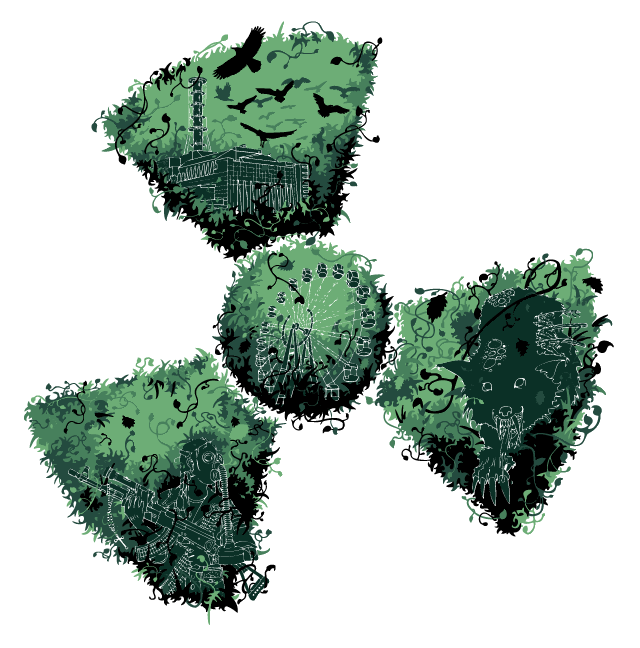
The sparseness of exposition leads to ambiguity as to the nature of The Zone. Seven years after the making of the film, the Chernobyl accident led to the depopulation of an area rather like that in the film. Some of those employed to take care of the abandoned nuclear power plant refer to themselves as ‘stalkers’ and to the area around the damaged reactor as ‘The Zone.’
read more »
Posted in Art, World |
Leave a Comment »
March 28, 2011

Andrei Tarkovsky (1932 – 1986) was a Russian filmmaker, widely regarded as one of the finest of the 20th century. Tarkovsky’s films include ‘Andrei Rublev,’ ‘Solaris,’ ‘The Mirror,’ and ‘Stalker.’ He directed the first five of his seven feature films in the Soviet Union; his last two films were produced in Italy and Sweden, respectively. They are characterized by spirituality and metaphysical themes, long takes, lack of conventional dramatic structure and plot, and distinctively authored use of cinematography.
read more »
Posted in Art, Philosophy, World |
Leave a Comment »
March 28, 2011

Sébastien Le Prestre, Seigneur de Vauban (1633 – 1707), commonly referred to as Vauban [voh-bahn], was a Marshal of France and the foremost military engineer of his age, famed for his skill in both designing fortifications and breaking through them. He also advised Louis XIV on how to consolidate France’s borders, to make them more defensible. Vauban made a radical suggestion of giving up some land that was indefensible to allow for a stronger, less porous border with France’s neighbors.
Vauban was born in Burgundy, to a family of minor nobility, but at the age of ten he was left an orphan, and his youth was spent amongst the peasantry of his native place. A fortunate event brought him under the care of a member of the Carmelites (a Catholic religious order), who undertook his education, and the grounding in mathematics, science and geometry.
Posted in Technology, War, World |
Leave a Comment »
March 25, 2011

Holi [hoh-lee] is a spring religious festival celebrated by Hindus. It is primarily observed in India, Nepal, Sri Lanka, and countries with large Indic diaspora populations, such as Suriname, Malaysia, Guyana, South Africa, Trinidad, United Kingdom, United States, Mauritius, and Fiji.
The main day, Holi, is celebrated by people throwing colored powder and colored water at each other. Bonfires are lit the on the eve of the festival in memory of the miraculous escape that young Prahlad accomplished when Demoness Holika carried him into the fire. Holika was burnt but Prahlad, a staunch devotee of god Vishnu, escaped without any injuries due to his unshakable devotion.
Posted in Philosophy, World |
Leave a Comment »
March 25, 2011

The Four Pests campaign was one of the first actions taken in the Great Leap Forward, a series of reforms in China from 1958 to 1962. The pests to be eliminated were rats, flies, mosquitoes, and sparrows. The masses of China were mobilized to eradicate the birds, and citizens took to banging pots and pans or beating drums to scare the birds from landing, forcing them to fly until they fell from the sky in exhaustion. Nests were torn down, eggs were broken, and nestlings were killed, resulting in the near-extinction of the birds in China. Non-material rewards and recognition were offered to schools, work units and government agencies in accordance with the volume of pests they had killed.
By April 1960, Chinese leaders realized that sparrows ate more insects than grains. Mao ordered the end of the campaign against sparrows, replacing them with bedbugs in the ongoing campaign against the Four Pests. By this time, however, it was too late. With no sparrows to eat them, locust populations ballooned, swarming the country and compounding the ecological problems already caused by the Great Leap Forward, including widespread deforestation and misuse of poisons and pesticides. Ecological imbalance is credited with exacerbating the Great Chinese Famine in which upwards of 30 million people died of starvation.
Posted in Food, Politics, World |
Leave a Comment »
March 24, 2011
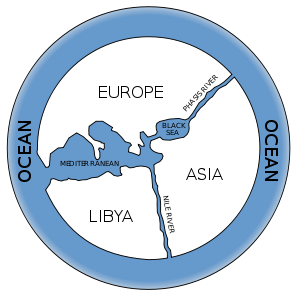
Most ancient cultures had conceptions of a Flat Earth, including Greece until the fifth century BCE, the Near East until fourth century BCE, India until the fourth century CE. In ancient China, the prevailing belief was that the Earth was flat and square, while the heavens were round, an assumption virtually unquestioned until the introduction of European astronomy in the 17th century. It was also typically held in the aboriginal cultures of the Americas, and a flat Earth domed by the firmament in the shape of an inverted bowl is common in pre-scientific societies.
The paradigm of a spherical Earth was developed in Greek astronomy, beginning with Pythagoras (6th century BCE), although most Pre-Socratics retained the flat Earth model. Aristotle accepted the spherical shape of the Earth on empirical grounds around 330 BCE, and knowledge of the spherical Earth gradually began to spread beyond the Hellenistic world from then on. The misconception that educated people at the time of Columbus believed in a flat Earth, and that his voyages refuted that belief, has been referred to as ‘The Myth of the Flat Earth.’
Posted in Science, World |
Leave a Comment »
March 24, 2011
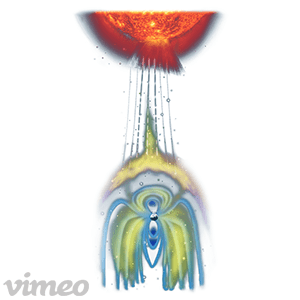
An aurora [uh-rawr-uh] is a flickering light caused by the sun’s radiation interacting with an atmosphere, usually found near the poles (Aurora borealis – Dawn of the North, or Aurora australis – Dawn of the South). They come in red, green and occasionally blue, and can sometimes resemble fire, and can be seen for a long way, many hundreds of kilometers or miles. Auroras can occur during the daytime, but are not visible to the naked eye.
The Sun emits a flow of charged particles into space called ‘solar wind.’ The Earth is shielded from these particles by its magnetosphere, a protective electromagnetic bubble created by the planet’s molten iron, outer core. The magnetic field is weakest at the cold areas, so at the poles some particles hit the atmosphere. They discharge their energy on impact, giving off light. An aurora can also happen in a coronal mass ejection, when charged particles are expelled so forcefully they that can penetrate electromagnetic fields.
Posted in Science, World |
Leave a Comment »
March 23, 2011

The Schienenzeppelin (‘rail zeppelin’) was an experimental railcar which resembles a zeppelin airship. It was designed and developed by the German aircraft engineer Franz Kruckenberg in 1929. Propulsion was by means of a propeller located at the rear, it accelerated the railcar to 230 km/h (140 mph) setting the land speed record for a petrol powered rail vehicles. Only a single example was ever built, which due to safety concerns remained out of service and was finally dismantled in 1939.
Anticipating the design of the Schienenzeppelin, the earlier Aerowagon, an experimental Russian high-speed railcar, was also equipped with an aircraft engine and a propeller. The chassis of Schienenzeppelin was designed aerodynamically having some resemblance to the era’s popular Zeppelin airships and it was built of aluminum in aircraft style to reduce weight. The interior of the railcar was spartan and designed in Bauhaus-style.
Posted in Technology, World |
Leave a Comment »





 The Daily Omnivore