March 11, 2011


Kruder & Dorfmeister is an Austrian duo most known for their downtempo-dub remixes of pop, hip-hop and drum and bass songs. Their mixes are usually flavored with sampler-processed vocals, deep bassline dub, trip-hop elements, bossa grooves and smoothly-shaped echoes. Some of their better-known works include ‘High Noon,’ ‘Original Bedroom Rockers’ and remixes of Madonna’s ‘Nothing Really Matters,’ Depeche Mode’s ‘Useless,’ Count Basic’s ‘Speechless’ and Roni Size’s ‘Heroes.’
Many of their remixes are collected on the double album ‘The K & D Sessions.’ Although best known internationally for their remixing work, the duo gained their primary reputation in Europe for their live DJ performances and ‘DJ-Kicks’ album. Peter Kruder and Richard Dorfmeister have their own record studio, G Stone Recordings in Vienna, through which they release many of their own albums.
Posted in Art, Money, World |
Leave a Comment »
March 10, 2011

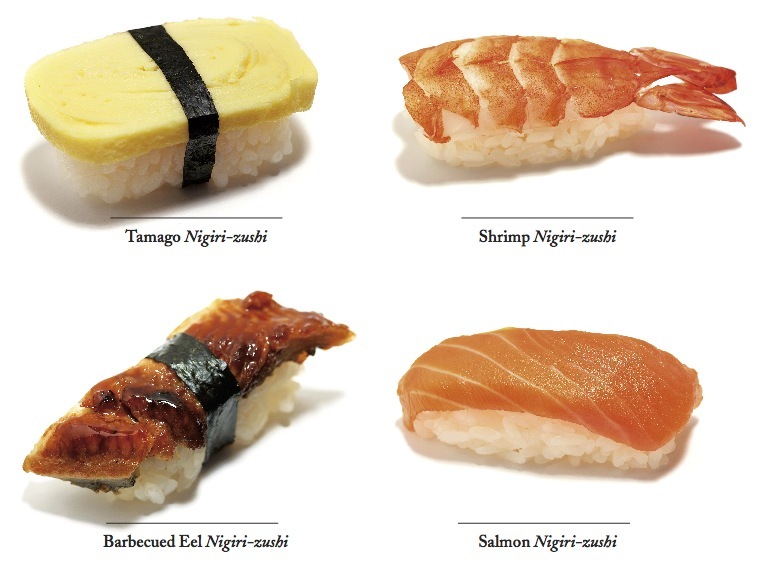
Nigirizushi [ni-geer-ee-zoo-shee] (‘hand-formed sushi’) is an oblong mound of sushi rice that the chef presses into a small rectangular box between the palms of the hands, usually with a bit of wasabi, and a topping draped over it (typically seafood). Certain toppings are bound to the rice with a thin strip of nori (seaweed), most commonly octopus (tako), freshwater eel (unagi), sea eel (anago), squid (ika), and sweet egg (tamago). When ordered separately, nigiri is generally served in pairs. A sushi set (a sampler dish) may contain only one piece of each topping.
Gunkanmaki (‘warship roll’) is a special type of nigirizushi: an oval, hand-formed clump of sushi rice that has a strip of nori wrapped around its perimeter to form a vessel that is filled with some soft, loose or fine-chopped ingredient that requires the confinement of nori such as roe, natto, oysters, sea urchin, corn with mayonnaise, and quail eggs. Temarizushi (‘ball sushi’) is a ball-shaped sushi made by pressing rice and fish into a ball-shaped form by hand using a plastic wrap.
Posted in Food, Language, World |
Leave a Comment »
March 10, 2011
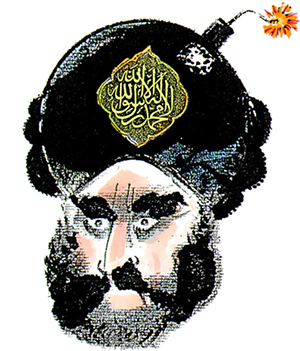
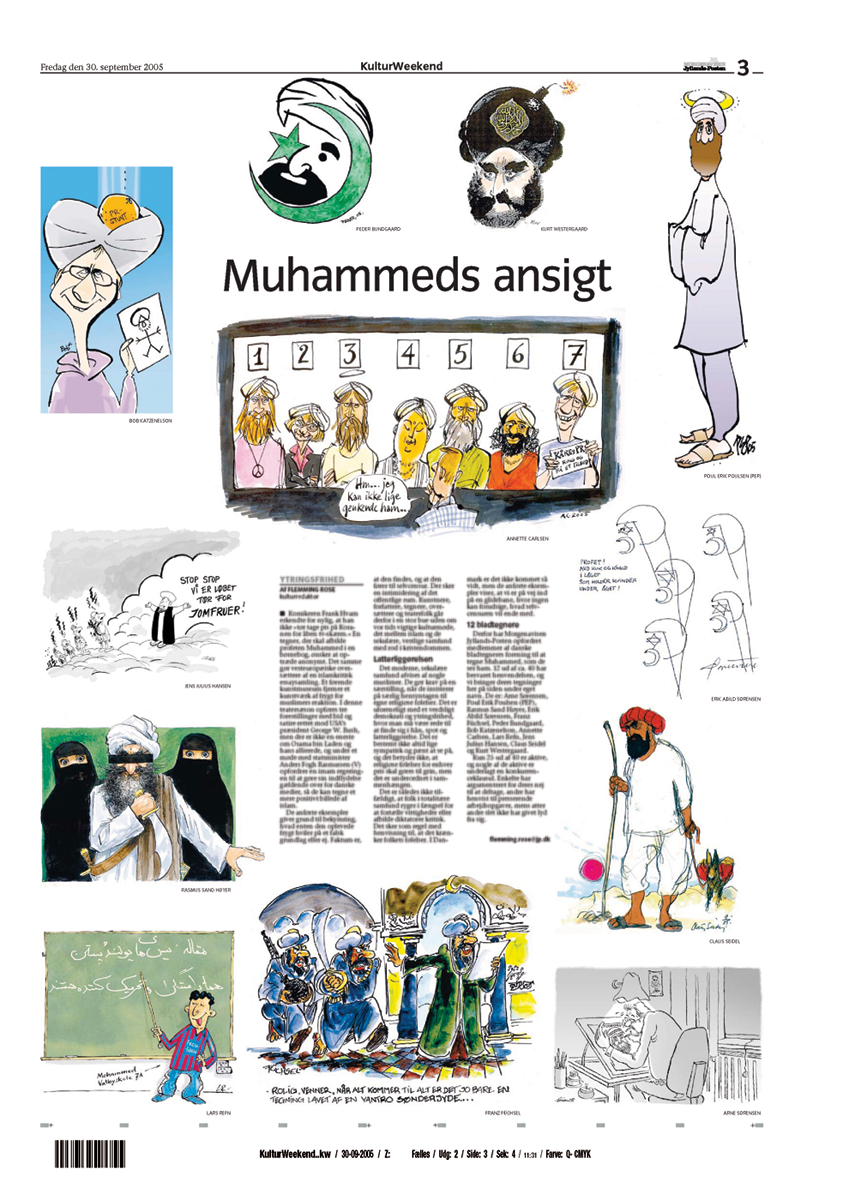
The Jyllands-Posten Muhammad cartoons controversy began after 12 editorial cartoons, most of which depicted the Islamic prophet Muhammad, were published in the Danish newspaper ‘Jyllands-Posten’ in 2005. The newspaper announced that this publication was an attempt to contribute to the debate regarding criticism of Islam and self-censorship. Danish Muslim organizations responded by holding public protests. The cartoons were reprinted in newspapers in more than 50 other countries, expanding the controversy.
Critics of the cartoons described them as Islamophobic or racist, and argued that they are blasphemous to people of the Muslim faith, are intended to humiliate a Danish minority, or are a manifestation of ignorance about the history of Western imperialism. Supporters have said that the cartoons illustrated an important issue in a period of Islamic terrorism and that their publication is a legitimate exercise of the right of free speech, explicitly tied to the issue of self-censorship.
Posted in Philosophy, Politics, World |
Leave a Comment »
March 10, 2011

Otaku is a Japanese term used to refer to people with obsessive interests, particularly anime (animation) and manga (graphic novels). The term is derived from a Japanese word for another’s house or family. It appears to have been coined by the humorist and essayist Akio Nakamori in 1983. Common uses are anime otaku, manga otaku, pasokon otaku (personal computers enthusiasts), gēmu otaku (video game players), and wota otaku (extreme fans of idols, heavily promoted singing girls). There are also tetsudō otaku or denshamania (railfans) or gunji otaku (military geeks).
While these are the most common uses, the word can be applied to anything (music otaku, martial arts otaku, cooking otaku, etc.). Some of Japan’s otaku use the term to describe themselves and their friends semi-humorously, accepting their position as fans, and some even use the term proudly, attempting to reclaim it from its negative connotations. In general colloquial usage however, most Japanese would consider it undesirable to be described in a serious fashion as ‘otaku’; many even consider it to be an offensive term.
Posted in Art, Language, World |
Leave a Comment »
March 10, 2011
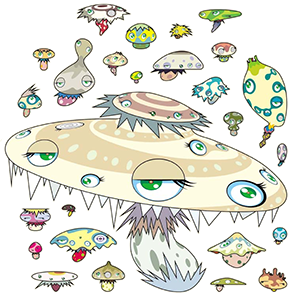
Takashi Murakami is a prolific contemporary Japanese artist who works in both fine arts media—such as painting—as well as digital and commercial media. He blurs the boundaries between high and low art by appropriating popular themes from mass media and pop culture, and turning them into thirty-foot sculptures, ‘Superflat’ paintings, or marketable commercial goods such as figurines or phone caddies.
read more »
Posted in Art, Money, World |
Leave a Comment »
March 10, 2011

Ah Beng is a stereotype applied to a certain group of young Chinese men in Southeast Asia, particularly Singapore and Malaysia. The stereotypical view of an Ah Beng is a young Chinese man or teenager who lacks cultural refinement or indulges in criminal activity or is involved in brawls or arguments out of disagreements with other people. Ah Bengs are also sometimes associated with extensively-modified or ‘zhng-ed’ cars, and are stereotypically seen as excessively flashy and show-offish. Ah Bengs are often stereotyped as trying to emulate Japanese street fashion.
In Malaysia, the term ‘Ah Beng’ usually refers to males who have unusual styles and tastes. And the term ‘lala-zai’ refers to males involved in stereotypical gangster activity or fashion such as the dyeing of hair. In Singapore, the term ‘Ah Beng’ is normally used describe gangster wannabes who cannot speak fluent English and have very low education. They commonly speak in Mandarin or Hokkien.
Posted in Language, Money, World |
1 Comment »
March 10, 2011

The story of The Dog in the Manger derives from an old Greek fable: There was a dog lying in a manger who did not eat the grain but who nevertheless prevented the horse from being able to eat anything either. The dog in the manger is a metaphor for those who spitefully prevent others from having something that they themselves have no use for.
Posted in Art, Language, World |
Leave a Comment »
March 10, 2011

Kiasu [kee-ah-soo] (lit: ‘fear of losing’) is a Chinese word describing behavior such as accumulating too much food on one’s plate during a buffet lunch (for fear of there not being enough) or joining a queue many days in advance just to ensure that one successfully gets hold of the limited free tickets to events. This word is so widely used by Singaporeans and Malaysians that it is incorporated into their English vocabulary (in the form of Singlish and Manglish).
It is often used in describing the social attitudes of people, especially about South East Asian society and its values and competitiveness. Kiasu is commonly compared to Kiasi (lit: ‘fear of death’) and both are commonly used to describe optimization behavior. Kiasu-ism means to take extreme measures to achieve success, and Kiasi-ism is doing the same to avoid risk.
Posted in Language, Money, World |
Leave a Comment »
March 10, 2011

The Stolen Generations is a term used to describe the children of Australian Aboriginal and Torres Strait Islander descent who were removed from their families by the Australian Federal and State government agencies and church missions, under acts of their respective parliaments. The removals occurred in the period between approximately 1869 and 1969, although in some places children were still being taken in the 1970s.
The extent of the removal of children, and the reasoning behind their removal, are contested. Documentary evidence, such as newspaper articles and reports to parliamentary committees, suggest a range of rationales. Motivations evident include child protection, beliefs that given their catastrophic population decline after white contact that black people would ‘die out,’ a fear of miscegenation by full blooded aboriginal people.
Posted in Politics, World |
Leave a Comment »
March 9, 2011


The World Federalist Movement (WFM) is a global citizens movement with member and associate organizations around the world. The WFM International Secretariat is based in New York City across from the United Nations headquarters.
Founded in 1947 in Montreux, Switzerland, the Movement brings together organizations and individuals which support the establishment of a global federal system of strengthened and democratized global institutions with plenary constitutional power accountable to the citizens of the world and a division of international authority among separate global agencies.
read more »
Posted in Politics, World |
Leave a Comment »
March 9, 2011

Balkan Beat Box is an Israeli musical group founded by ex-Gogol Bordello member Tamir Muskat, Ori Kaplan of Firewater and Big Lazy, and Tomer Yosef. As a musical project they often cooperate with a host of other musicians both in the studio as well as live.
Co-founders Ori Kaplan and Tamir Muskat both met in Brooklyn, New York as teenagers. Both had grown up with music and Kaplan had been a klezmer clarinetist, while Muskat was a drummer in a punk band. They began playing together and had trouble finding a style that they felt represented themselves, so they decided to create one. They established their own unique sound by fusing the musical styles of Mediterranean and Balkan traditions with hip-hop and dancehall beats.
Posted in Art, World |
Leave a Comment »
March 8, 2011

Kwaito is a music genre that emerged in Johannesburg, South Africa, during the late 1990s. It is house music combined with local African sounds. Typically at a slower tempo, Kwaito often contains catchy melodic and percussive loop samples, deep bass lines, and vocals. Although bearing similarities to hip hop music, a distinctive feature of Kwaito is the manner in which the lyrics are often shouted, ‘blabbered,’ and chanted. American music producer, Diplo described Kwaito as ‘slowed-down garage music,’ popular among the black youth of South Africa.
The word kwaito riginates from the Afrikaans word kwaai, which traditionally means strict or angry, although in its more common and contemporary use, the word is a translation of the loose English term ‘cool.’ Despite the fact that the Afrikaans language is associated with the apartheid regime and racial oppression, Afrikaans words are often drawn into the indigenous vocabulary, typically reshaped and used in a related or new context.
Posted in Art, World |
Leave a Comment »




 The Daily Omnivore