February 27, 2011

Wabi-sabi represents a comprehensive Japanese world view or aesthetic centered on the acceptance of transience. The aesthetic is sometimes described as one of beauty that is ‘imperfect, impermanent and incomplete.’ It is a concept derived from the Buddhist assertion of the Three marks of existence (impermanence, suffering, and non-self).
Characteristics of the wabi-sabi aesthetic include asymmetry, asperity, simplicity, economy, austerity, modesty, intimacy and appreciation of the ingenuous integrity of natural objects and processes.
read more »
Posted in Art, Philosophy, World |
Leave a Comment »
February 27, 2011

Mono no aware (literally ‘the pathos of things’), also translated as ‘an empathy toward things,’ or ‘a sensitivity of ephemera,’ is a Japanese term used to describe the awareness of ‘mujo’ or the transience of things and a gentle sadness (or wistfulness) at their passing. The term was coined in the eighteenth century by the Edo period Japanese cultural scholar Motoori Norinaga, and was originally a concept used in his literary criticism of ‘The Tale of Genji,’ and later applied to other seminal Japanese works including the ‘Man’yōshū,’ becoming central to his philosophy of literature, and eventually to Japanese cultural tradition.
The word is derived from the Japanese word ‘mono’ (lit. ‘things’) and ‘aware,’ which was a Heian period expression of measured surprise (similar to ‘ah’ or ‘oh’), translating roughly as ‘pathos,’ ‘poignancy,’ ‘deep feeling,’ or ‘sensitivity.’ Thus, mono no aware has frequently been translated as “the ‘ahh-ness’ of things,” life and love. The quintessentially ‘Japanese’ director Yasujiro Ozu was well known for creating a sense of mono no aware, frequently climaxing with a character saying a very understated ‘ii tenki desu ne’ (‘It is fine weather, isn’t it?’), after both a familial and societal paradigm shift, such as daughter being married off, against the backdrop of a swiftly changing Japan.
Posted in Art, Language, World |
Leave a Comment »
February 27, 2011

Saudade is a Portuguese word difficult to translate adequately, which describes a deep emotional state of nostalgic longing for something or someone that one was fond of and which is lost. It often carries a fatalist tone and a repressed knowledge that the object of longing might really never return. Saudade has been described as a ‘vague and constant desire for something that does not and probably cannot exist … a turning towards the past or towards the future.’ A stronger form of saudade may be felt towards people and things whose whereabouts are unknown, such as a lost lover, or a family member who has gone missing.
It may also be translated as a deep longing or yearning for something which does not exist or is unattainable. Saudade was once described as ‘the love that remains’ or ‘the love that stays’ after someone is gone. Saudade is the recollection of feelings, experiences, places or events that once brought excitement, pleasure, well-being, which now triggers the senses and makes one live again.
Posted in Art, Language, World |
Leave a Comment »
February 27, 2011

Sehnsucht is a German noun translated as ‘longing,’ ‘yearning’ and ‘craving,’ or in a wider sense a type of ‘intensely missing.’ The word is almost impossible to translate adequately and describes a deep emotional state. Its meaning is somewhat similar to the Portuguese word, ‘saudade.’ The stage director and author Georg Tabori called Sehnsucht one of those quasi-mystical terms in German for which there is no satisfactory corresponding term in another language.
The term is a compound word, originating from an ardent longing or yearning (‘das Sehnen’) and addiction (‘die Sucht’). However, these words do not adequately encapsulate the full meaning of their resulting compound, even when considered together.
read more »
Posted in Language, Philosophy, World |
Leave a Comment »
February 27, 2011

Persepolis is a French-language autobiographical comic by Marjane Satrapi depicting her childhood up to her early adult years in Iran during and after the Islamic revolution. The title is a reference to the ancient capital of the Persian Empire, Persepolis. Drawn in black and white, the graphic novel found great popularity following its release, and was translated into several languages. The English edition combines the first two French books and was translated by Blake Ferris and Satrapi’s husband, Mattias Ripa.
In 2007, an animated film adaptation of the graphic novel was created, with author Satrapi co-directing with French comic artist Vincent Paronnaud. The film utilized the same style of the graphic novel, although there are a handful of scenes in the present day that are shown in color, while the rest of the flashback events are illustrated in black and white, as in the novel.
Posted in Art, Politics, World |
Leave a Comment »
February 27, 2011

A third-culture kid (TCK) is someone who, as a child, has spent a significant period of time in one or more culture(s) other than his or her own, thus integrating elements of those cultures and their own birth culture, into a third culture. TCKs tend to have more in common with one another, regardless of nationality, than they do with non-TCKs from their passport country. TCKs are often multilingual and highly accepting of other cultures. Although moving between countries may become an easy thing for some TCKs, after a childhood spent in other cultures, adjusting to their passport country often takes years.
Before World War II, 66% of TCKs came from missionary families, and 16% came from business families. After World War II, with the increase of international business and the rise of two international superpowers, the composition of international families changed. Sponsors are generally broken down into five categories: missionary (17%), business (16%), government (23%), military (30%), and “other” (14%). Some TCK families migrate for work independently of any organization based in their country of origin.
Posted in Language, Politics, World |
Leave a Comment »
February 27, 2011

Maoz is a chain of falafel fast food restaurants, serving purely vegetarian fare and promoting the ‘vegetarian lifestyle.’ The chain was founded by a husband and wife, Nahman Milo and Sima Bar-On, Israelis, who were living in Amsterdam. The first restaurant opened in 1991, and the first store outside The Netherlands opened in 1996. There are now 22 franchises globally, located in the Netherlands, The United States, France, Spain, the United Kingdom, Australia, and India.
Originally, restaurants offered only falafel, but the menu in some locations has since been expanded to include other vegetarian items, such as pommes frites (Belgian-style french fries). Muma Vegetarian is a copycat restaurant in Los Angeles.
Posted in Food, Money, World |
Leave a Comment »
February 24, 2011
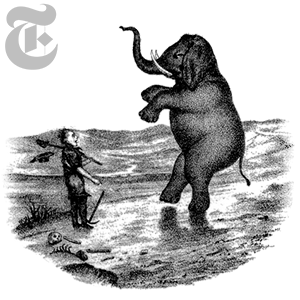
The phrase ‘seeing the elephant‘ is an Americanism of the mid to late 19th century. Those planning to travel west announced they were ‘going to see the elephant.’ Those turning back claimed they had seen the ‘elephant’s tracks’ or the ‘elephant’s tail,’ and confessed they’d seen more than enough of the animal. The expression is said to arise from a tale current when circus parades first featured elephants. A farmer, so the story went, hearing that a circus was in town, loaded his wagon with vegetables for the market there. He had never seen an elephant and very much wished to. On the way to town he encountered the circus parade, led by an elephant. The farmer was thrilled. His horses, however, were terrified.
Bolting, they overturned the wagon and ruined the vegetables. ‘I don’t give a hang,’ the farmer said, ‘for I have seen the elephant.’ The elephant symbolized both the high cost of their endeavor — the myriad possibilities for misfortune on the journey or in California — and, like the farmer’s circus elephant, an exotic sight, and unequaled experience, the adventure of a lifetime. As early as the 1590s, the English used the idiom to ‘see the lions.’ This referred to the Tower of London which is thought to have been one of the world’s oldest zoos. Travelers and visitors were hopeful for a glimpse of the animals, especially the lion which was the living emblem of the king.
Posted in Language, World |
Leave a Comment »
February 23, 2011

Britpop is a subgenre of alternative rock that that grew out of the British independent music scene of the early 1990s and was characterized by bands influenced by British guitar pop music of the 1960s and 1970s. The movement developed as a reaction against various musical and cultural trends in the late 1980s and early 1990s, particularly the grunge phenomenon from the United States. In the wake of the musical invasion into the UK of American grunge bands, new British groups such as Suede and Blur launched the movement by positioning themselves as opposing musical forces, referencing British guitar music of the past and writing about uniquely British topics and concerns.
These bands were soon joined by others including Oasis, Pulp, Supergrass, Sleeper and Elastica. Britpop groups brought British alternative rock into the mainstream and formed the backbone of a larger British cultural movement called ‘Cool Britannia.’ Although its more popular bands were able to spread their commercial success overseas, especially to the United States, the movement largely fell apart by the end of the decade.
Posted in Art, Language, World |
Leave a Comment »
February 23, 2011

Cool Britannia is a media term that was used during the mid-to-late 20th century to describe the contemporary culture of the United Kingdom. The term was prevalent during the 1990s and later became closely associated with the early years of ‘New Labour’ under Tony Blair. It is a pun on the title of the British patriotic song ‘Rule, Britannia!’
The phrase ‘Cool Britannia’ was first used in 1967 as a song title by the Bonzo Dog Doo Dah Band. The phrase reappeared in the mid-1990s as a registered trade mark for one of Ben & Jerry’s ice-creams (vanilla with strawberries and chocolate-covered shortbread). The ice cream name and recipe was coined in early 1996 by an American lawyer living in London, Sarah Moynihan-Williams, as a winning entry in a Ben and Jerry’s ice cream competition. The phrase was quickly adopted in the media and in advertising.
Posted in Art, World |
Leave a Comment »
February 22, 2011

Lake Vostok is the largest of more than 140 subglacial lakes found under the surface of Antarctica. The overlying ice provides a continuous paleo-climatic record of 400,000 years, and the lake water itself has been isolated for 15 million years. The lake is named after the ship of Fabian von Bellingshausen, an Antarctic pioneer. There is presently underway a scientific effort to reach the lake by drill. The lake is under complete darkness and expected to be rich in oxygen, so there is speculation that any organisms inhabiting the lake could have evolved in a manner unique to this environment. These adaptations to an oxygen-rich environment might include high concentrations of protective oxidative enzymes.
Living Hydrogenophilus thermoluteolus microorganisms have been found in Lake Vostok’s deep ice core drillings, an extant surface dwelling species. This suggests the presence of a deep biosphere utilizing a geothermal system of the bedrock encircling the subglacial lake. There is optimism that microbial life in the lake may be possible despite high pressure, constant cold, low nutrient input, potentially high oxygen concentration and an absence of sunlight. Due to the lake’s similarity to the Jupiter moon Europa and Saturn’s moon Enceladus, any confirmation of life living in Lake Vostok would strengthen the prospect for the possible presence of life on Europa or Enceladus.
Posted in Science, World |
Leave a Comment »
February 17, 2011
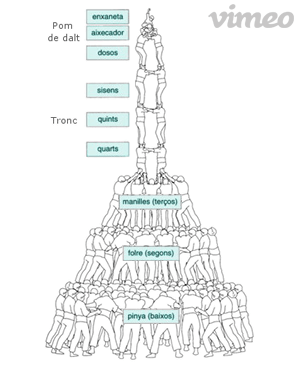
A castell is a human tower built traditionally in festivals at many locations within Catalonia, Spain. At these festivals, several ‘colles castelleres’ or teams often succeed in building and dismantling a tower’s structure.
The tradition of building castells originated in Valls, near the city of Tarragona, in the southern part of Catalonia towards the end of the 18th century. Later it developed a following in other regions of Catalonia and, since 1981, when the first castell of 9 levels of the 20th century was built.
Posted in Games, Humor, World |
Leave a Comment »




 The Daily Omnivore