December 19, 2010

Captain Harlock is a fictional character created by manga artist Leiji Matsumoto. Harlock is the archetypical romantic hero, a space pirate with an individualist philosophy of life. He is as noble as he is taciturn and rebellious; he stoically fights against totalitarian regimes, whether they be earthborn or alien.
The character was introduced in Adventures of a Honeybee (1953), but did not debut as a lead character until 1978’s Space Pirate Captain Harlock. Since then, he has appeared in numerous animated TV series and films, the latest of which re-imagines him as an Iron Cross fighter pilot and a gunslinger in the American Old West.
Posted in Art, World |
Leave a Comment »
December 19, 2010

‘Interstella 5555: The 5tory of the 5ecret 5tar 5ystem’ is a 2003 feature-length Japanese animated musical film set to French duo, Daft Punk’s second studio album, ‘Discovery.’ The film depicts the abduction and rescue of an interstellar pop band. The film was produced by Daft Punk and Toei Animation, under the supervision of famed managa and anime artist, Leiji Matsumoto. The film has no dialogue and minimal sound effects. Daft Punk’s concept for the project involved the merging of science fiction with entertainment industry culture and was further developed with their collaborator Cédric Hervet.
All three brought the album and the completed story to Tokyo in the hope of creating the film with their childhood hero, Leiji Matsumoto. Many elements common to Matsumoto’s stories, such as a romanticism of noble sacrifice and remembrance of fallen friends, appear in ‘Interstella 5555.’ Daft Punk revealed in an interview that ‘Captain Harlock’ was a great influence on them in their childhood. They also stated, ‘The music we have been making must have been influenced at some point by the shows we were watching when we were little kids.’
Posted in Art, World |
Leave a Comment »
December 19, 2010

ALDI, short for ‘Albrecht Discount,’ is a discount supermarket chain based in Germany founded by brothers Karl Albrecht and Theo Albrecht in 1913. Karl has since retired and is Germany’s richest man. Theo was Germany’s second richest man until his death in July 2010. The Aldi group operates about 8,210 individual stores worldwide. A new store opens every week in Britain alone.
Originally Aldi stores were ridiculed as being cheap shops selling low-quality goods, and that Aldi’s customers were mostly people who could not afford to shop elsewhere. Gradually many German consumers discovered that the poor reputation of Aldi’s products was either undeserved or economically justifiable. This shift in public perception was boosted by actions like a series of cookbooks that only used Aldi ingredients, which led to the emergence of a kind of Aldi fandom into parts of the German mainstream.
Posted in Food, Money, World |
Leave a Comment »
December 15, 2010
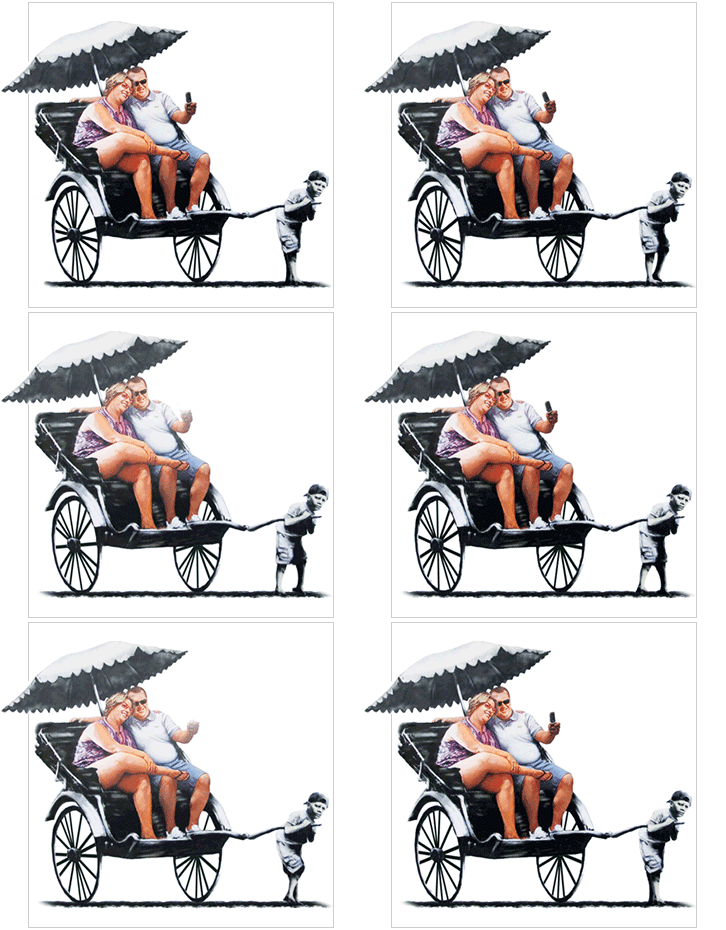
The Gini coefficient is a measure of statistical dispersion developed by the Italian statistician Corrado Gini in 1912. It has found application in the study of inequalities in disciplines as diverse as economics, health science, ecology, chemistry and engineering. It is commonly used as a measure of inequality of income or wealth. Worldwide, on a scale of 0 (total equality) to 1 (total inequality) Gini coefficients for income range from approximately 0.23 (Sweden) to 0.70 (Namibia) although not every country has been assessed.
Posted in Politics, Science, World |
Leave a Comment »
December 14, 2010

Vestas Wind Systems is a Danish manufacturer, seller, installer, and servicer of wind turbines. It is the largest in the world, but due to very rapid growth of its competitors – GE (US), Sinovel (China), Enercom (Germany), and Gamesa (Spain) – its market share decreased from 28% in 2007 to 12.5% in 2009. Vestas has installed over 41,000 wind turbines in 63 countries on five continents. The company employs more than 22,000 people globally, and has built production facilities in more than 12 countries.
Vestas spent €92 million ($128 million), or 1.4% of revenue, on research and development in 2009. It has filed 787 wind turbine patents (165 in 2009) according to United Kingdom Intellectual Property Office (UK-IPO), while General Electric has 666 and Siemens Wind Power has 242. In October 2009, Vestas and QinetiQ claimed a successful test of a stealth wind turbine blade mitigating radar reflection problems for aviation.
Posted in Money, Technology, World |
Leave a Comment »
December 14, 2010

Parasite single is a Japanese term for a single person who lives with their parents until their late twenties or early thirties in order to enjoy a carefree and comfortable life. In English, the expression ‘sponge’ or ‘basement dweller’ may sometimes be used. The expression is mainly used in reference to Japanese society, but similar phenomena can also be found in other countries worldwide.
In Italy, 30-something singles still relying on their mothers are derided as ‘bamboccioni’ (literally, big babies) and in Germany they are known as Nesthocker (German for nestling), who are still living at ‘Hotel Mama.’ In the U.K. they are referred to by the acronym NEET (not in employment, education, or training). The expression was first used by Professor Masahiro Yamada of Tokyo Gakugei University in 1999. The catchy phrase quickly found its way into the media and is now a well-known expression in Japan.
Posted in Language, Money, World |
Leave a Comment »
December 14, 2010

Simo Häyhä (1905 – 2002), nicknamed ‘White Death‘ by the Soviet Red Army, was a Finnish sniper. Using a modified Mosin-Nagant rifle in the Winter War of 1939 he tallied 505 confirmed kills, the most in any major war. Häyhä, born near the present-day border of Finland and Russia, was a farmer before entering combat. He joined the Finnish militia at 17, and his farmhouse was reportedly full of trophies for marksmanship.
read more »
Posted in Death, War, World |
Leave a Comment »
December 13, 2010

Lagom is a Swedish word with no direct English equivalent, meaning ‘just the right amount.’ It is also widely translated as ‘in moderation,’ ‘in balance,’ ‘optimal,’ ‘suitable,’ and ‘average.’ But whereas words like ‘sufficient’ and ‘average’ suggest some degree of abstinence, scarcity, or failure, lagom carries the connotation appropriateness although not necessarily perfection. The archetypical Swedish proverb ‘Lagom är bäst,’ literally ‘The right amount is best,’ is translated as ‘Enough is as good as a feast.’ The concept of lagom is similar to that of the Middle Path in Eastern philosophy, and Aristotle’s ‘golden mean’ of moderation in Western philosophy.
The value of ‘just enough’ can be compared to idiom ‘ess is more,’ or contrasted to the value of ‘more is better.’ It is viewed favorably as a sustainable alternative to the hoarding extremes of consumerism. It can also be viewed as repressive: ‘You’re not supposed to be too good, or too rich.’ In a single word, lagom is said to describe the basis of the Swedish national psyche, one of consensus and equality. In recent times Sweden has developed greater tolerance for risk and failure as a result of severe recession in the early 1990s. Nonetheless, it is still widely considered ideal to be modest and avoid extremes.
Posted in Language, Philosophy, World |
Leave a Comment »
December 13, 2010

Paris syndrome is a transient psychological disorder encountered by some people visiting or vacationing in Paris. It is characterized by acute delusional states, hallucinations, feelings of persecution (delusions of being a victim of prejudice, aggression, or hostility from others), derealization, depersonalization, anxiety, and also psychosomatic manifestations such as dizziness, tachycardia, sweating, etc. Japanese visitors are observed to be especially susceptible, and around twenty Japanese tourists a year are affected. It was first noted in Nervure, the French journal of psychiatry in 2004.
Posted in Health, Science, World |
Leave a Comment »
December 13, 2010

The Tata Nano is a low-cost, rear-engined, four-passenger city car built by the Indian company Tata Motors, which began selling its ‘one-lakh’ (100,000 Rupees or $2,200) car in 2009. The price has risen somewhat since its introduction due to increasing materials costs. It features a 623cc, 2 cylinder engine with a top speed of 43 mph. It is an example of ‘Gandhian engineering,’ a concept involving deep frugality and a willingness to challenge conventional wisdom.
The Nano’s design implements many cost-reducing innovations: the trunk is only accessible from inside the car, as the rear hatch does not open; one windscreen wiper instead of the usual pair; no power steering, unnecessary due to its light weight; three lug nuts on the wheels instead of the usual four; only one side-view mirror; no radio, no air-conditioning, and no airbags.
Posted in Money, Technology, World |
Leave a Comment »
December 10, 2010

American fried rice (khao phat Amerikan) is a Thai fried rice dish with ‘American’ side ingredients like fried chicken, ham, hot dogs, raisins, ketchup, and croutons. It was invented during the Vietnam War era to serve to United States Marine Corps and United States Air Force personnel stationed in Thailand. The Malaysian equivalent of American fried rice, called Nasi Goreng USA, is made with many of the same ingredients; however, no pork products are used, and customers are given the choice of ketchup or chili sauce.
Posted in Food, World |
Leave a Comment »
December 10, 2010

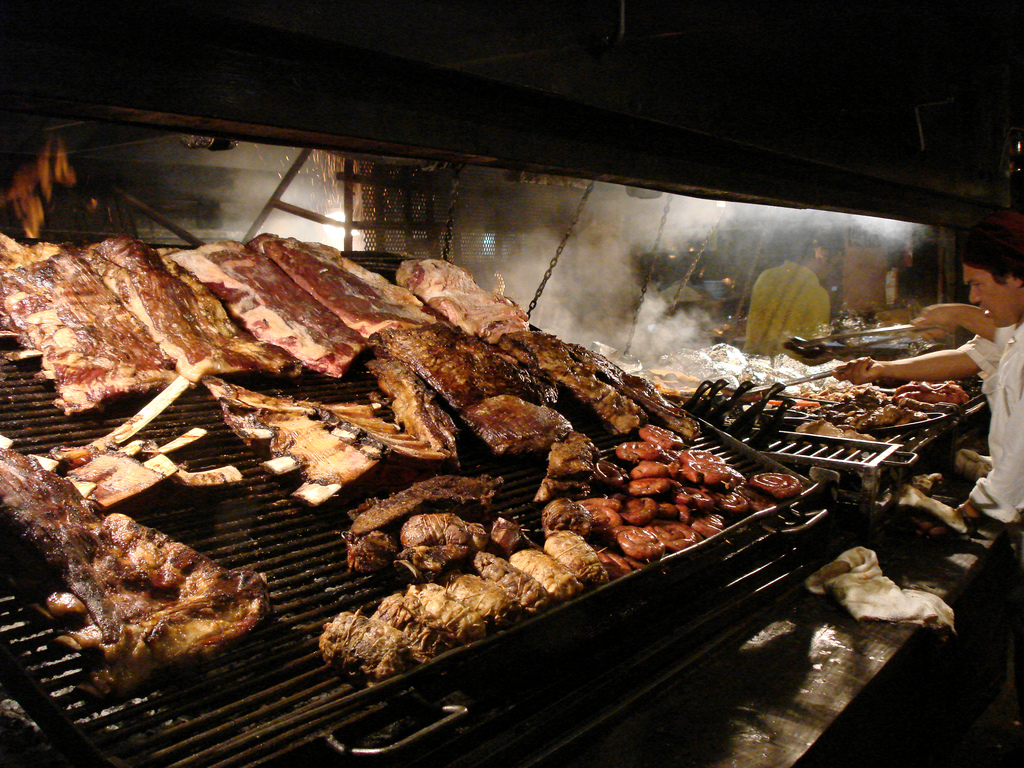
Asado [ah-sahdo] is a technique for cooking meat on a grill (parrilla) or open fire. It is considered the traditional dish of Argentina, Uruguay, Paraguay, and Chile. In southern Brazil it’s called ‘churrasco.’ An asado typically has a sequence: First are the chorizos, morcillas (black pudding), chinchulines (chitterlings), mollejas (sweetbread) and other organs, often accompanied by provoleta, a grilled cheese dish. Organs are sometimes these are served on a coal-heated brasero. Then costillas or asado de tira (ribs) are served. Finally, vacío (flank steak), matambre and possibly chicken and chivito (baby goat). Dishes such as the Uruguayan Pamplona, pork and Patagonian lamb are becoming more frequent, particularly in restaurants.
An asado also includes bread, a simple mixed salad of, for instance, lettuce, tomato and onions, or it could be accompanied with verdurajo (grilled vegetables), a mixture made of potatoes, corn, onion and eggplant cooked on the parrilla and seasoned with olive oil and salt. The meat for an asado is not marinated, the only preparation being the application of salt before and/or during the cooking period. Chimichurri, a sauce of chopped parsley, dried oregano, garlic, salt, pepper, onion, and paprika with olive oil, and salsa criolla, a sauce of tomato and onion in vinegar, are common accompaniments to an asado, where they are traditionally used on the offal, but not the steaks.
Posted in Food, World |
Leave a Comment »


 The Daily Omnivore