December 8, 2010
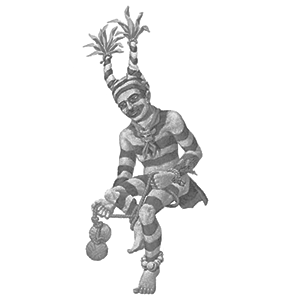
Clown society is a term used in anthropology and sociology for an organization of comedic entertainers (or ‘clowns’) who have a formalized role in a culture or society. Sometimes clown societies have a sacred role, to represent a trickster character in religious ceremonies. Other times the purpose served by members of a clown society is only to parody excessive seriousness, or to deflate pomposity. A clown shows what is wrong with the ordinary way of doing things, and a clown shows how to do ordinary things the wrong way.
Members of a clown society always dress in some kind of a special costume reserved for clowns, which is usually an absurdly extreme form of normal dress. While in their costume, clowns have special permission from their society to parody or criticize defective aspects of their own culture. Clown societies usually train new members to become clowns in an apprentice system. Sometimes the training is improvisational comedy, but usually a clown society trains members in well known forms of costume, pantomime, song, dance, and common visual gags
Posted in Humor, Philosophy, World |
Leave a Comment »
December 8, 2010

Bisha’a (‘trial by fire’) is a ritual practiced today by some Bedouin tribes for the purpose of lie detection. It is the best-known of various forms of trial by ordeal which are practiced by the Bedouin, but is increasingly uncommon, with more and more Bedouins preferring standard courts of law for enactment of justice. The basic ritual consists of the accused being asked to lick a hot metal object thrice. He is provided with water for rinsing after the ceremony. He is then inspected by the official who presides over the ceremony, the Mubesha, and by the designated witnesses of the ritual.
read more »
Posted in Language, Philosophy, World |
Leave a Comment »
December 4, 2010

The Scramble for Africa, also known as the Race for Africa or African fever, was a process of invasion, attack, occupation, and annexation of African territory by European powers during the New Imperialism period, between 1881 and World War I in 1914. As a result of the heightened tension between European states in the last quarter of the 19th century, the partitioning of Africa may be seen as a way for the Europeans to eliminate the threat of a Europe-wide war over Africa.
Popular European ideas in the 19th century also aided the partitioning of Africa. The eugenics movement and racism helped to foster European expansionist policy. The last 20 years of the nineteenth century saw transition from ‘informal imperialism’ of control through military influence and economic dominance to that of direct rule. Many African polities, states and rulers (such as the Ashanti, the Abyssinians, the Moroccans and the Dervishes) sought to resist this wave of European aggression.
Posted in Politics, War, World |
Leave a Comment »
December 4, 2010
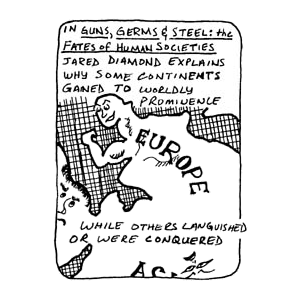
‘Guns, Germs, and Steel: The Fates of Human Societies’ is a 1997 book by Jared Diamond, professor of geography and physiology at UCLA. The book’s title is a reference to the means by which European nations conquered populations of other areas and maintained their dominance, despite often being vastly outnumbered – superior weapons provided immediate military superiority (guns); Eurasian diseases weakened and reduced local populations, making it easier to maintain control over them (germs) and centralized government promoted nationalism and powerful military organizations (steel).
The book attempts to explain why Eurasian civilizations (including North Africa) have survived and conquered others, while attempting to refute the belief that Eurasian hegemony is due to genetic superiority. Diamond argues that the gaps in power and technology between human societies originate in environmental differences, which are amplified by various positive feedback loops. When cultural or genetic differences have favored Eurasians (for example Chinese centralized government, or improved disease resistance among Eurasians), these advantages were only created due to the influence of geography and were not inherent in the Eurasian genomes.
Posted in Science, War, World |
Leave a Comment »
December 1, 2010

The Pickelhaube (from the old German pickel, ‘point’ or ‘pickaxe;’ and haube, ‘bonnet’) was a spiked helmet worn in the 19th and 20th centuries by German military, firefighters, and police. Although typically associated with the Prussian army, the helmet enjoyed wide use among uniformed occupations in the Western world. It was originally designed in 1842 by King Frederick William IV of Prussia, maybe as a copy of similar helmets that were adopted at the same time by the Russian military.It is not clear whether this was a case of imitation, or parallel invention.
Posted in Art, War, World |
Leave a Comment »
December 1, 2010

The pith helmet (also known as the safari helmet, sun helmet, topee, sola topee, salacot or topi) is a lightweight cloth-covered helmet made of cork or pith (typically pith from the sola Indian swamp growth). Designed to shade the wearer’s head and face from the sun, pith helmets were once often worn by Westerners in the tropics.
Crude forms of pith helmets had existed as early as the 1840s, but it was around 1870 that the pith helmet became popular with military personnel in Europe’s tropical colonies. The Franco-Prussian War had popularized the German Pickelhaube, which may have influenced the distinctive design of the pith helmet. Such developments may have merged with a traditional design from the Philippines, the salakot. The alternative name salacot (also written salakhoff) appears frequently in Spanish and French sources; it comes from the Tagalog word salacsac (or Salaksak).
Posted in Art, War, World |
1 Comment »
December 1, 2010

The Lençóis Maranhenses National Park is located on the coast of northeastern Brazil; it is an area of low, flat, occasionally flooded land, overlaid with large, discrete sand dunes. It encompasses roughly 1000 square kilometers, and despite abundant rain, supports almost no vegetation. The park was created on June 2, 1981. The National Park is quite extensive and has no access roads. Because of the nature of the park’s protected status, most vehicles are not permitted access. Entrance to the park is made exclusively by 4-wheel drive trucks.
Lying just outside the Amazon basin, the region is subject to a regular rain season during the beginning of the year. The rains cause a peculiar phenomenon: fresh water collects in the valleys between sand dunes, spotting the desert with blue and green lagoons that reach their fullest between July and September. The area is also home to a variety of fish which, despite the almost complete disappearance of the lagoons during the dry season, have their eggs brought from the sea by birds.
Posted in Science, World |
Leave a Comment »
November 30, 2010

Bacha Bazi (literally ‘playing with children’), also known as bacchá, is a practice recognized as sexual slavery and child prostitution in which prepubescent and adolescent boys are dressed as girls and sold to wealthy or powerful men for entertainment and sexual activities.
This business thrives in southern Afghanistan, where many men keep them as status symbols. The bacchá tradition, historically more common, waned after World War I, was forced out by Victorian era prudery and colonial powers. The reverse of bacha bazi is bacha posh, where girls are dressed up as boys.
Posted in Politics, Sex, World |
Leave a Comment »
November 30, 2010

Bacha posh is a cultural practice in areas of Afghanistan where a family in which there are no sons may have a girl dress in characteristic male clothing and have her hair cut short, occupying an intermediate status in which she is treated as neither a daughter nor fully as a son. In Afghan culture, pressure exists to have a son to carry on the family name and to inherit his father’s property. In the absence of a son, families may dress one of their daughters as a male, with some holding the superstition that having a bacha posh will make it more likely for a woman to give birth to a son in a subsequent pregnancy.
As a bacha posh, a girl is more readily able to attend school, escort her sisters in public places and find work, in addition to helping overcome the shame that a family experiences at not having any male children. The girl’s status as a bacha posh usually ends when she enters puberty. Women raised as a bacha posh often have difficulty making the transition from life as a boy and adapting to the traditional constraints placed on women in Afghan society. The reverse of bacha posh is bacha bazi, where boys are dressed up as girls.
Posted in Politics, Sex, World |
Leave a Comment »
November 23, 2010

Mother Hero was an honorary title in the Soviet Union awarded to all mothers bearing and raising 10 or more children. It was awarded upon the first birthday of the last child, provided that nine other children (natural or adopted) remained alive. Children who had perished under heroic, military or other respectful circumstances, including occupational diseases, were also counted.
Mother Heroes were entitled to wear a badge, which was a gold star with silver straight rays between the arms; it was suspended on a metal, red-enameled ‘ribbon’ bearing the words ‘Мать-героиня.’ They were also entitled to a number of privileges in terms of retirement pension, the payment of public utility charges, and the supply of food and other goods. Around 430,000 women were awarded this title during its existence. The only man to be awarded the title was Veniamin Petrovich Makarov from Orenburg, who raised 12 adopted boys.
Posted in Politics, Sex, World |
Leave a Comment »
November 22, 2010

Ka’ak is the Arabic word for ‘cake,’ and can refer to several different types of baked goods produced throughout the Arab world and the Near East. A common type of ka’ak is a bread consumed throughout the Near East that is made in a large ring-shape and is covered with sesame seeds. Fermented chickpeas (known as hummus in Arabic and Hebrew) are used as a leavening agent. Widely sold by street vendors, it is usually eaten as a snack or for breakfast with za’atar. In East Jerusalem, it’s sometimes served alongside oven-baked eggs and falafel. Palestinians consider Jerusalem ka’ak to be a unique specialty good, and those from the city or visiting there often buy several loaves to give as gifts.
In Lebanon, ka’ak bread rings are made of sweet dough rolled into ropes and formed into rings and topped with sesame seeds. Instead of za’atar, after baking, it is glazed with milk and sugar and then dried. Tunisian Jews also make a slightly sweet-and-salty version of the pastry, but don’t use a yeast-based dough. In Egypt, usually at wedding parties, a variation made with almonds, known as kahk bi loz, is served.
Posted in Food, World |
Leave a Comment »
November 22, 2010
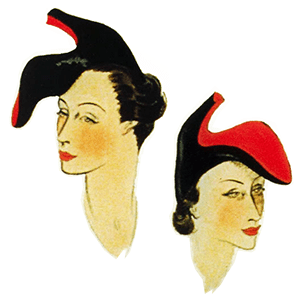
Elsa Schiaparelli [skap-uh-rel-ee] (1890 — 1973) was an Italian fashion designer. Along with Coco Chanel, her greatest rival, she is regarded as one of the most prominent figures in fashion in the early 20th century. Starting with knitwear, Schiaparelli’s designs were heavily influenced by surrealists like her collaborators Salvador Dalí and Alberto Giacometti. Her clients included the heiress Daisy Fellowes and actress Mae West. Schiaparelli did not adapt to the changes in fashion following World War II and her business closed in 1954.
read more »
Posted in Art, Money, World |
Leave a Comment »




 The Daily Omnivore