September 20, 2010

Fabric is a nightclub in London by Keith Reilly and Cameron Leslie that opened on 29 October 1999. Fabric has three separate rooms (two of which feature stages for live acts) with independent sound systems. A feature of the club is its vibrating floor in Room One: known as a ‘bodysonic’ dancefloor, sections of the floors are attached to 400 bass transducers emitting bass frequencies of the music being played.
The musical genres played there vary. FabricLive is a Friday-night ‘soundclash,’ (music competition) including tempos from hip hop to breakbeat to drum and bass to electro. Fabric’s Saturday nights showcase house and techno. The club has been releasing monthly compilation albums mixed by popular DJs since November 2001. There are two series that alternate months, entitled fabric and FabricLive.
Posted in Art, Money, World |
Leave a Comment »
September 20, 2010

Nacirema [nak-uh-ree-ma] (American backwards) is a tongue-in-cheek reference to the people of the United States. Anthropologists and sociologists use the term to examine (with a degree of anthropological self-distancing) aspects of the behavior and society of American people.
The original use of the term was in ‘Body Ritual Among the Nacirema’, which satirizes anthropological papers on ‘other’ cultures, and the Northern American Culture. Horace Miner wrote the paper and originally published it in the June 1956 edition of American Anthropologist.
Posted in Humor, World |
Leave a Comment »
September 20, 2010

The Kayan are an ethnic minority of Burma. Women of the various Kayan tribes identify themselves by their different form of dress. The Kayan Lahwi tribe are the most renowned as they wear ornaments known as neck rings, brass coils that are placed around the neck. The government of Burma has discouraged this practice in its efforts to modernize and ease some of the cultural restrictions placed upon women. Consequently, many women in Burma began breaking the tradition, though a few older women still wear them and in remote villages some of the younger girls as well. In Thailand, however, the practice has gained popularity in recent years because it draws tourists who bring business to the tribe.
Coils are first applied to young girls when they are around six years old. Each coil is replaced with longer coil, as the weight of the brass pushes the collar bone down and compresses the rib cage. Contrary to popular belief, the neck is not actually lengthened; the illusion of a stretched neck is created by the deformation of the clavicle.
Posted in World |
Leave a Comment »
September 20, 2010

L’esprit de l’escalier (staircase wit) is thinking of a clever remark when it is too late. The German word Treppenwitz and the Yiddish word trepverter are used to express the same idea. This name for the phenomenon comes from French encyclopedist and philosopher Denis Diderot. A remark was made to him at a dinner party which left him speechless at the time because, he explains, ‘a sensitive man like me, overwhelmed by the argument levelled against him, becomes confused and can only think clearly again [when he reaches] the bottom of the stairs.’ The reception room was located on the étage noble, the noble storey, upstairs, so that to have reached the bottom of the stairs means to have definitively left the gathering in question.
Diderot’s fellow-philosophe Jean-Jacques Rousseau also recognised his own affliction with l’esprit de l’escalier, staircase wit. In his autobiographical book Confessions he blamed such social blunders and missed opportunities for turning him into a misanthrope, and reassured himself that he was better at ‘conversations by mail’.
Posted in Language, World |
Leave a Comment »
September 17, 2010


Omertà [aw-mer-tah] is a popular attitude and code of honor, common in areas of southern Italy where criminal organizations like the Mafia, ‘Ndrangheta, and Camorra are strong. A common definition is the ‘code of silence.’ Omertà implies ‘the categorical prohibition of cooperation with state authorities or reliance on its services, even when one has been victim of a crime.’ Even if somebody is convicted for a crime he has not committed, he is supposed to serve the sentence without giving the police any information about the real criminal, even if that criminal has nothing to do with the Mafia himself. Within Mafia culture, breaking omertà is punishable by death.
The code was adopted by Sicilians long before the emergence of Cosa Nostra (some observers date it to the 16th century as a way of opposing Spanish rule). It is also deeply rooted in rural Crete, Greece. The origin of the word is often traced to the Spanish word ‘hombredad,’ meaning manliness, through the Sicilian word ‘omu’ for man. According to a different theory, the word comes from Latin ‘humilitas’ (humility), which became ‘umirtà’ and then finally omertà in some southern Italian dialects.
Posted in Language, World |
Leave a Comment »
September 17, 2010


Gianduja [gee-an-du-ya] is a sweet chocolate analogue containing about 30% hazelnut paste. It was invented in Turin, Italy by choclatier Caffarel in 1852, after taxes on cocoa beans hindered the production of conventional chocolate. It takes its name from a Carnival and marionette character who represents the archetypal Piedmontese, the Italian region where hazelnut confectionery is common. Ferreo Nutella is a giaduja spread first sold in Piedmont in 1963 and now available in over 75 countries.
Pietro Ferrero, who owned a patisserie in Alba, in the Langhe district of Piedmont, an area known for the production of hazelnuts, sold an initial batch of 300 kilograms (660 lb) of ‘Pasta Gianduja’ in 1946. This was originally a solid block, but in 1949, Pietro started to sell a creamy version in 1951 as ‘Supercrema.’ In 1963, Pietro’s son Michele revamped Supercrema with the intention of marketing it across Europe. Its composition was modified and it was renamed ‘Nutella.’ The first jar of Nutella left the Ferrero factory in Alba on 20 April 1964. The product was an instant success and remains widely popular. The estimated Italian production of Nutella averages 179,000 tons per year.
Posted in Food, World |
Leave a Comment »
September 16, 2010
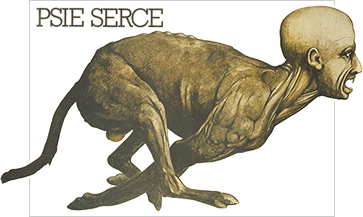
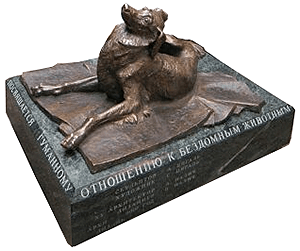
Malchik was a black mongrel stray dog living in Moscow, Russia. For about three years, Malchik lived at the Mendeleyevskaya station on the Moscow Metro. Malchick became a popular station ‘resident’ among rail employees and commuters, and territorially protected the station from drunks and other dogs.
Malchik was killed when a 21-year-old woman Yulia Romanova stabbed him with a kitchen knife. Later it was revealed that Romanova has a long history of cruelty to animals and psychiatric treatment. The incident sparked a wave of public outrage regarding the treatment of animals, and, in 2007, a monument was erected in Malchik’s honor at Mendeleyevskaya station.
Posted in World |
Leave a Comment »
September 16, 2010

Esperanto [es-puh-rahn-toh] is the most widely spoken constructed language. Its name derives from Doktoro Esperanto, the pseudonym under which L. L. Zamenhof published the first book detailing Esperanto, the Unua Libro, in 1887. The word esperanto means ‘one who hopes’ in the language itself. Zamenhof’s goal was to create an easy to learn and politically neutral language that would serve as a universal second language to foster peace and international understanding.
Esperanto has approximately one thousand native speakers, i.e. people who learned Esperanto as one of their native languages from their parents. There is controversy over the number of people who are fluent in Esperanto. Estimates range from 10,000 to as high as two million. The users are spread in about 115 countries. Although no country has adopted the language officially, Esperanto was officially recognized by UNESCO in 1954, and is also the language of instruction in one university, the Akademio Internacia de la Sciencoj in San Marino.
Posted in Language, World |
1 Comment »
September 14, 2010

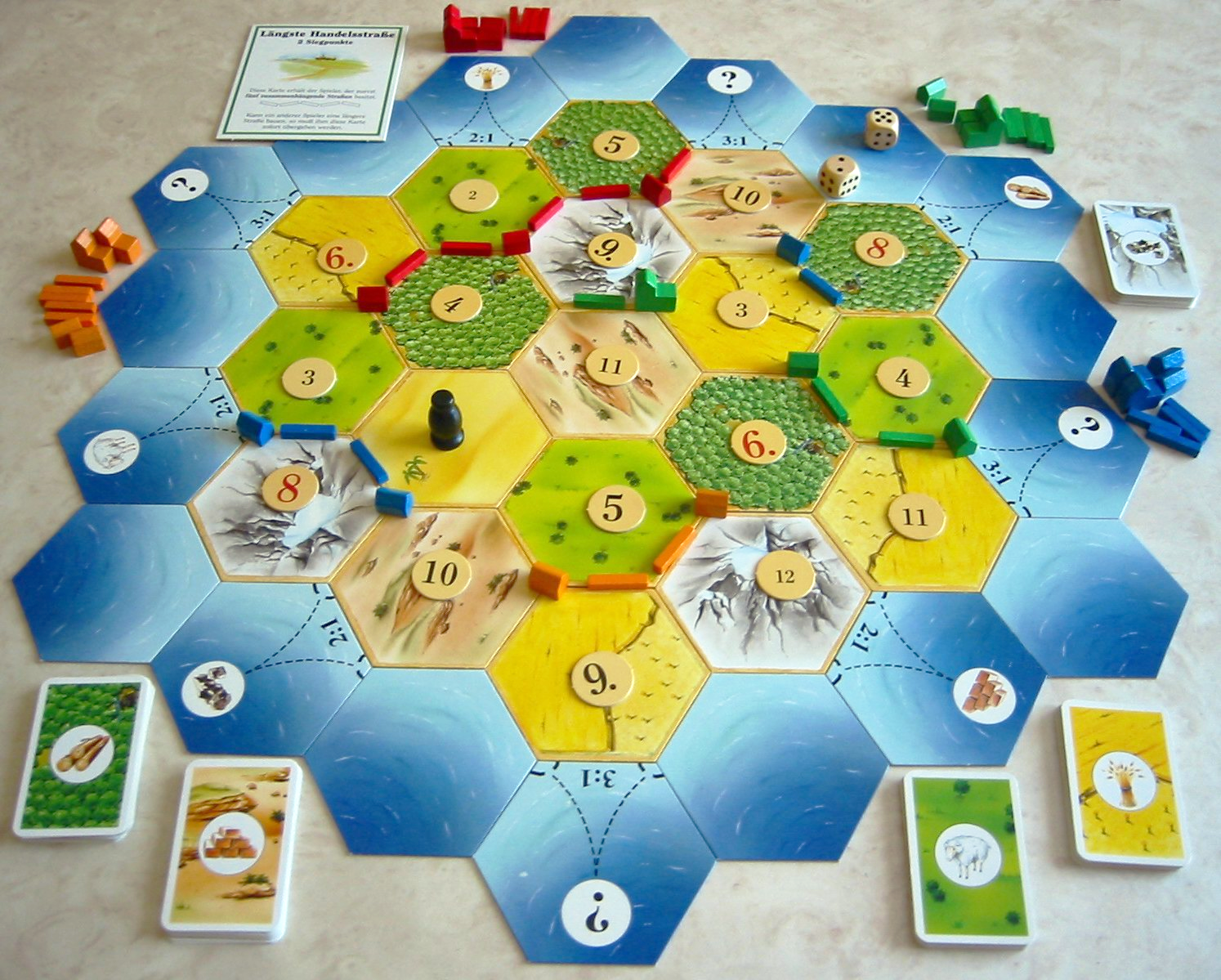
The Settlers of Catan is a board game designed by Klaus Teuber. It was first published in 1995 in Germany, where board games enjoy especially great popularity. It has sold over 15 million games and been translated into thirty languages from the original German. The players in the game represent settlers establishing colonies on the fictional island of Catan. Players build settlements, cities, and roads to connect them as they develop the island.
read more »
Posted in Games, World |
Leave a Comment »
September 14, 2010


Italo disco is a broad term, encompassing much of the dance music output in Europe during the 1980s. It is one of the world’s first forms of completely electronic dance music and evolved during the late 1970s and early 1980s in Italy, Germany, the Netherlands and other parts of Europe. Italo disco music has a distinct, futuristic and spacey sound, which was created using synthesizers, drum machines and vocoders. The term ‘Italo disco’ was marketed only in Europe in the early 1980s by the German record label ZYX Music. Prior to 1983, the music was simply considered dance or disco music from Europe.
Posted in Art, World |
Leave a Comment »
September 14, 2010

The Great Pacific Garbage Patch refers to marine litter trapped in gyre (a system of rotating ocean currents) in the central North Pacific Ocean. The patch extends over an indeterminate area, with estimates ranging very widely depending on the degree of plastic concentration used to define the affected area.
The Patch is characterized by exceptionally high concentrations of plastics, chemical sludge, and other debris. Despite its size and density, it is not visible from satellite photography; it consists primarily of suspended particulates in the upper water column.
read more »
Posted in Food, Science, World |
Leave a Comment »
September 13, 2010

Shin-Lamedh-Mem are the three letter root of many Semitic words, including shalom and salām, which mean ‘peace’ (among other things) in Hebrew and Arabic respectively. The root itself translates as ‘whole, safe, intact.’
Posted in Language, World |
Leave a Comment »


 The Daily Omnivore