August 24, 2010

Sprezzatura is an Italian word originating from Castiglione’s ‘The Book of the Courtier,’ where it is defined by the author as ‘a certain nonchalance, so as to conceal all art and make whatever one does or says appear to be without effort and almost without any thought about it.’
It is the ability of a courtier to display an easy facility in accomplishing difficult actions which hides the conscious effort that went into them. Sprezzatura has also been described as a form of defensive irony: the ability to disguise what one really desires, feels, thinks, and means or intends behind a mask of apparent reticence and nonchalance.
Posted in Language, World |
Leave a Comment »
August 17, 2010
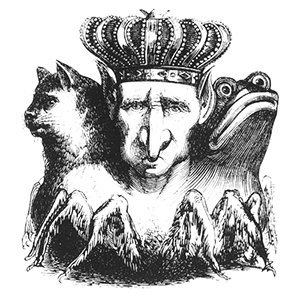
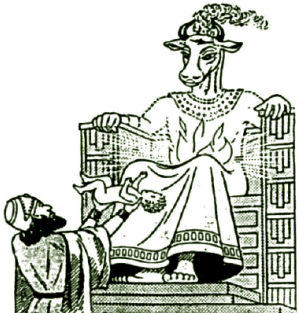
Baal [bahl] is one of the seven princes of Hell. He is mentioned widely in the Old Testament as the primary pagan idol of the Phoenicians, often associated with the heathen goddess Ashtaroth. Baal means ‘The Lord.’ Baal is the son of the god Dagan, another Semitic Cannonite god. While his Semitic predecessor was depicted as a man or a bull, the demon Baal was said to appear in the forms of a man, cat, toad, or combinations thereof.
The idea of Baal as a demon was created when Christianity turned ancient gods into demons and demonology divided the demonic population of Hell in several hierarchies. Baal, the Semitic god, did not escape, becoming a separate entity from Beelzebub. During the English Puritan period, Baal was either compared to Satan or considered his main assistant.
Posted in Philosophy, World |
Leave a Comment »
August 16, 2010
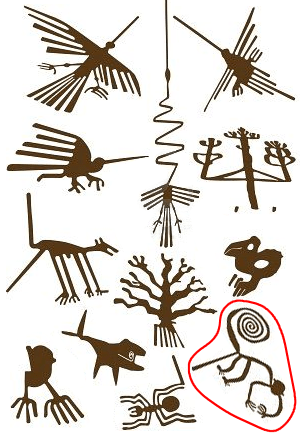
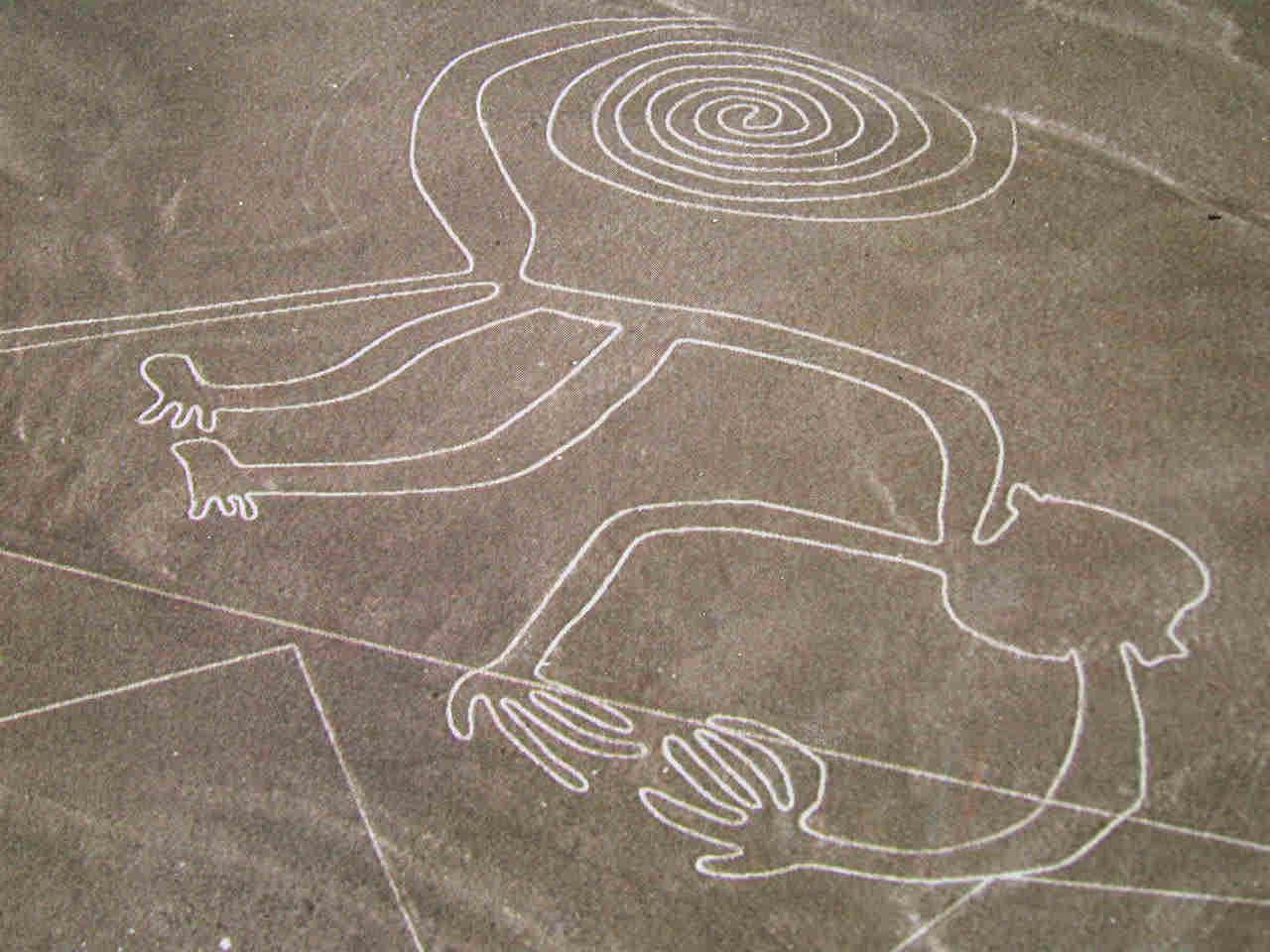
The Nazca Lines are a series of ancient geoglyphs located in the Nazca Desert of Peru. They have been designated a UNESCO World Heritage Site. Scholars believe the Nazca Lines were created by the Nazca culture between 400 and 650 AD. The hundreds of individual figures range in complexity from simple lines to stylized hummingbirds, spiders, monkeys, fish, sharks or orcas, llamas, and lizards.
The lines are shallow designs made in the ground by removing the ubiquitous reddish pebbles and uncovering the whitish ground beneath. Hundreds are simple lines or geometric shapes; more than seventy are designs of animal, bird, fish or human figures. The largest figures are over 660 ft across. Scholars differ in interpreting the purpose of the designs, but they generally ascribe religious significance to them, as they were major works that required vision, planning and coordination of people to achieve.
Posted in Art, World |
Leave a Comment »
August 16, 2010

In some Native American legends, a skinwalker is a person with the supernatural ability to turn into any animal he or she desires, though they first must be wearing a pelt of the animal to be able to transform. Similar lore can be found in cultures throughout the world and is often referred to as shapeshifting by anthropologists.
Posted in Philosophy, World |
Leave a Comment »
August 16, 2010
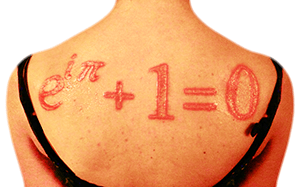
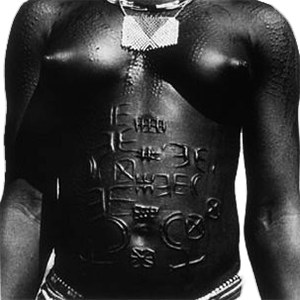
Scarification [skar-uh-fi-key-shuhn], sometimes called cicatrization, involves scratching, etching, burning, or superficially cutting designs, pictures, or words into the skin as a permanent body modification.
Posted in Art, World |
Leave a Comment »
August 16, 2010

Svalbard Global Seed Vault is a secure seedbank located on the Norwegian island of Spitsbergen in the remote Arctic Svalbard archipelago, about 1,300 kilometres from the North Pole. The facility preserves a wide variety of plant seeds in an underground cavern. The seed vault will provide insurance against the loss of seeds in genebanks, as well as a refuge for seeds in the case of large scale regional or global crises. The seed vault is managed under terms spelled out in a tripartite agreement between the Norwegian government, the Global Crop Diversity Trust (GCDT) and the Nordic Genetic Resource Center.
Construction of the seed vault, which cost approximately $9 million, was funded entirely by the Government of Norway. Storage of seeds in the vault is free of charge. Operational costs are paid by Norway and the Global Crop Diversity Trust. The primary funding of the Trust came from the Bill & Melinda Gates Foundation, United Kingdom, Norway, Australia, Switzerland, and Sweden, though funding has been received from a wide variety of sources including four developing countries: Brazil, Colombia, Ethiopia, and India.
Posted in Money, Science, World |
Leave a Comment »
August 16, 2010
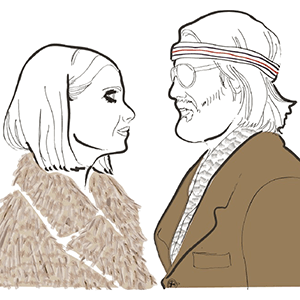
Mamihlapinatapai is a word from the Yaghan language of Tierra del Fuego, listed in The Guinness Book of World Records as the ‘most succinct word,’ and is considered one of the hardest words to translate. It describes ‘a look shared by two people with each wishing that the other will initiate something that they both desire but which neither one wants to start.’
Posted in Language, World |
Leave a Comment »
August 16, 2010
Baidu is a Chinese search engine established in 2000 by co-founders, Robin Li and Eric Xu. Both of the co-founders are Chinese nationals who have studied and worked overseas before returning to China. Baidu.com Inc. is registered in the Cayman Islands. In April 2010, Baidu ranked 7th overall in Alexa’s internet rankings.
In December 2007, Baidu became the first Chinese company to be included in the NASDAQ-100 index. Baidu proactively censors its content in line with government regulations. The name Baidu, whose literal meaning is ‘hundreds of times,’ is taken from the last line of Xin Qiji’s classical poem ‘Green Jade Table in The Lantern Festival.’
Posted in Money, Technology, World |
1 Comment »
August 16, 2010

Yandex is a Russian IT company which operates the largest search engine in Russia (with 64% market share, ranked eighth-largest in the world) and develops a number of Internet-based services and products. Yandex was launched in 1997 and began earning a profit in 2002. Its name stands for ‘Yet Another iNDEXer.’
Posted in Money, Technology, World |
Leave a Comment »
August 12, 2010

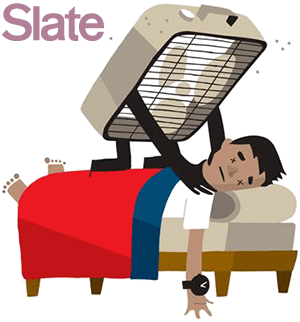
Fan death is a putative phenomenon, generally accepted only in South Korea, in which an electric fan left running overnight in a closed room can cause the death of those inside. Fans sold in Korea are equipped with a timer switch that turns them off after a set number of minutes, which users are frequently urged to set when going to sleep with a fan on.
The genesis of this misconception is unclear. Some have speculated that the South Korean government created the idea of fan death as propaganda in order to curb the energy consumption of Korean households. This theory is based on the fact that reports of fan death first appeared in the 1970s. This coincided with the 1970s energy crisis, which led to a short supply and high prices of oil; it also coincided with the rule of President Park Chung-hee, who listed attaining a self-reliant economy and modernization as his top goals, as announced in his Five Year Economic development Plan.
read more »
Posted in Death, Money, World |
1 Comment »
August 12, 2010

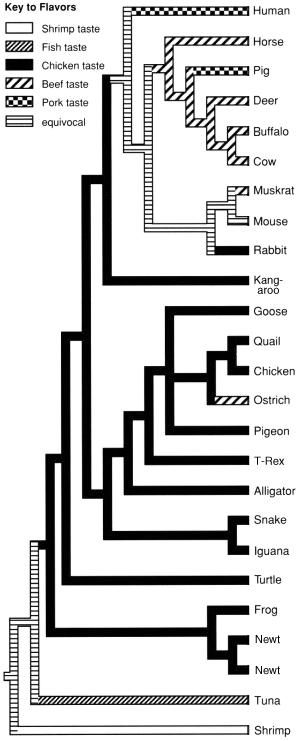
Umami [oo-mah-mee], also referred to as savoriness, has been proposed as one of the basic tastes sensed by specialized receptor cells present on the human and animal tongue. Umami is a loanword from Japanese meaning ‘good flavor’ or ‘good taste.’ In English, however, ‘brothy,’ ‘meaty,’ or savory’ have been proposed as alternative translations. Inasmuch as it describes the flavor common to savory products such as meat, cheese, and mushrooms, umami is similar to French gastronome Brillat-Savarin’s concept of osmazome, an early attempt to describe the main flavoring component of meat as extracted in the process of making stock.
The umami taste is due to the detection of the carboxylate anion of glutamic acid, a naturally occurring amino acid common in meat, cheese, broth, stock, and other protein-heavy foods. Salts of glutamic acid, known as glutamates, easily ionize to give the same carboxylate form and therefore the same taste. For this reason, they are used as flavor enhancers. The most commonly used of these is monosodium glutamate (MSG).
Posted in Food, Science, World |
Leave a Comment »
August 12, 2010
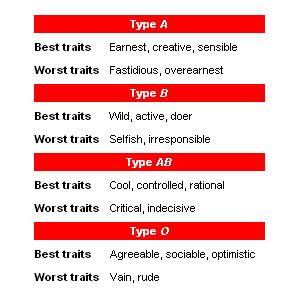

Ketsuekigata is a Japanese pseudoscience based on human blood types. There is a popular belief in Japan that a person’s ABO blood type is predictive of their personality, temperament, and compatibility with others. Ultimately deriving from ideas of historical scientific racism, the popular belief originates with publications by Masahiko Nomi in the 1970s. The scientific community dismisses such beliefs as superstition. Discussion of blood types is widely popular in women’s magazines as a way of gauging relationship compatibility with a potential or current partner. Morning television shows feature blood type horoscopes, and similar horoscopes are published daily in newspapers. In addition, a series of four books that describe people’s character by blood type ranked third, fourth, fifth and ninth on a list of best selling books in Japan in 2008.
Although there is no proven correlation between blood type and personality, it remains popular with the many matchmaking services that cater to blood type. In this way, it is similar to the use of astrological signs in the West, which is also popular in Japan. Asking one’s blood type is common in Japan, and people are often surprised when a non-Japanese does not know his or her own blood type.
Posted in Humor, Philosophy, World |
Leave a Comment »




 The Daily Omnivore