October 29, 2013

Patrice Wilson is a Nigerian singer and songwriter who goes by the stage names Pato and Fat Usher. He got his start in music as a backup singer with Malian-Slovak pop star Ibrahim Maiga (and learned to speak fluent Slovak while touring Eastern Europe).
Wilson moved to the US in 2001, where he took his flavor of Nigerian music, along with eastern Europe pop, and combined it with hip-hop. In 2010 he co-founded ARK Music Factory in partnership with Clarence Jey, an Australian record producer, songwriter and multi-instrumentalist musician. Jey left the following year, with Wilson remaining the CEO of the company. He co-authored and co-produced alongside Jey the song ‘Friday’ sung by Rebecca Black.
Continue reading →
Posted in Humor, Money |
Leave a Comment »
October 28, 2013

Pharmacy automation is the automation of tasks performed in pharmacy:
measuring and mixing powders and liquids for compounding; tracking and updating customer information in databases (e.g. personally identifiable information, medical history, drug interaction risk detection); inventory management; and dispensing of medication.
Continue reading →
Posted in Drugs, Health, Technology |
Leave a Comment »
October 26, 2013

The Kessler syndrome (proposed by the NASA scientist Donald J. Kessler in 1978) is a scenario in which the density of objects in low Earth orbit is high enough that collisions between objects could cause a cascade—each collision generating space debris which increases the likelihood of further collisions.
One implication is that the distribution of debris in orbit could render space exploration, and even the use of satellites, infeasible for many generations. Every satellite, space probe, and manned mission has the potential to create space debris. A cascading Kessler syndrome becomes more likely as satellites in orbit increase in number and old satellites become inoperative.
Posted in Technology, World |
Leave a Comment »
October 25, 2013

Wiki-PR is a public relations firm that markets its ability to edit Wikipedia. Its practices have contradicted Wikipedia practices, including those on sockpuppetry (using an online identity for purposes of deception) and conflict-of-interest editing, leading to hundreds of blocked accounts.
Wiki-PR was created in 2010 by Darius Fisher, its current COO, and Jordan French, its current CEO. Clients have included Viacom and Priceline. The firm claimed having administrator access enabling it to manage the Wikipedia presence of more than 12,000 clients. Wiki-PR uses aggressive email marketing to acquire new customers.
Posted in Money, Politics, Technology |
1 Comment »
October 24, 2013
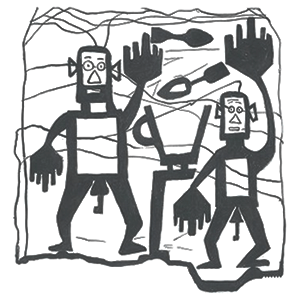
On the Origin of the “Influencing Machine” in Schizophrenia is a highly influential article written by German psychoanalyst Viktor Tausk in 1919. The paper describes Tausk’s observations and psychoanalytic interpretation of a type of paranoid delusion that occurs in patients diagnosed with schizophrenia. The delusion often involves their being influenced by a ‘diabolical machine,’ just outside the technical understanding of the victim, that influences them from afar.
It was typically believed to be operated by a group of people who were persecuting the individual, whom Tausk suggested were ‘to the best of my knowledge, almost exclusively of the male sex’ and the persecutors, ‘predominantly physicians by whom the patient has been treated.’ These delusions are known in contemporary psychiatry as ‘passivity delusions’ or ‘passivity phenomena’ and are listed among Kurt Schneider’s ‘first rank’ symptoms which are thought to be particularly diagnostic of schizophrenia, and still form some of the core diagnostic criteria.
Continue reading →
Posted in Health, Technology |
1 Comment »
October 23, 2013

Colossus: The Forbin Project is a 1970 American science fiction thriller film based on a 1966 novel Colossus, by Dennis Feltham Jones, about a massive American defense computer, named Colossus, becoming sentient and deciding to assume control of the world. The machine was built in secret by Dr. Charles A. Forbin to control all of the United States and Allied nuclear weapons systems.
Colossus is built to be impervious to any attack, encased within a mountain and powered by its own nuclear reactor, filling the area with gamma radiation. When it is activated, the President of the United States announces its existence at a press conference with Forbin in Washington, proudly proclaiming it a perfect defense system that will ensure peace.
Continue reading →
Posted in Art, Technology, War |
Leave a Comment »
October 22, 2013


SCS Software is a Czech video game development company. It primarily produces simulation games, including the ’18 Wheels of Steel’ (based on truck driving in North America) and ‘Euro Truck Simulator’ series. Other titles include ‘Bus Driver,’ ‘Scania Truck Driving Simulator,’ as well as the ‘Hunting Unlimited’ series. SCS Software has also published several screensavers.
In 2013, SCS Software announced ‘World of Trucks’ with its official motto: ‘One Trucking Game to Rule them All.’ The expected map will feature over 150 countries and more than 600 cities, more than 20 truck brands, more than 70 cargo types, and more than 50 fictional or real companies.
Posted in Games, Humor, World |
Leave a Comment »
October 21, 2013

Ernest P. Worrell is a fictional character that was portrayed by Jim Varney (1949 – 2000) in a series of television commercials, and later in a television series (‘Hey Vern, It’s Ernest!’) as well as a series of feature films. Ernest was created by a Nashville advertising agency for local television ad campaigns.
The first Ernest commercial, filmed in 1980, advertised an appearance by the Dallas Cowboys Cheerleaders at Beech Bend Park, an amusement park near Bowling Green, Kentucky. The format of the commercials seldom varied. The rubber-faced Ernest, almost always dressed in a denim vest and baseball cap, appeared at the door of an unseen and unheard but seemingly unwilling neighbor named Vern. Continue reading →
Posted in Humor |
Leave a Comment »
October 21, 2013

Stroszek is a 1977 film by German director Werner Herzog. It was written in four days specifically for German actor and musician Bruno Schleinstein (known as Bruno S.) and was shot in Berlin, two towns in Wisconsin, and in North Carolina. Most of the lead roles are played by non-actors. Schleinstein was often beaten as a child, and spent much of his youth in mental institutions. He was a largely self-taught musician, who over the years developed considerable skill on the piano, accordion, glockenspiel and handbells.
He was spotted by director Werner Herzog in the documentary ‘Bruno der Schwarze – Es blies ein Jäger wohl in sein Horn’ (1970). Herzog promptly cast Schleinstein (under the name Bruno S.) as his lead actor in ‘The Enigma of Kaspar Hauser’ (1974), though he had no acting experience, and the historical figure he portrayed was only in his teens. ‘Stroszek’ has a number of biographical details from Schleinstein’s life, including the use of his own flat as the home of Bruno Stroszek. He also played his own instruments.
Continue reading →
Posted in Art, Death, Humor |
Leave a Comment »
October 20, 2013

‘Nightfall‘ is a 1941 science fiction short story by Isaac Asimov about the coming of darkness to the people of a planet ordinarily illuminated at all times on all sides. It was adapted into a novel with Robert Silverberg in 1990. It was first published in an issue of ‘Astounding Science Fiction’ magazine under editor John W. Campbell. It was the 32nd story by Asimov, written while he was working in his father’s candy store and studying at Columbia University.
According to Asimov’s autobiography, Campbell asked Asimov to write the story after discussing with him a quotation from Ralph Waldo Emerson: ‘If the stars should appear one night in a thousand years, how would men believe and adore, and preserve for many generations the remembrance of the city of God!’ Campbell’s opinion to the contrary was: ‘I think men would go mad.’
Continue reading →
Posted in Language, Science |
Leave a Comment »
October 19, 2013
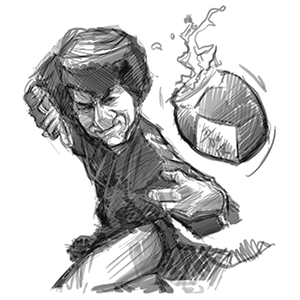
Zui quan is a concept in traditional Chinese martial arts literally meaning ‘drunken fist,’ the term is also commonly translated as drunken boxing.
Zui quan has the appearance of a drunkard’s movements. The postures are created by momentum and weight of the body, and imitation is generally through staggering and certain type of fluidity. It is considered to be among the most difficult wushu styles to learn due to the need for powerful joints and fingers. While in fiction practitioners of zui quan are often portrayed as being actually intoxicated, the actual practice is usually performed sober. Continue reading →
Posted in Drugs, World |
Leave a Comment »
October 18, 2013

Virtuix Omni is an omnidirectional treadmill video game peripheral for virtual reality games currently in development by Virtuix. The Omni uses a slippery platform used to simulate the motion of walking. The platform requires special shoes that reduce friction when walking.
The player is fully enclosed within a ring that works with a safety harness to absorb the player’s weight. The Omni is designed to be used with a head-mounted virtual reality display, such as the Oculus Rift.
Posted in Games, Technology |
Leave a Comment »


 The Daily Omnivore