December 29, 2012

The tragic mulatto [muh-lat-oh] is a stereotypical fictional character that appeared in American literature during the 19th and 20th centuries, from the 1840s.
The ‘tragic mulatto’ is an archetypical mixed-race person (a ‘mulatto’), who is assumed to be sad, or even suicidal, because they fail to completely fit in the ‘white world’ or the ‘black world.’ As such, the ‘tragic mulatto’ is depicted as the victim of the society they live in, a society divided by race. Continue reading →
Posted in Art, Language, Politics |
Leave a Comment »
December 29, 2012

Negative capability describes the capacity of human beings to transcend and revise their contexts. The term has been used by poets and philosophers to describe the ability of the individual to perceive, think, and operate beyond any presupposition of a predetermined capacity of the human being.
It further captures the rejection of the constraints of any context, and the ability to experience phenomenon free from epistemological bounds, as well as to assert one’s own will and individuality upon their activity. The term was first used by the Romantic poet John Keats to critique those who sought to categorize all experience and phenomena and turn them into a theory of knowledge.
Continue reading →
Posted in Art, Language, Philosophy |
1 Comment »
December 29, 2012

Ithkuil is a constructed language marked by outstanding grammatical complexity, expressed with a rich phonemic inventory or through an original, graphically structured, system of writing. The language’s author, John Quijada, presents Ithkuil as a cross between an a priori philosophical and a logical language designed to express deeper levels of human cognition overtly and clearly, particularly in regard to human categorization, yet briefly. It also strives to minimize the ambiguities and semantic vagueness found in natural human languages.
The many examples from the original grammar book show that a message, like a meaningful phrase or a sentence, can usually be expressed in Ithkuil with fewer sounds, or lexically distinct speech-elements, than in natural human languages. Quijada deems his creation too complex and strictly regular a language to have developed ‘naturally,’ but nonetheless a language suited for human conversation. No person is hitherto known to be able to speak Ithkuil fluently; Quijada, for one, does not.
Continue reading →
Posted in Language, Philosophy, World |
Leave a Comment »
December 24, 2012

Reclaim the Streets (RTS) is a collective with a shared ideal of community ownership of public spaces. Participants characterize the collective as a resistance movement opposed to the dominance of corporate forces in globalization, and to the car as the dominant mode of transport. Reclaim the Streets often stage non-violent direct action street reclaiming events such as the ‘invasion’ of a major road, highway or freeway to stage a party.
While this may obstruct the regular users of these spaces such as car drivers and public bus riders, the philosophy of RTS is that it is vehicle traffic, not pedestrians, who are causing the obstruction, and that by occupying the road they are in fact opening up public space. The events are usually spectacular and colorful with sand pits for children to play in, free food and music, however they have been known to degenerate into riots and violence. A Temporary Autonomous Zone sometimes results. The style of the parties in many places has been influenced by the rave scene in the UK, with sound systems playing dance music. Continue reading →
Posted in Money, Politics, Technology |
Leave a Comment »
December 24, 2012

‘No Logo: Taking Aim at the Brand Bullies’ is a book by Canadian author Naomi Klein.
First published in December 1999, shortly after the 1999 WTO Ministerial Conference protests in Seattle had generated media attention around such issues, it became one of the most influential books about the alter-globalization movement. The book focuses on branding, and often makes connections with the alter-globalization movement (also known as the the global justice movement). Continue reading →
Posted in Language, Money, Politics |
1 Comment »
December 23, 2012

Ad-creep refers to the gradual introduction of advertising into previously ad-free spaces. The earliest verified appearance of the term is in a 1996 article ‘Creeping Commercials: Ads Worming Way Into TV Scripts’ by Steve Johnson for the ‘Chicago Tribune,’ however it may have been coined by a subscriber to ‘Stay Free!’ magazine, according to another source.
While the virtues of advertising can be debated, ad-creep often especially refers to advertising which is invasive and coercive, such as ads in schools, doctor’s offices and hospitals, restrooms, elevators, on ATM’s, on garbage cans, on vehicles, and on restaurant menus. In Johnson’s piece, he criticizes product placement and ‘creative advertising enhancements’ as ‘one more manifestation of an environment in which the commercial assault is almost nonstop.’ Continue reading →
Posted in Money, Politics |
Leave a Comment »
December 23, 2012

The Adbusters Media Foundation is a Canadian-based not-for-profit, anti-consumerist, pro-environment organization founded in 1989 by Kalle Lasn and Bill Schmalz in Vancouver. Adbusters describes itself as ‘a global network of artists, activists, writers, pranksters, students, educators and entrepreneurs who want to advance the new social activist movement of the information age.’
Characterized by some as anti-capitalist or opposed to capitalism, it publishes the reader-supported, advertising-free ‘Adbusters,’ an activist magazine with an international circulation of 120,000 devoted to challenging consumerism. Adbusters has launched numerous international campaigns, including ‘Buy Nothing Day,’ ‘TV Turnoff Week,’ and ‘Occupy Wall Street,’ and is known for their ‘subvertisements’ that spoof popular advertisements. Continue reading →
Posted in Language, Money, Politics |
Leave a Comment »
December 23, 2012

Culture jamming is a tactic used by many anti-consumerist social movements to disrupt or subvert media culture and its mainstream cultural institutions, including corporate advertising. It purports to ‘expose the methods of domination’ of mass society to foster progressive change.
Culture jamming is a form of subvertising (subversive advertising. Many culture jams are intended to expose apparently questionable political assumptions behind commercial culture. Common tactics include re-figuring logos, fashion statements, and product images as a means to challenge the idea of ‘what’s cool’ along with assumptions about the personal freedoms of consumption. Continue reading →
Posted in Humor, Money, Politics |
Leave a Comment »
December 22, 2012

A bandwidth cap, also known as a bit cap, limits the transfer of a specified amount of data over a period of time. Internet service providers commonly apply a cap when a channel intended to be shared by many users becomes overloaded, or may be overloaded, by a few users. Implementation of a bandwidth cap is sometimes termed a Fair Access Policy or Usage-based billing. In many situations, each user of a network is expected to use high speed transmission for only a short time, for example to download a megabyte web page in less than a second.
When use is continuous, as it might be in the case of file sharing, Internet radio or streaming video, a few users who use the connection at high rates for hours at a time may seriously impair the service of others. The concept is more relevant in cable internet where both the core network and the access network are shared, than in DSL where the core network is shared but the access network is not. It is most relevant in wireless internet, particularly satellite internet, where both the core network and the access network are shared and total network bandwidth is relatively narrow.
Continue reading →
Posted in Money, Technology, World |
Leave a Comment »
December 22, 2012

Female genital mutilation (FGM), also known as female circumcision, is defined by the World Health Organization (WHO) as ‘all procedures that involve partial or total removal of the external female genitalia, or other injury to the female genital organs for non-medical reasons.’ FGM is typically carried out on girls from a few days old to puberty. It may take place in a hospital, but is usually performed, without anaesthesia, by a traditional circumciser using a knife, razor, or scissors.
According to the WHO, it is practiced in 28 countries in western, eastern, and north-eastern Africa, in parts of the Middle East, and within some immigrant communities in Europe, North America, and Australasia. The WHO estimates that 100–140 million women and girls around the world have experienced the procedure, including 92 million in Africa. The practice is carried out by some communities who believe it reduces a woman’s libido.
Continue reading →
Posted in Health, Philosophy, Sex |
Leave a Comment »
December 22, 2012

Male circumcision has often been, and remains, the subject of controversy on a number of grounds—including religious, ethical, sexual, and health related. The Ancient Greeks and Romans valued the foreskin and were opposed to circumcision – an opposition inherited by the canon and secular legal systems of the Christian West that lasted at least through to the Middle Ages. Traditional Judaism and Islam have advocated male circumcision as a religious obligation.
The ethics of circumcision are sometimes controversial. From the mid-19th century, there has been advocacy in some Anglophone countries on medical grounds, such as the prevention of masturbation and ‘reflex neurosis.’ Modern proponents argue that circumcision reduces the risks of a range of infections and diseases as well as conferring sexual benefits. In contrast, opponents, particularly of infant circumcision, often question its effectiveness in preventing disease, and object to subjecting newborn boys, without their consent, to a procedure they consider to have debatable benefits, significant risks, and a potentially negative impact on general health and later sexual enjoyment. Continue reading →
Posted in Health, Philosophy, Sex |
2 Comments »
December 22, 2012
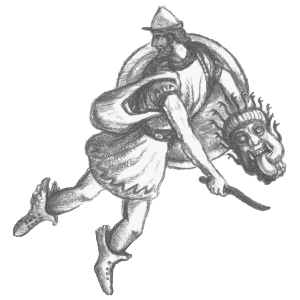
Ingri (1904 – 1980) and Edgar (1898 – 1986) Parin d’Aulaire [doe-lair] were married writers and illustrators of children’s books in the 20th century.
Using their research and travel experiences as inspiration, the husband and wife team produced 27 picture books for children. They also wrote and illustrated introductory books of Greek and Norse mythology. Continue reading →
Posted in Art, Education, Language |
Leave a Comment »



