November 13, 2012
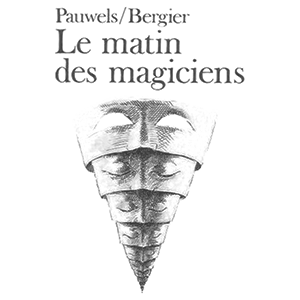
The Morning of the Magicians, first published as ‘Le Matin des magiciens’ was written by Louis Pauwels and Jacques Bergier in 1960, it became a bestseller, first in French, then translated into English in 1963 as ‘The Dawn of Magic.’ A German edition was published with the title ‘Aufbruch ins dritte Jahrtausend’ (‘Departure into the third Millennium’).
In a generalized and wide ranging overview of the occult, the book speculates on a variety of Forteana (anomalous phenomena), mysticism, and conspiracy theories such as secret societies, ancient prophesies, alchemical transmutation, a giant race that once ruled the Earth, and the Nazca Lines. It also includes speculations such as Nazi occultism and supernatural phenomena conspiracy theory that the Vril Society and the Thule Society were the philosophical precursors to the NSDAP Nazi party. Continue reading →
Posted in Philosophy |
1 Comment »
November 13, 2012

According to ancient astronaut theories, intelligent extraterrestrial beings visited Earth during the origins or development of human cultures, technologies, and/or religions. Some of these theories propose that deities from most – if not all – religions are actually extraterrestrials, and their technologies were taken as evidence of their divine status. Ancient astronaut theories have been widely used as a plot device in science fiction (e.g. ‘2001: A Space Odyssey,’ ‘Stargate’).
Such theories have not received support within the scientific community, and have received little or no attention in peer reviewed studies from scientific journals. Continue reading →
Posted in Art, Philosophy, Science |
Leave a Comment »
November 13, 2012

Mechanitis is a genus of tigerwing (ithomiine) butterflies, named by Danish zoologist Johan Christian Fabricius in 1807.
They are in the brush-footed butterfly family, Nymphalidae. It has gained fame due to the metallic appearance of the cocoons of certain phenotypes.
Posted in Science |
Leave a Comment »
November 13, 2012

The uncanny valley is a hypothesis regarding the field of robotics. The theory holds that when robots and other facsimiles of humans look and act almost like actual humans, it causes a response of revulsion among human observers.
The ‘valley’ in question is a dip in a proposed graph of the positivity of human reaction as a function of a robot’s lifelikeness. People are not as affected in an emotional way by an object if it is easy to tell it is not human. After a certain point, they start to feel emotionally about it, but feel bad emotions because it is so nonhuman. As it gets closer to looking human, they start to feel more positive emotions towards it. Continue reading →
Posted in Philosophy, Technology |
Leave a Comment »
November 12, 2012

Russell’s teapot, sometimes called the celestial teapot or cosmic teapot, is an analogy first coined by the philosopher Bertrand Russell to illustrate that the philosophic burden of proof lies upon a person making scientifically unfalsifiable claims rather than shifting the burden of proof to others, specifically in the case of religion.
Russell wrote that if he claims that a teapot orbits the Sun somewhere in space between the Earth and Mars, it is nonsensical for him to expect others to believe him on the grounds that they cannot prove him wrong. Russell’s teapot is still referred to in discussions concerning the existence of God. Continue reading →
Posted in Humor, Philosophy |
Leave a Comment »
November 12, 2012

The DeltaWing is a racing car designed by Ben Bowlby that debuted at the 2012 24 Hours of Le Mans.
The entry will run under the Project 56 name, composed of Ben Bowlby’s DeltaWing Racing Cars (design), Dan Gurney’s All American Racers (constructor), Duncan Dayton’s Highcroft Racing (racing team) and International Motor Sports Association owner Don Panoz (advisor). Nissan’s NISMO division is also assisting in the development of the car. Continue reading →
Posted in Games, Technology |
Leave a Comment »
November 12, 2012
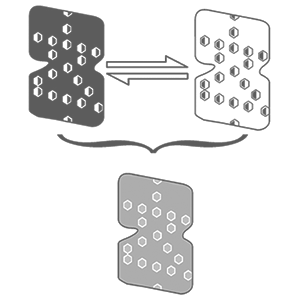
The quantum mind hypothesis proposes that classical mechanics cannot explain consciousness, while quantum mechanical phenomena, such as quantum entanglement (two particles acting in unison) and superposition (physical systems exist partly in all their particular, theoretically possible states, but, when measured, give a result corresponding to only one of the possible configurations [decoherence]), may play an important part in the brain’s function, and could form the basis of an explanation of consciousness.
However, physicist Victor Stenger characterized quantum consciousness as a ‘myth’ having ‘no scientific basis’ that ‘should take its place along with gods, unicorns and dragons.’ The main argument against the quantum mind proposition is that quantum states in the brain would decohere before they reached a spatial or temporal scale at which they could be useful for neural processing. This argument was elaborated by the physicist, Max Tegmark. Based on his calculations, Tegmark concluded that quantum systems in the brain decohere quickly and cannot control brain function.
Continue reading →
Posted in Health, Philosophy, Science |
Leave a Comment »
November 12, 2012
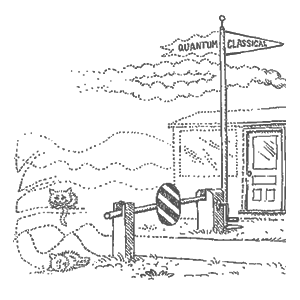
In quantum mechanics, quantum decoherence is the loss of coherence in a quantum superposition. Physical system—such as an electron—exists partly in all its particular, theoretically possible states (or, configuration of its properties) simultaneously; but, when measured, it gives a result corresponding to only one of the possible configurations. The act of observation collapses the multi-state wave function into a single-state particle from the perspective of the observer; and justifies the framework and intuition of classical physics as an acceptable approximation.
Decoherence is the mechanism by which the classical limit emerges out of a quantum starting point and it determines the location of the quantum-classical boundary. It occurs when a system interacts with its environment in a thermodynamically irreversible way. This prevents different elements in the quantum superposition of the system+environment’s wavefunction from interfering with each other. Decoherence has been a subject of active research since the 1980s.
Continue reading →
Posted in Science, Technology |
Leave a Comment »
November 12, 2012
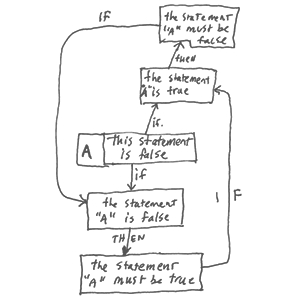
Gödel’s [ger-del] incompleteness theorems is the name given to two theorems, proved by Kurt Gödel in 1931. They are about limitations in all but the most trivial formal systems for arithmetic of mathematical interest. The theorems are very important for the philosophy of mathematics.
The idea behind the theorems is that some mathematical systems are not complete. Most people think they show that any attempt to find a complete and consistent set of axioms for all of mathematics (e.g. Hilbert’s program) is impossible. Continue reading →
Posted in Philosophy, Science |
1 Comment »
November 11, 2012


Appropriation [uh-proh-pree-ey-shuhn] in the arts is the use of pre-existing objects or images with little or no transformation applied to them. The use of appropriation has played a significant role in the history of the arts (literary, visual, and musical).
Appropriation can be understood as ‘the use of borrowed elements in the creation of a new work.’ In the visual arts, to appropriate means to properly adopt, borrow, recycle, or sample aspects (or the entire form) of man-made visual culture. Most notable in this respect are the ‘Readymades’ of Marcel Duchamp (are ordinary manufactured objects that the artist selected and modified, as an antidote to what he called ‘retinal art’).
Continue reading →
Posted in Art, Money, Politics |
Leave a Comment »
November 10, 2012

Scène à faire (French for ‘scene to be made’ or ‘scene that must be done’) is a scene in a book or film which is almost obligatory for a genre of its type. In the U.S. it also refers to a principle in copyright law in which certain elements of a creative work are held to be not protected when they are mandated by or customary to the genre.
For example, a spy novel is expected to contain elements such as numbered Swiss bank accounts, a femme fatale, and various spy gadgets hidden in wristwatches, belts, shoes, and other personal effects. These elements are not protected by copyright, though specific sequences and compositions of them can be.
Continue reading →
Posted in Art, Money, Politics |
Leave a Comment »
November 10, 2012


Fair use is a limitation and exception to the exclusive right granted by copyright law to the author of a creative work. Examples of fair use include commentary, search engines, criticism, news reporting, research, teaching, library archiving, and scholarship.
It provides for the legal, unlicensed citation or incorporation of copyrighted material in another author’s work under a four-factor balancing test (Purpose and character; Nature of the copied work; Amount and substantiality; and Effect upon work’s value). Along with Public Domain, Fair use is one of the ‘Traditional Safety Valves’ (techniques that balance the public’s interest in open access with the property interest of copyright owners)
Continue reading →
Posted in Money, Politics, Technology |
Leave a Comment »



