October 31, 2011

The interrobang [in-ter-uh-bang], ‽ (often represented by ?! or !?), is a nonstandard punctuation mark used in various written languages and intended to combine the functions of the question mark (also called the ‘interrogative point’) and the exclamation mark or exclamation point (known in printers’ jargon as the ‘bang’). The glyph is a superimposition of these two marks. A sentence ending with an interrobang asks a question in an excited manner, expresses excitement or disbelief in the form of a question, or asks a rhetorical question.
Many writers, especially in informal writing, have used multiple punctuation marks to end a sentence expressing surprise and question. Like multiple exclamation marks and multiple question marks, such strings are poor style in formal writing. Writers had combined question marks and exclamation marks (along with using multiple punctuation marks) for decades before the ‘invention’ of the interrobang. They were prevalent in informal media such as print advertisements and comic books.
Continue reading →
Posted in Language |
Leave a Comment »
October 29, 2011
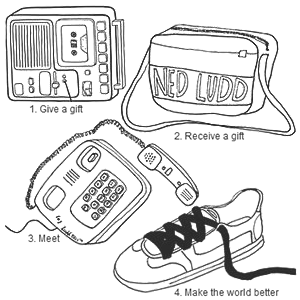
DaruDar is an international community where people give away things, their skills and time to each other for absolutely free requiring nothing in return. The community is based on principles of self-organization. Main condition of participation is following the rules of gift giving and communication set on the site. The global mission of DaruDar is to create a widespread social practice of gift-giving, to make it a daily and routine act. Words like ‘lot,’ ‘exchange,’ ‘freebie,’ ‘junk,’ or ‘crap’ are considered obscene on DaruDar. The service was launched in Russian in 2008. It was created by four friends who had worked with Habrahabr project earlier, a collaborative blog. They were inspired by flashmobs, Russian philosopher Peter Kropotkin and Gandhi.
Darudar users call themselves comembers (‘community members’). DaruDar gift is a thing, skill or service of a comember that he/she wants to give away to someone. In order to offer a gift a comember creates a publication describing what he gives. Other comembers can wish it. Later the gift giver chooses someone to promise their gift. Every gift can be commented, wished, promised and thanked. Only those offers which simultaneously satisfy all three of the following conditions and cannot exist without them should be considered gifts on Darudar: It can be wished; It can be promised; and It can be given.
Posted in Money, Technology, World |
Leave a Comment »
October 29, 2011

CouchSurfing is a corporation based in San Francisco that offer its users hospitality exchange and social networking services. It recently suffered significant criticism from thousands of users after becoming a for-profit corporation after having been been a non-profit for many years. Couchsurfing is a neologism referring to the practice of moving from one friend’s house to another, sleeping in whatever spare space is available, floor or couch, generally staying a few days before moving on to the next house.
The CouchSurfing project was conceived by Casey Fenton in 1999. According to Fenton’s account, the idea arose after finding an inexpensive flight from Boston to Iceland. Fenton randomly e-mailed 1,500 students from the University of Iceland asking if he could stay. He ultimately received more than 50 offers of accommodation. On the return flight to Boston, he began to develop the ideas that would underpin the CouchSurfing project. Continue reading →
Posted in Money, Technology, World |
Leave a Comment »
October 29, 2011
Mickey Hart (b. 1943), real name Michael Steven Hartman, is an American percussionist and musicologist. He is best known as one of the two drummers of the rock band the Grateful Dead. He and fellow Dead drummer Bill Kreutzmann earned the nickname ‘the rhythm devils.’ Before joining the Grateful Dead, Hart and his father, Leonard Hart, a champion rudimental drummer, owned and operated Hart Music, selling drums and musical instruments in San Carlos, California. Hart joined the Grateful Dead in 1967, and left in 1971 when he extricated himself from the band, due to conflict between band management and Mickey’s father. During his sabbatical, in 1972, he recorded the album ‘Rolling Thunder.’ He returned to the Dead in 1974, and remained with the group until their official dissolution in 1995. Collaboration with the remaining members of the Grateful Dead continues, under the band name The Dead.
Alongside his work with the Grateful Dead, Mickey Hart has flourished as a solo artist, percussionist, and the author of several books. In these endeavors he has pursued a lifelong interest in ethnomusicology and in world music. His travels and his interest in all things percussion-related led him to collect percussion instruments, and to collaborate with percussion masters the world over.
Continue reading →
Posted in Art, Health, World |
1 Comment »
October 29, 2011

Wake therapy is a form of sleep deprivation used as a treatment for depression. The subject is woken at 1AM and stays awake all morning, and the next full day.
While sleepy, patients find that their depression vanishes, until they sleep again. Combining this with bright light therapy make the beneficial effects last longer than one day.
Posted in Health |
1 Comment »
October 29, 2011

Lifestyle medicine is defined as the application of environmental, behavioral, medical and motivational principles to the management of lifestyle-related health problems in a clinical setting. It is an established branch of medicine which discusses lifestyle’s contribution to health in addition to non-pharmacological intervention in the treatment and management of lifestyle diseases such as exercise in diabetes mellitus and weight management in obesity. It should not be confused with lifestyle drugs (medications which treat non-life threatening and non-painful conditions such as baldness, impotence, wrinkles, or acne).
Lifestyle medicine is often prescribed in conjunction with a typical medicine approach of pharmacotherapy. For example, diabetic patients who may be on medication to help control the blood glucose levels in the short term might also be prescribed a lifestyle intervention of a healthy diet and exercise to assist in the long term management of their pathology. In some cases lifestyle interventions are more effective when augmented with appropriate pharmacotherapy, as with tobacco use where medications such as buproprion may be prescribed to assist the patient to quit smoking and adopt a healthy lifestyle change.
Posted in Food, Health |
Leave a Comment »
October 29, 2011
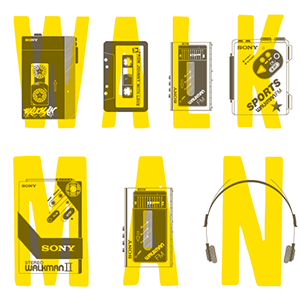
The Walkman Effect refers to the way music listened to via headphones allows the user to gain more control over their environment. It was coined by International Research Center for Japanese Studies Professor Shuhei Hosokawa in an article of the same name published in the journal ‘Popular Music’ in 1984. While the term was named after the dominant portable music technology of the time, the Sony Walkman, it applies to all such devices and has been cited numerous times to refer to more current products such as the Apple iPod.
When Sony released the first Walkmans, they featured two headphone jacks and a ‘talk button.’ When pressed, this button activated a microphone and lowered the volume to enable those listening to have a conversation without removing their headphones. Sony Chairman Akio Morita added these features to the design for fear the technology would be isolating. Though he ‘thought it would be considered rude for one person to be listening to his music in isolation,’ however, people bought their own units rather than share and these features were removed for later models.
Continue reading →
Posted in Health, Technology |
1 Comment »
October 28, 2011
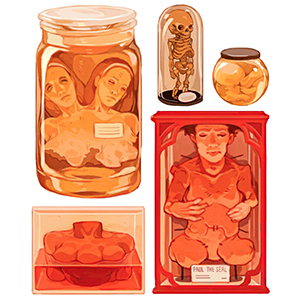
A freak show is an exhibition of biological rarities, referred to as ‘freaks of nature.’ Typical features would be physically unusual humans, such as those uncommonly large or small, those with both male and female secondary sexual characteristics, people with other extraordinary diseases and conditions, and performances that are expected to be shocking to the viewers. Heavily tattooed or pierced people have sometimes been seen in freak shows, as have attention-getting physical performers such as fire-eating and sword-swallowing acts.
Freak shows were popular in the United States from the mid 19th to mid 20th centuries, and were often, but not always, associated with circuses and carnivals. Some shows also exhibited deformed animals (such as two-headed cows, one-eyed pigs, and four-horned goats) and famous hoaxes, or simply ‘science gone wrong’ exhibits (such as deformed babies). Continue reading →
Posted in Health, Money |
1 Comment »
October 28, 2011

In the folklore of the Chiloé Island in southern Chile, the imbunche [im-boon-chay] is a legendary monster that protects the entrance to a warlock’s cave. According to legend, the Imbunche was a male child kidnapped by, or sold by his parents to a Brujo Chilote (a type of sorcerer or warlock of Chiloé).
The Brujo chilote transformed the child into a deformed hairy monster by breaking his legs and twisting them over his back, applying a magic cream over the boy’s to cause thick hairs and, finally splitting his tongue to produce a forked, snake-like, tongue.
Posted in Philosophy |
1 Comment »
October 28, 2011
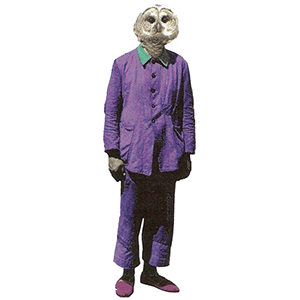
The Obscene Bird of Night (El obsceno pájaro de la noche, 1970) is the most acclaimed novel by the Chilean writer José Donoso (1924-1996). Donoso was a member of the Latin American literary boom and the literary movement known as magical realism. The novel explores the cyclical nature of life and death, in that our fears and fantasies of childhood resurface in adulthood and old age. It is about the deconstruction of self – to the extreme of trying ‘to live’ in non-existence.
The Imbunche myth is a major theme in the novel. According to legend, the Imbunche was a male child kidnapped by, or sold by his parents to a sorcerer who turns the child into a monster to guard his lair. It symbolizes the process of implosion of the physical and/or intellectual self, turning the living being into a thing or object incapable of interacting with the outside world, and depriving it of its individuality and even of its name. This can either be self-inflicted or forced upon by others.
Continue reading →
Posted in Death, Language, Philosophy |
Leave a Comment »
October 28, 2011

Comprachicos is a compound Spanish neologism meaning ‘child-buyers,’ which was coined by Victor Hugo in his novel ‘The Man Who Laughs’ (1869). It refers to various groups in folklore who were said to change the physical appearance of human beings by manipulating growing children, in a similar way to the horticultural method of bonsai – that is, deliberate mutilation.
The most common methods said to be used in this practice included stunting children’s growth by physical restraint, muzzling their faces to deform them, slitting their eyes, dislocating their joints, and malforming their bones. The resulting human monsters made their living as mountebanks (con artists and hustlers) or were sold to lords and ladies to be used as pages or court jester.
Continue reading →
Posted in Art, Language |
Leave a Comment »
October 28, 2011

A child beauty pageant is a beauty contest featuring contestants including and younger than 18 years of age. Divisions include talent, interview, sportswear, casual wear, swim wear, western wear, theme wear, outfit of choice, decade wear, and evening wear, typically wearing makeup as well as elaborate hairstyles. The contestants wear custom fitted and designed outfits to present their routines on stage.
Some pageants do their best to make every child feel like a winner. There is a queen for every age division and there are Ultimate Grand Supreme awards, Mini supreme queens for certain blocks of age divisions (0-5, 6-11, 12-16, 17 and up). There are also side awards and overall side awards. Pageants may cater to the ‘natural’ contestant (who typically wears minimal makeup, only her own hair, no false teeth, no spray tan, and unmanicured nails) and/or the ‘high glitz’ contestant (who typically uses any and all of the above listed techniques to enhance her appearances). Continue reading →
Posted in Health, Politics, Sex |
14 Comments »




