February 14, 2011

In popular music, a break is an instrumental or percussion section or interlude during a song derived from or related to stop-time – being a ‘break’ from the main parts of the song or piece. A solo break in jazz occurs when the rhythm section stops playing behind a soloist for a brief period, usually two or four bars leading into the soloist’s first chorus. In DJ parlance, a break is where all elements of a song (e.g., pads, basslines, vocals), except for percussion, disappear for a time. This is distinguished from a breakdown, a section where the composition is deliberately deconstructed to minimal elements (usually the percussion or rhythm section with the vocal re-introduced over the minimal backing), all other parts having been gradually or suddenly cut out.
In hip hop and electronica, a short break is also known as a ‘cut,’ and the reintroduction of the full bass line and drums is known as a ‘drop,’ which is sometimes accented by cutting off everything, even the percussion. A break beat is the sampling of breaks as drum loops (beats), originally from soul tracks, and using them as the rhythmic basis for hip hop and rap songs. It was invented by DJ Kool Herc. A particularly innovative style of street dance was created to accompany break beat-based music, and was hence referred to as ‘The Break,’ or break dancing.
Posted in Art, Language |
Leave a Comment »
February 14, 2011
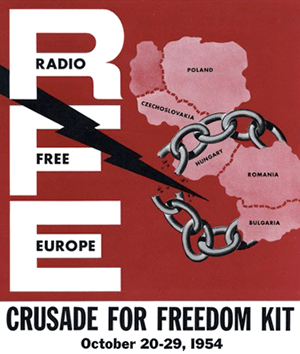
Radio Free Europe/Radio Liberty (RFE/RL) is a broadcaster funded by the U.S. Congress that provides news, information, and analysis to countries in Eastern Europe, Central Asia, and the Middle East where the free flow of information is either banned by government authorities or not fully developed. Founded as an anti-communist source of information during the Cold War, RFE/RL was headquartered at Englischer Garten in Munich from 1949 until 1995 when they were moved to Prague.
It maintains 20 local bureaus, but authoritarian governments often attempt to obstruct the radios’ activities through a range of tactics, including extensive jamming, shutting down local re-broadcasting affiliates, or finding legal excuses to close down offices. In many of these countries, RFE/RL is often the first and most reliable source of domestic news for citizens. The safety of RFE/RL’s journalists and freelancers, who often risk their lives to broadcast information to their listeners and readers, has been a major concern throughout its broadcast history.
Posted in Money, Politics, World |
Leave a Comment »
February 14, 2011

The Marshall Plan (officially the European Recovery Program, ERP) was a large-scale economic program, from 1947–51 by the US to rebuild post-war Europe. The initiative was named after Secretary of State George Marshall and was largely the creation of State Department officials. The same aid was offered to the Soviet Union and its allies, but they did not accept it. $13 billion ($124 billion in 2009 dollars) in economic and technical assistance were given to help the recovery of the European countries that had joined in the Organization for European Economic Co-operation. This $13 billion was in the context of a U.S. GDP of $258 billion in 1948, and was on top of $12 billion in American aid to Europe between the end of the war and the start of the Plan that is counted separately from the Marshall Plan.
By 1952 as the funding ended, the economy of every participant state had surpassed pre-war levels; for all Marshall plan recipients, output in 1951 was 35% higher than in 1938. Over the next two decades, Western Europe enjoyed unprecedented growth and prosperity, but economists are not sure what proportion was due directly to the ERP, what proportion indirectly, and how much would have happened without it. The Marshall Plan was one of the first elements of European integration, as it erased trade barriers and set up institutions to coordinate the economy on a continental level—that is, it stimulated the total political reconstruction of western Europe.
Posted in Money, Politics, War |
Leave a Comment »
February 14, 2011

Copernicus named his treatise on the movements of planets around the sun ‘On the Revolutions of Celestial Bodies’ in 1583 The word ‘Revolution‘ then passed from astronomy into vernacular speech; coming to represent abrupt change in the social order. Political usage of the word first appeared in 1688 in the young United Kingdom as a description of the replacement of James II with William III. The process was termed ‘The Glorious Revolution.’
Posted in Language, Politics, Science |
Leave a Comment »
February 14, 2011

Weathering steel, also known as COR-TEN steel, is a group of steel alloys which were developed to obviate the need for painting, and form a stable rust-like appearance if exposed to the weather for several years. Weathering steel is popularly used in outdoor sculptures and as exterior facades, for its rustic antique appearance. It is very widely used in marine transportation, in the construction of Intermodal containers.
Using weathering steel in construction presents several challenges. Ensuring that weld-points weather at the same rate as the other materials may require special welding techniques or material. Weathering steel is not rustproof in itself. If water is allowed to accumulate in pockets, those areas will experience higher corrosion rates, so provision for drainage must be made. Weathering steel is sensitive to salt-laden air environments. In such environments, it is possible that the protective patina may not stabilize but instead continue to corrode.
Posted in Art, Money, Technology |
Leave a Comment »
February 14, 2011

Jaron Lanier [lah-neer] (b. 1960) is an American computer scientist and artist. In the early 1980s he popularized the term ‘Virtual Reality’ (VR) for a field in which he was a pioneer. At that time, he founded VPL Research, the first company to sell VR products. His current appointments include Interdisciplinary Scholar-in-Residence, CET, UC Berkeley. In what is probably his most famous paper ‘One-Half of a Manifesto’ (Wired, 2000) Lanier opposes the prospect of so called ‘cybernetic totalism,’ which is ‘a cataclysm brought on when computers become ultra-intelligent masters of matter and life.’
Lanier’s position is that humans may not be considered to be biological computers, i.e., they may not be compared to digital computers in any proper sense, and it is very unlikely that humans could be generally replaced by computers easily in few decades, even economically. While processor performance increases according to Moore’s law, overall performance rises only very slowly. This is because our productivity in developing software increases only slightly, and software becomes more bloated and remains as error-prone as it ever was. He warns that the biggest problem of any theory is not that it is false, ‘but when it claims to be the sole and utterly complete path to understanding life and reality.’
Posted in Philosophy, Politics, Technology |
Leave a Comment »
February 14, 2011

Zhongnanhai is an area in central Beijing, China adjacent to the Forbidden City which serves as the central headquarters for the Communist Party of China and the State Council of the People’s Republic of China. The term Zhongnanhai is closely linked with the central government and senior Communist Party officials. It is a symbol of the Chinese leadership at large (in the same sense that the term White House frequently refers to the President of the United States and his associates).
The President of China, including Hu Jintao, and other top CPC and PRC leadership figures carry out many of their day-to-day administrative activities inside the compound, such as meetings with foreign dignitaries. However, the complex is shrouded in some mystery as it is closed to the general public, with photography additionally being strictly curtailed at several prominent locations such as the main gate. Since Zhongnanhai became the central government compound, it has been mostly inaccessible to the general public in the same way the Forbidden City was during the imperial era.
Posted in Politics, World |
Leave a Comment »
February 14, 2011

Flaming, also known as bashing, is hostile and insulting interaction between Internet users. Flaming usually occurs in the social context of a Internet forum, Internet Relay Chat (IRC), Usenet, by e-mail, game servers such as Xbox Live or Playstation Network, and on video-sharing websites. It is frequently the result of the discussion of heated real-world issues such as politics, sports, religion, and philosophy, or of issues that polarise subpopulations, but can also be provoked by seemingly trivial differences. Deliberate flaming, as opposed to flaming as a result of emotional discussions, is carried out by individuals known as flamers, who are specifically motivated to incite flaming. These users specialize in flaming and target specific aspects of a controversial conversation, and are usually more subtle than their counterparts.
Their counterparts are known as trolls who write obvious and blunt remarks to incite a flame war, as opposed to the more subtle, yet precise flamers. Some websites even cater for flamers and trolls, by allowing them a free environment, such as Flame-Wars forum. Flamebait is a message posted to a public Internet discussion group, such as a forum, newsgroup or mailing list, with the intent of provoking an angry response (a ‘flame’) or argument over a topic the poster often has no real interest in. While flaming can occur as a result of legitimate debates or grievances, flamebait implies the intentional posting of inflammatory rhetoric or images.
Posted in Language, Technology |
Leave a Comment »
February 14, 2011

Netiquette is a set of social conventions that facilitate interaction over networks. The points most strongly emphasized about netiquette often include using simple electronic signatures, and avoiding multiposting, cross-posting, off-topic posting, hijacking a discussion thread, and other techniques used to minimize the effort required to read a post or a thread.
Netiquette guidelines posted by IBM for employees utilizing Second Life in an official capacity, however, focus on basic professionalism, amiable work environment, and protecting IBM’s intellectual property. Similarly, some guidelines call for use of unabbreviated English while users of online chat protocols like IRC and instant messaging protocols like SMS occasionally encourage just the opposite, bolstering use of SMS language. However, many other online communities frown upon this practice.
Posted in Language, Technology |
1 Comment »
February 14, 2011

Phineas P. Gage (1823 – 1860) was an American railroad construction foreman now remembered for his improbable survival of an accident in which a large iron rod was driven completely through his head, destroying much of his brain’s left frontal lobe, and for that injury’s reported effects on his personality and behavior—effects so profound that friends saw him as ‘no longer Gage.’
Long called ‘the American Crowbar Case, Phineas Gage influenced 19th-century discussion about the brain, particularly debate on cerebral localization (determination of areas of the cortex involved in performance of certain functions) and was perhaps the first case suggesting that damage to specific regions of the brain might affect personality and behavior.
Posted in Health, Science |
Leave a Comment »
February 14, 2011
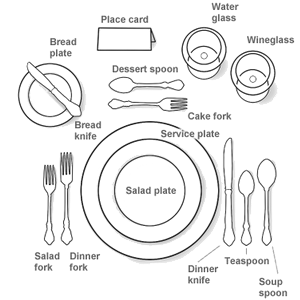
Emily Post (1872 – 1960) was an American author on etiquette. She wrote in various styles, including humorous travel books, early in her career. In 1922 her book Etiquette (full title Etiquette in Society, in Business, in Politics, and at Home) was a best seller, and updated versions continued to be popular for decades. In 1946, she founded The Emily Post Institute which continues her work. She died in 1960 in her New York City apartment at the age of 87.
Today, The Emily Post Institute, located in Burlington, Vermont, provides etiquette experts and advice to news outlets and other corporations. The authors at the Emily Post Institute write books and columns, conduct seminars and workshops, give speeches, and act as spokespeople for select corporations. They give media interviews each year on a variety of topics. Emily Post’s name has become synonymous, at least in North America, with proper etiquette and manners. Nearly half a century after her death, her name is still used in titles of etiquette books.
Posted in Language, Money |
Leave a Comment »
February 14, 2011

Tuxedo Park is a village in New York, about 50 miles north of New York City in Orange County from which the formal attire of the same name originates. The population was 731 at the 2000 census.The name is derived from a Native American word of the Lenape language, tucsedo, which means either ‘place of the bear’ or ‘clear flowing water.’ Tuxedo Park is a village within the southern part of the Town of Tuxedo (pop. 3,334).
Continue reading →
Posted in Art, Language, Money |
Leave a Comment »




 The Daily Omnivore