February 8, 2011
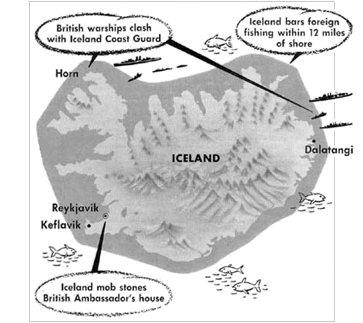
The Cod Wars were a series of confrontations in the 1950s and 1970s between the United Kingdom and Iceland regarding fishing rights in the North Atlantic. In 1972, Iceland unilaterally declared an Exclusive Economic Zone extending beyond its territorial waters, before announcing plans to reduce overfishing. It policed its quota system with the coast guard, leading to a series of net-cutting incidents with British trawlers that fished the areas. As a result, a fleet of Royal Naval warships and tug-boats were employed to act as a deterrent against any future harassment of British fishing crews by the Icelandic craft.
The conflict involved several cases of vessels ramming each other. The dispute ended in 1976 after Iceland threatened to close a major NATO base in retaliation for Britain’s deployment of naval vessels within the disputed 200 nautical mile (370 km) limit. The British government conceded, and agreed that after 1 December 1976 British vessels would not fish within the previously disputed area.
Posted in Food, Money, War |
Leave a Comment »
February 8, 2011
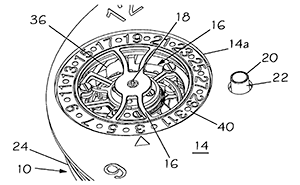

A tourbillon [tor-bee-yon] (French for ‘whirlwind’) is an addition to the mechanics of a watch escapement (the device which converts continuous rotational motion into an oscillating or back and forth motion; the source of the ‘ticking’ sound produced by watches and clocks).
Developed around 1795 by the French – Swiss watchmaker Abraham-Louis Breguet from an earlier idea by the English chronometer maker John Arnold a tourbillon counters the effects of gravity by mounting the escapement and balance wheel in a rotating cage. Originally an attempt to improve accuracy, tourbillons are still included in some expensive modern watches as a novelty and demonstration of watchmaking virtuosity. The mechanism is usually exposed for display on the watch’s face.
Posted in Art, Money, Technology |
Leave a Comment »
February 8, 2011

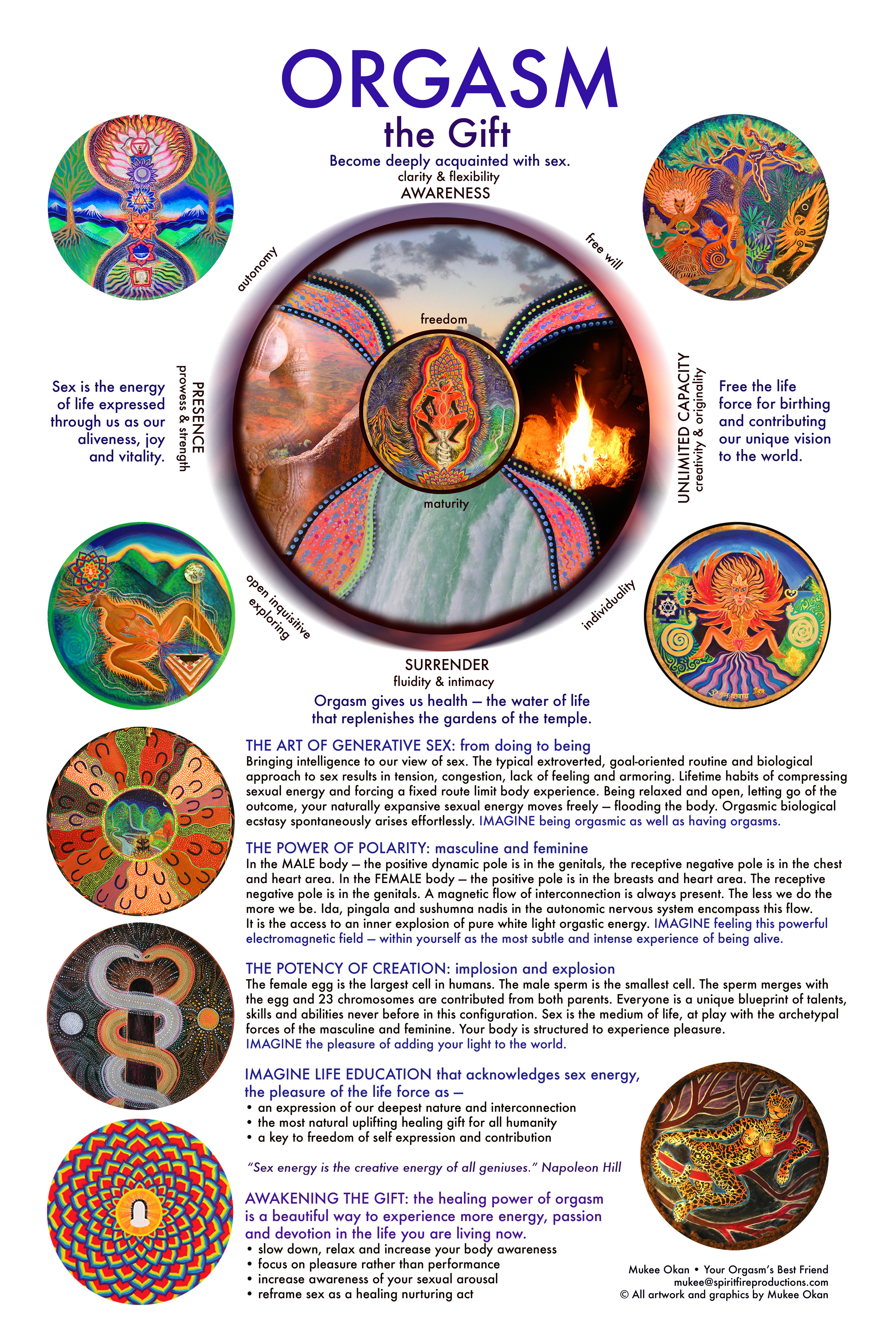
Oxytocin is a mammalian hormone that acts primarily in the brain. It is best known for roles in female reproduction. It is released in large amounts during labor, and after stimulation of the nipples, facilitating birth and breastfeeding. Recent studies have begun to investigate oxytocin’s role in various behaviors, including orgasm, social recognition, pair bonding, anxiety, and maternal behaviors. For this reason, it is sometimes referred to as the ‘love hormone.’
Posted in Health, Love, Sex |
Leave a Comment »
February 8, 2011

Coitus reservatus (also known as sexual continence) is commonly thought of as a form of sexual intercourse in which the man does not attempt to ejaculate within his partner, but instead attempts to remain at the plateau phase of intercourse for as long as possible avoiding the orgasm and seminal emission. Another term used for this kind of relationship is the word karezza.
Posted in Language, Sex |
Leave a Comment »
February 8, 2011
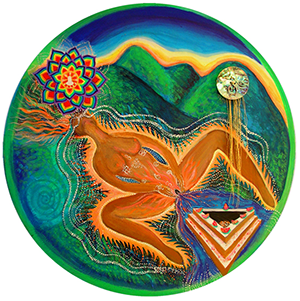
Neotantra is a term used to describe the modern, western use of the word Tantra (one of the later Hindu or Buddhist scriptures dealing especially with techniques and rituals including meditative and sexual practices). Neotantra refers to both the New Age and modern Western interpretations of traditional Indian tantra. Some of its proponents refer to ancient and traditional texts and principles, and many others use tantra as a catch-all phrase for ‘sacred sexuality,’ and may incorporate unorthodox practices. In addition, not all of the elements of Indian tantra are used in neotantric practices, in particular the reliance on a guru, or teacher.
Posted in Language, Philosophy, Sex |
Leave a Comment »
February 8, 2011

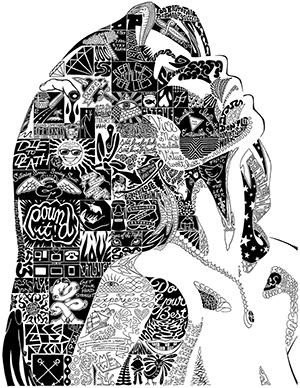
La petite mort, French for ‘the little death,’ is a metaphor for orgasm. More widely, it can refer to the spiritual release that comes with orgasm or to a short period of melancholy or transcendence as a result of the expenditure of the ‘life force,’ the feeling whereof is caused by the release of oxytocin in the brain after the occurrence of the orgasm. The term does not only apply to sexual experiences.
Literary critic Roland Barthes spoke of la petite mort as the chief objective of reading literature. He metaphorically used the concept to describe the feeling one should get when experiencing any great literature. It can also be used when some undesired thing has happened to a person and has affected them so much that ‘a part of them dies inside.’
Posted in Language, Sex, World |
Leave a Comment »
February 8, 2011
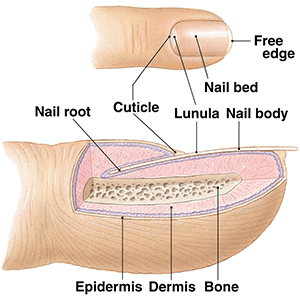
The lunula [loo-nyuh-luh] (‘little moon’ in Latin) is the crescent-shaped whitish area of the bed of a fingernail or toenail. The lunula is the visible part of the nail matrix (i.e. the root of the nail). In humans, it appears by week 14 of gestation, and has a primary structural role in defining the free edge of the distal nail plate (the part of the nail that grows outward). The lunula is most noticeable on the thumb, however, not everyone’s lunula is visible. In some cases, the eponychium may partially or completely cover the lunula.
It is located at the end of the nail (that is closest to the skin of the finger), but it still lies under the nail. It is not actually white, but it only appears so, when it is seen through the nail. Outlining the nail matrix, the lunula is a very delicate part of the nail structure. If one damages the lunula, the nail will permanently be deformed. Even when the totality of the nail is removed, the lunula remains in place and is similar in appearance to another smaller fingernail embedded in the nail bed.
Posted in Health, Language, Science |
Leave a Comment »
February 8, 2011
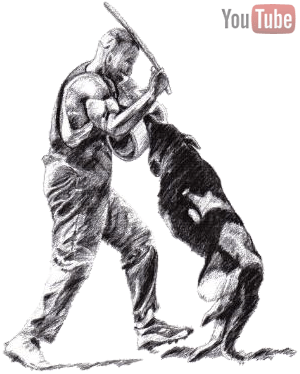
Schutzhund (German for protection dog) is a dog sport that was developed in Germany in the early 1900s to test whether German Shepherd Dogs exhibit the traits necessary for police-type work, rather than simply evaluating a dog’s appearance. Today, many breeds other than German Shepherds can compete in Schutzhund, but it is a demanding test for any dog and few are able to pass successfully.
Posted in Games, Language, World |
Leave a Comment »
February 8, 2011

Bo Burnham (b. 1990) is an American comedian and musician. He performs satirical songs with a politically incorrect slant, and rose to fame on YouTube.
Posted in Art, Humor |
1 Comment »
February 8, 2011
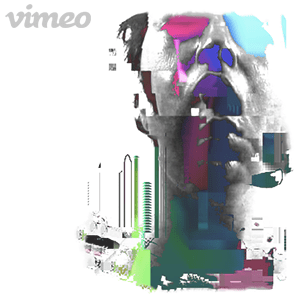
Compression artifacts may intentionally be used as a visual style, sometimes known as glitch art. In still images, an example is Jpegs, by German photographer Thomas Ruff, which intentionally uses JPEG artifacts.
In video art, one technique is datamoshing – mixing two videos sources, or exploiting the way different video codecs process motion and color information. The technique was pioneered by artists Sven König, Takeshi Murata and Paul B. Davis in collaboration with an American art collective called Paperrad.
Posted in Art, Language, Technology |
Leave a Comment »
February 7, 2011

Andreas Gursky (b. 1955) is a German visual artist known for his enormous architecture and landscape color photographs, some ten feet or more wide, and most employing a high point of view. As of early 2007, Gursky holds the record for highest price paid at auction for a single photographic image. His print 99 Cent II, Diptych, sold for GBP 1.7 million (USD $3.3 million) at Sotheby’s, London. Before the 1990s, Gursky did not digitally manipulate his images.
In the years since, Gursky has been frank about his reliance on computers to edit and enhance his pictures, creating an art of spaces larger than the subjects photographed. Visually, Gursky is drawn to large, anonymous, man-made spaces—high-rise facades at night, office lobbies, stock exchanges, the interiors of big box retailers (See his print 99 Cent II Diptychon). His style is described by art critics as enigmatic and deadpan. There is little to no explanation or manipulation on the works. His photography is straightforward.
Posted in Art, Money, Technology |
Leave a Comment »
February 7, 2011
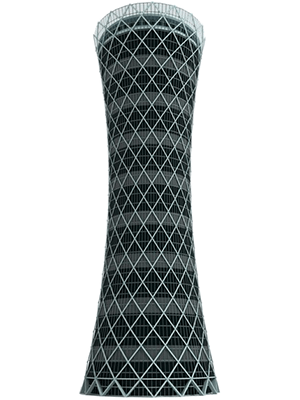
Doha [doh-hah] (Arabic for ‘the big tree’ or ‘the sticky tree’) is the capital city of the state of Qatar. Located on the Persian Gulf, it has a population of around one million. Doha is Qatar’s largest city, with over 80% of the nation’s population residing in the city or its surrounding suburbs, and is also the economic center of the country.
Much of Qatar’s oil and natural gas wealth is visible in Doha, which is home to the headquarters of the country’s largest oil and gas companies. Doha’s economy is built on the revenue the country has made from its oil and natural gas industries, and the Qatari government is rapidly trying to diversify the Qatari economy in order to move away from this dependence on oil. As a result, Doha is currently experiencing a very large boom, with the city developing very rapidly.
Posted in Money, Technology, World |
Leave a Comment »





 The Daily Omnivore