January 10, 2011
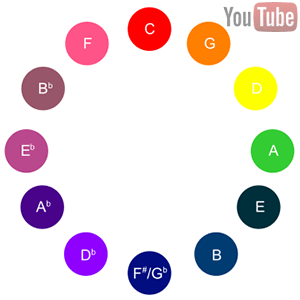
The clavier [kluh-veer] à [ah] lumières [ly-myer] keyboard with lights) was a musical instrument invented by Russian composer, Alexander Scriabin for use in his work Prometheus: Poem of Fire. However, only one version of this instrument was constructed, for the performance in New York in 1915. The instrument’s keyboard lights up as synesthetic system, specified in the score.
Scriabin was a friend of Nikolai Rimsky-Korsakov, who was a synesthete (someone with a neurologically-based condition in which stimulation of one sensory or cognitive pathway leads to automatic, involuntary experiences in a second sensory or cognitive pathway). Scriabin was also heavily influenced by Theosophy, which had its own different system of associating colors and pitches.
Posted in Art, Technology |
Leave a Comment »
January 10, 2011


A spiritual successor, sometimes called a spiritual sequel or a companion piece, is a successor to a work of fiction which does not directly build upon the storyline established by a previous work as do most traditional prequels or sequels, but nevertheless features many of the same elements, themes, and styles as its source material.
Continue reading →
Posted in Art, Language, Money |
Leave a Comment »
January 10, 2011

The peanut butter and jelly sandwich (PB&J) is a sandwich, popular in North America, that includes a layer of peanut butter and either jam or jelly on bread. It has numerous common additions including honey, chocolate or maple syrup, Nutella, bananas, apples, strawberries, butter, marshmallow fluff, potato chips, cheese, raisins and other dried fruit, and last but not least, bacon.
Both peanut butter and jelly were on the U.S. Military ration menus in World War II. It is said that the American soldiers added jelly to their peanut butter to make it more palatable. Peanut butter provided an inexpensive and high protein alternative to meat for soldiers. It was an instant hit and returning servicemen made peanut butter and jelly sales soar in the United States. Food historians haven’t found any ads or other mentions of peanut butter and jelly sandwiches before the 1940s.
Posted in Food |
Leave a Comment »
January 10, 2011

Infrared grills work by igniting propane or natural gas to superheat a ceramic tile, causing it to emit infrared radiation. The thermal radiation is generated when heat from the movement of charged particles within atoms is converted to electromagnetic radiation in the infrared heat frequency range.
IR offers heat that is uniformly distributed across the cooking surface and temperatures reach over 900 °F. This technology was previously patented, but the patents expired in 2000 and more companies have started offering infrared grills at lower prices.
Posted in Food, Technology |
Leave a Comment »
January 10, 2011


Music visualization, a feature found in electronic music visualizers and media player software, generates animated imagery based on a piece of music. The imagery is usually generated and rendered in real time and synchronized with the music as it is played, but some visualizations are pre-rendered.
Visualization techniques range from simple ones (e.g., a simulation of an oscilloscope display) to elaborate ones, which often include a plurality of composited effects. The changes in the music’s loudness and frequency spectrum are among the properties used as input to the visualization.
Posted in Art, Technology |
Leave a Comment »
January 10, 2011
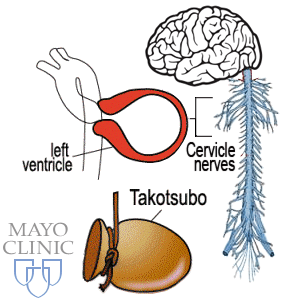
Takotsubo cardiomyopathy, is a sudden temporary weakening of the myocardium (the muscle of the heart). Because this weakening can be triggered by emotional stress, such as the death of a loved one, the condition is also known as broken heart syndrome. A tako tsubo is a jar-shaped, Japanese octopus trap that bears a resemblance to a heart experiencing Takotsubo cardiomyopathy: a bulging left ventricular apex and a preserved base of the left ventricle. The cause of the syndrome is not entirely understood, and is currently thought to involve high circulating levels of catecholamines (fight-or-flight hormones like adrenaline).
Evaluation of individuals with takotsubo cardiomyopathy typically includes a coronary angiogram, which will not reveal any significant blockages that would cause the left ventricular dysfunction. Provided that the individual survives their initial presentation, the left ventricular function improves within two months. Takotsubo cardiomyopathy is more commonly seen in post-menopausal women, and those with a history of a recent severe emotional or physical stress. A 2008 study by life insurance companies indicated that in the year following a loved one’s death, women were more than twice as likely to die than normal, and men more than six times as likely.
Posted in Death, Health |
Leave a Comment »
January 10, 2011

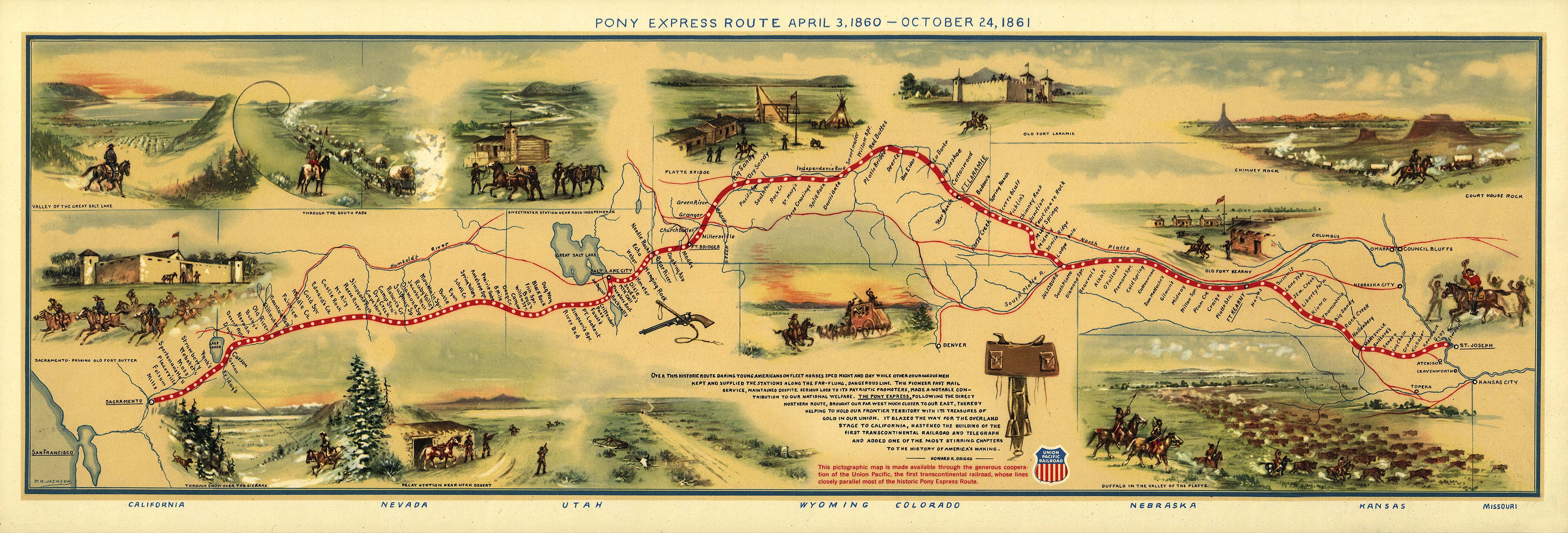
The Pony Express was a fast mail service crossing the Great Plains, the Rocky Mountains, and the High Sierras from Missouri to California, founded in 1860. It became the west’s most direct means of east-west communication before the telegraph and was vital for tying California closely with the Union just before the American Civil War. Patee House (a historic hotel in St. Joseph, Missouri) served as the Pony Express headquarters from 1860 to 1861. It is one block away from the home of infamous outlaw Jesse James, where he was shot and killed by Robert Ford. After his murder, Jesse James’ family took up lodging at the hotel.
Messages were carried by horseback riders in relays to stations across the prairies, plains, deserts, and mountains of the Western United States. For its 18 months of operation, it briefly reduced the time for messages to travel between the Atlantic and Pacific coasts to about ten days, with telegraphic communication covering about half the distance across the continent and mounted couriers the rest. The continued popularity of the Pony Express can be linked to Buffalo Bill Cody who claimed to have been an Express rider.
Posted in Language, Money |
Leave a Comment »
January 10, 2011


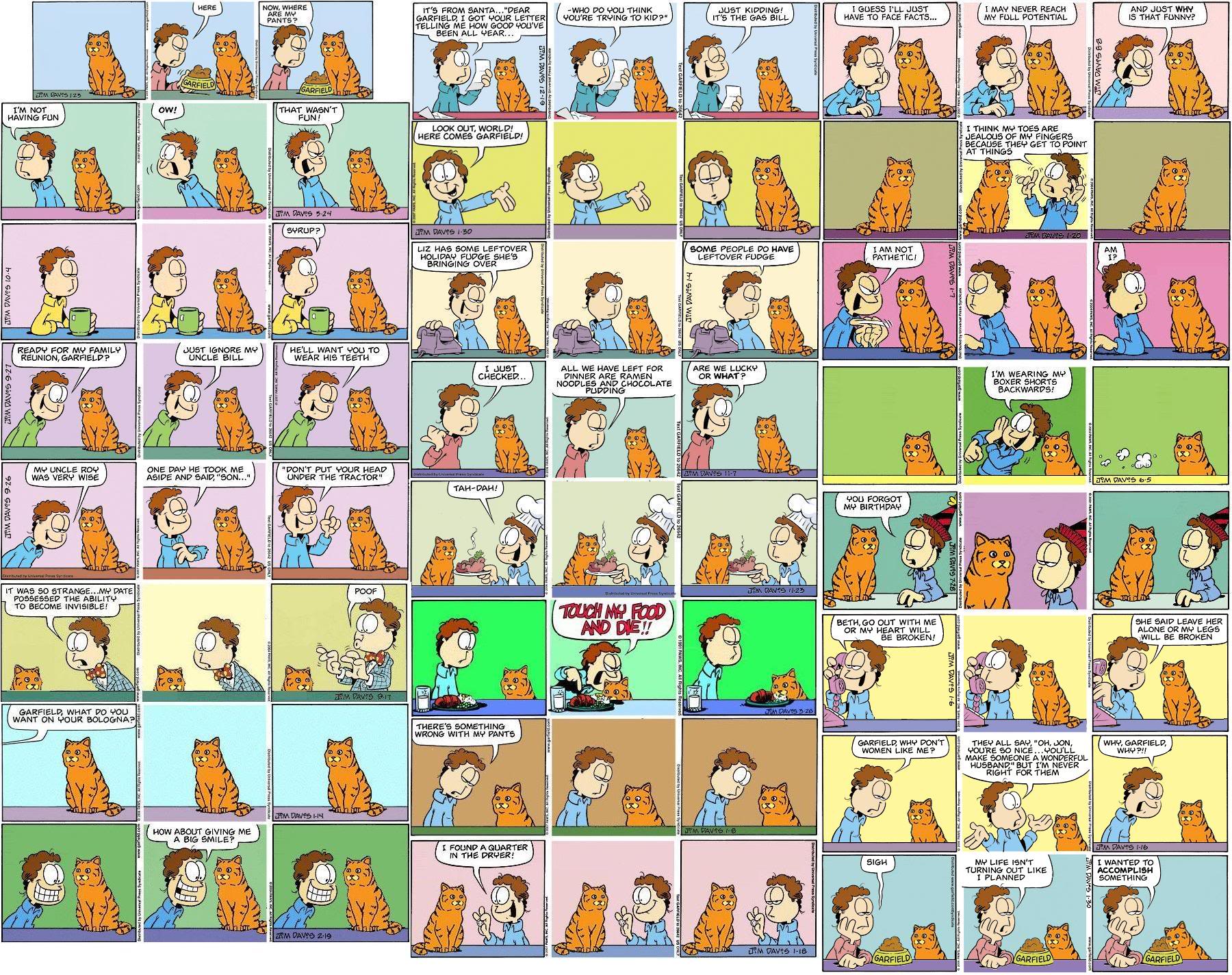
‘Silent Garfield‘ refers to the removal of Garfield’s thought balloons from his comic strips. A webcomic called Arbuckle does the above but also redraws the originals in a different art style. Garfield changes from being a comic about a sassy, corpulent feline, and becomes a compelling picture of a lonely, pathetic, delusional man who talks to his pets.
Another variation along the same lines, called ‘Realfield’ or ‘Realistic Garfield,’ is to redraw Garfield as a real cat as well as removing his thought balloons. Still another approach to editing the strips involves removing Garfield and other main characters from the originals completely, leaving Jon talking to himself, such as in ‘Garfield Minus Garfield’ by Dan Walsh.
Posted in Art, Humor |
Leave a Comment »
January 6, 2011

Místico (b. 1982) is a Mexican Luchador enmascarado, or masked professional wrestler currently working for the lucha libre promotion Consejo Mundial de Lucha Libre (CMLL). Since 2006 Místico has been the main tecnico (good guy) in CMLL and the biggest box office draw in all of Mexico. Místico is Spanish for ‘Mystic,’ a religious ring character who is the storyline protege of the wrestling priest Fray Tormenta.
Posted in Games, Humor |
Leave a Comment »
January 6, 2011


A telomere [tel-uh-meer] is a protective region of repetitive DNA at the end of a chromosome, The telomere regions deter the degradation of genes near the ends of chromosomes by allowing for the shortening of chromosome ends, which necessarily occurs during chromosome replication. The telomeres are disposable buffers blocking the ends of the chromosomes and are consumed during cell division and replenished by an enzyme, the telomerase reverse transcriptase.
The telomere shortening mechanism normally limits cells to a fixed number of divisions, and animal studies suggest that this is responsible for aging on the cellular level and sets a limit on lifespans. Telomeres also protect a cell’s chromosomes from fusing with each other or rearranging — abnormalities that can lead to cancer — and so cells are destroyed when their telomeres are consumed. Most cancers are the result of ‘immortal’ cells that have ways of evading this programmed destruction.
Posted in Death, Health, Science |
Leave a Comment »
January 6, 2011

Googie architecture (also known as populuxe or Doo-Wop) is a form of modern architecture and a subdivision of futurist architecture, influenced by car culture and the Space and Atomic Ages. Originating in Southern California during the late 1940s and continuing approximately into the mid-1960s, the types of buildings that were most frequently designed in a Googie style were motels, coffee houses and bowling alleys.
The school later became widely-known as part of the Mid-Century modern style, and some of those more notable variations represent elements of the populuxe aesthetic, as in Eero Saarinen’s TWA Flight Center. Features of Googie include upswept roofs, curvaceous, geometric shapes, and bold use of glass, steel and neon. Googie was also characterized by Space Age designs that depict motion, such as boomerangs, flying saucers, atoms and parabolas, and free-form designs such as ‘soft’ parallelograms and the ubiquitous artist’s palette motif.
Posted in Art |
Leave a Comment »
January 6, 2011

The TI-83 series of graphing calculators is manufactured by Texas Instruments. The original TI-83 is itself an upgraded version of the TI-82. Released in 1996, it is one of the most used graphing calculators for students. TI replaced the TI-83 with the TI-83 Plus calculator in 1999, which included flash memory, enabling the device’s operating system to be updated if needed, or for large new Flash Applications to be stored, accessible through a new Apps key.
The Flash memory can also be used to store user programs and data. In 2001 the TI-83 Plus Silver Edition was released, which featured approximately nine times the available Flash memory, and over twice the processing speed (15 MHz) of a standard TI-83 Plus.
Posted in Education, Money, Technology |
Leave a Comment »