December 1, 2010

The Pickelhaube (from the old German pickel, ‘point’ or ‘pickaxe;’ and haube, ‘bonnet’) was a spiked helmet worn in the 19th and 20th centuries by German military, firefighters, and police. Although typically associated with the Prussian army, the helmet enjoyed wide use among uniformed occupations in the Western world. It was originally designed in 1842 by King Frederick William IV of Prussia, maybe as a copy of similar helmets that were adopted at the same time by the Russian military.It is not clear whether this was a case of imitation, or parallel invention.
Posted in Art, War, World |
Leave a Comment »
December 1, 2010

The pith helmet (also known as the safari helmet, sun helmet, topee, sola topee, salacot or topi) is a lightweight cloth-covered helmet made of cork or pith (typically pith from the sola Indian swamp growth). Designed to shade the wearer’s head and face from the sun, pith helmets were once often worn by Westerners in the tropics.
Crude forms of pith helmets had existed as early as the 1840s, but it was around 1870 that the pith helmet became popular with military personnel in Europe’s tropical colonies. The Franco-Prussian War had popularized the German Pickelhaube, which may have influenced the distinctive design of the pith helmet. Such developments may have merged with a traditional design from the Philippines, the salakot. The alternative name salacot (also written salakhoff) appears frequently in Spanish and French sources; it comes from the Tagalog word salacsac (or Salaksak).
Posted in Art, War, World |
1 Comment »
December 1, 2010
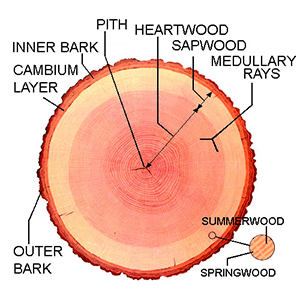
Pith is a substance that is found in vascular plants. It consists of soft, spongy cells, and is located either in the center of the stem or the center of the roots in flowering plants. It is encircled by a ring of xylem (woody tissue), and outside that, a ring of phloem (bark tissue). In some plants the pith is solid, but for most it is soft. A few plants, such as walnuts, have distinctive chambered pith with numerous short cavities.
The word comes from the Old English word piþa, meaning substance, akin to Middle Dutch pit, meaning the pit of a fruit. The modern word pithy (concise and forcefully expressive) derives from it. The inner rind of citrus fruits and other hesperidium is also called pith. The pith and the peel are where about three quarters of the nutrients of an orange are. The pith itself is bitter and is usually added to marmalade or otherwise prepared to be eaten.
Posted in Language, Science |
Leave a Comment »
December 1, 2010

The Lençóis Maranhenses National Park is located on the coast of northeastern Brazil; it is an area of low, flat, occasionally flooded land, overlaid with large, discrete sand dunes. It encompasses roughly 1000 square kilometers, and despite abundant rain, supports almost no vegetation. The park was created on June 2, 1981. The National Park is quite extensive and has no access roads. Because of the nature of the park’s protected status, most vehicles are not permitted access. Entrance to the park is made exclusively by 4-wheel drive trucks.
Lying just outside the Amazon basin, the region is subject to a regular rain season during the beginning of the year. The rains cause a peculiar phenomenon: fresh water collects in the valleys between sand dunes, spotting the desert with blue and green lagoons that reach their fullest between July and September. The area is also home to a variety of fish which, despite the almost complete disappearance of the lagoons during the dry season, have their eggs brought from the sea by birds.
Posted in Science, World |
Leave a Comment »
December 1, 2010


Teetotalism [tee-toht-l-iz-uhm] refers to either the practice of or the promotion of complete abstinence from alcoholic beverages. A person who practices or advocates teetotalism is called a teetotaler (plural teetotalers or teetotalli). The teetotalism movement was first started in Preston, England in the early 19th century. Some common reasons for choosing teetotalism are religious, health, family, philosophical, or social reasons, and, sometimes, as simply a matter of taste or preference.
Contemporary and colloquial usage has somewhat expanded teetotalism to include strict abstinence from most recreational intoxicants (legal and illegal). Most teetotaler organizations also demand from their members that they do not promote or produce alcoholic intoxicants.
Continue reading →
Posted in Drugs, Language, Politics |
Leave a Comment »
December 1, 2010

The NatureMill is an automated, indoor composter. Powered by about 10 watts of electricity per month, it heats and mixes food scraps every four hours. Steady aeration and low heat accelerates the composting process; it takes two to the three weeks to convert waste into usable soil.
Natural compost cultures consume waste quickly, without odors. They produce a mild aroma like sourdough, mushrooms, or straw. Sawdust and baking soda reduce acidity, and a fan draws air into the machine, providing oxygen to the cultures. A powerful carbon filter removes any lingering odors. The NatureMill Pro costs $399. Maximum input is 120 lbs. per month. Bones and peach and avocado pits will not compost in a NatureMill, and acidic foods like citrus, tomatoes, and grapes will only compost in limited quantities.
Posted in Food, Technology |
Leave a Comment »
December 1, 2010

Asteroid mining refers to exploiting raw materials from asteroids and planetoids in space, especially near-Earth objects. Minerals and volatiles could be mined from an asteroid or spent comet to provide space construction material (e.g., iron, nickel, titanium), to extract water and oxygen to sustain the lives of prospector-astronauts on site, as well as hydrogen and oxygen for use as rocket fuel. In space exploration, these activities are referred to as in-situ resource utilization.
A relatively small metallic asteroid with a diameter of 1 mile contains more than $20 trillion US dollars worth of industrial and precious metals. The gold, cobalt, iron, manganese, nickel, palladium, platinum, and other metals that we now mine from the Earth’s crust, and that are essential for economic and technological progress, came originally from the rain of asteroids that struck the primordial Earth. Earth’s massive gravity pulled all such siderophilic (iron loving) elements into the planet’s core during its molten youth more than four billion years ago. Initially, this left the crust utterly depleted of such valuable elements. Asteroid impacts re-infused the depleted crust with metals.
Posted in Money, Science, Technology |
Leave a Comment »
December 1, 2010

Landfill mining and reclamation (LFMR) is the excavation and processing of solid wastes which have previously been landfilled to reduce the amount of landfill mass encapsulated within the closed landfill and/or to remove hazardous materials. In the process, mining recovers valuable recyclable materials, a combustible leachate (liquid that, in passing through matter, extracts solutes, suspended solids or any other component of the material through which it has passed), soil, and landfill space.
The aeration of the landfill soil is a secondary benefit regarding the landfill’s future use, and the combustible leachate is useful for the generation of power. The concept was introduced as early as 1953 at the Hiriya landfill near the city of Tel Aviv, Israel. Waste contains many resources with high value, the most notable of which are non-ferrous metals such as aluminium cans and scrap metal. The concentration of aluminium in many landfills is higher than the concentration of aluminum in bauxite from which the metal is derived.
Posted in Money, Technology |
Leave a Comment »
November 30, 2010

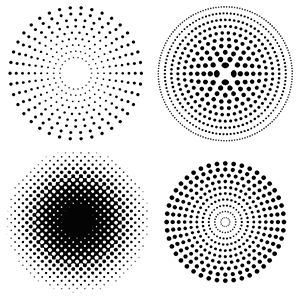
Halftone is the reprographic technique that simulates continuous tone imagery through the use of dots, varying either in size, in shape or in spacing. ‘Halftone’ can also be used to refer specifically to the image that is produced by this process. Whereas continuous tone imagery contains an infinite range of colors or greys, the halftone process reduces visual reproductions to a binary image that is printed with only one color of ink. This binary reproduction relies on a basic optical illusion— tiny halftone dots are perceived as smooth tones by the human brain.
At a microscopic level, developed black and white photographic film also consists of only two colors, and not an infinite range of continuous tones. For details, see film grain. Just as color photography evolved with the addition of filters and film layers, color printing is made possible by repeating the halftone process for each subtractive color—most commonly using what is called the ‘CMYK color model.’ The semi-opaque property of ink allows halftone dots of different colors to create another optical effect—full-color imagery.
Posted in Art, Technology |
Leave a Comment »
November 30, 2010

Hedcut is a term referring to a style of drawing, associated with ‘The Wall Street Journal’ half-column portrait illustrations. They use the stipple method of many small dots and the hatching method of small lines to create an image, and are designed to emulate the look of woodcuts from old-style newspapers, and engravings on certificates and currency. The phonetic spelling of ‘hed’ may be based on newspapers’ use of the term ‘hed’ for ‘headline.’ The ‘Wall Street Journal’ adopted the current form of this portraiture in 1979 when freelance artist Kevin Sprouls approached the paper with some ink dot illustrations he’d created. The front page editor felt that the drawings complemented the paper’s classical feeling and gave it a sense of stability. Additionally, they are generally more legible than photographs of the same size would be.
Sprouls was subsequently hired as a staff illustrator and remained there until 1987. Today, there are six hedcut artists on staff. Each drawing takes between three and five hours to produce. First, a high quality photograph must be secured. This photograph is scanned, converted to grayscale, and the contrast is adjusted. The photograph is then printed and placed on a light table, and overlaid with tracing vellum. The illustrators then trace directly over this image with ink pens, recreating the source photo using specific dot and line patterns. Women are sometimes more difficult to depict than men as they tend to have more complicated haircuts, which are often cropped for simplicity.
Posted in Art, Language |
Leave a Comment »
November 30, 2010
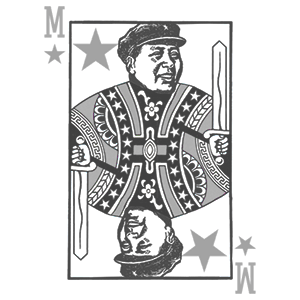
Mao (also known as Chairman, Dictator, Point of Order, Bjorn, and Peebo among many others) is a card game of the Shedding family, in which the aim is to get rid of all of the cards in hand without breaking certain unspoken rules. The game is from a subset of the Stops family, and is similar in structure to the card game Uno or Crazy Eights. The game forbids its players from explaining the rules, and new players are often told only ‘the only rule you may be told is this one.’
The ultimate goal of the game is to be the first player to get rid of all the cards in their hand. Specifics are discovered through trial and error. A player who breaks a rule is penalized by being given an additional card from the deck. The person giving the penalty must state what the incorrect action was, without explaining the rule that was broken.
Posted in Games |
Leave a Comment »
November 30, 2010

Anti-humor (also known as unjokes) are a kind of humor based on the surprise factor of absence of an expected joke or of a punch line in a narration which is set up as a joke. This kind of anticlimax is similar to that of the shaggy dog story. In anti-comedy the gist of the humor is in how poor the joke is or how poorly it was told. A popular kind of unjoke involves any seemingly humorous setup leading to the non-sequitur punchline of ‘No soap, radio’ or the joke ‘A man walks into a bar. He is an alcoholic and it’s destroying his family.’ Another form of anti-humor is poking fun at bad humor by the way of parody. An example is Jim’s Journal, a comic strip by Scott Dikkers, co-founder of The Onion, whose four-panel strips end without any sort of punchline.
Alternative comedy, among its other aspects, parodies the traditional idea of the joke as a form of humor. Andy Kaufman saw himself as a practitioner of anti-humor. Other comedians known for their anti-humor are Tim and Eric of Tim and Eric Awesome Show, Great Job!, Norm Macdonald, Ted Chippington, Neil Hamburger, Corey Mystyshyn, Jimmy Carr, and Bill Bailey.
Posted in Humor |
Leave a Comment »




 The Daily Omnivore