November 18, 2010

Prize indemnity insurance is indemnification insurance for a promotion in which the participants are offered the chance to win prizes. Instead of keeping cash reserves to cover large prizes, the promoter pays a premium to an insurance company, which then reimburses the insured should a prize be given away. One of the earliest and most common forms of prize indemnity insurance is hole-in-one insurance, which began to gain prominence during the early 1980s. Continue reading →
Posted in Games, Money |
Leave a Comment »
November 18, 2010

The Sokal affair was a publishing hoax perpetrated by Alan Sokal, a physics professor at New York University. In 1996, Sokal submitted an article to Social Text, an academic journal of postmodern cultural studies. The submission was an experiment to test the magazine’s intellectual rigor and, specifically, to learn if such a journal would ‘publish an article liberally salted with nonsense if it (a) sounded good and (b) flattered the editors’ ideological preconceptions.’
Continue reading →
Posted in Humor, Language, Science |
Leave a Comment »
November 18, 2010

The Goddess movement is a loose grouping of social and religious phenomena growing out of second-wave feminism, predominantly in North America, Western Europe, Australia and New Zealand in the 1970s, which spread to the metaphysical community as well.
Spurred by the perception that women were not treated equitably by mainstream religions, many women turned to a female deity, as more in tune with their beliefs and spiritual needs. Masculine gender and male imagery were, at the time, attached to deity to the exclusion of female gender and female imagery. A unifying theme of this diverse movement is the female-ness of the deity (as opposed and contrasted to a patriarchal, male God).
Posted in Philosophy, Politics, Sex |
Leave a Comment »
November 18, 2010

The Buddhabrot is a special rendering of the Mandelbrot set which, when traditionally oriented, resembles to some extent certain depictions of the Buddha. The rendering technique was discovered and later described in a 1993 Usenet post to sci.fractals by Melinda Green. Previous researchers had come very close to finding the precise Buddhabrot technique. In 1988 Linas Vepstas relayed similar images to Cliff Pickover for inclusion in Pickover’s forthcoming book Computers, Pattern, Chaos, and Beauty.
Posted in Art, Technology |
Leave a Comment »
November 18, 2010
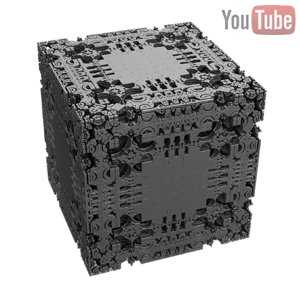
The Mandelbrot [man-del-brot] set is a mathematical fractal named after Benoît Mandelbrot, who studied and popularized it. When computed and graphed it displays an elaborate boundary which, being a fractal, does not simplify at any given magnification, meaning it shows more intricate detail the closer one looks or magnifies the image, usually called ‘zooming in.’
The Mandelbrot set has become popular outside mathematics both for its aesthetic appeal and for being a complicated structure arising from a simple definition, and is one of the best-known examples of mathematical visualization. Many mathematicians, including Mandelbrot, communicated this area of mathematics to the public.
Posted in Art, Technology |
1 Comment »
November 18, 2010

Tulip mania was a period in the Dutch Golden Age during which contract prices for bulbs of the recently introduced tulip reached extraordinarily high levels and then suddenly collapsed. At the peak of tulip mania in February 1637, some bulbs sold for more than 10 times the annual income of a skilled craftsman. The most sought after variety of tulip was the Semper Augustus; as much as 12 acres of land was reportedly offered in exchange for a single bulb. It is generally considered the first recorded speculative bubble (or economic bubble). The term ‘tulip mania’ is now often used metaphorically to refer to any large economic bubble (when asset prices deviate from intrinsic values).
Research on the tulip mania is difficult because of the limited data from the 1630s. Although these explanations are not generally accepted, some modern economists have proposed rational explanations, rather than a speculative mania, for the rise and fall in prices. For example, other flowers, such as the hyacinth, also had high prices on the flower’s introduction, which then fell dramatically. The high prices may also have been driven by expectations of a parliamentary decree that contracts could be voided for a small cost—thus lowering the risk to buyers.
Posted in Money, World |
Leave a Comment »
November 17, 2010
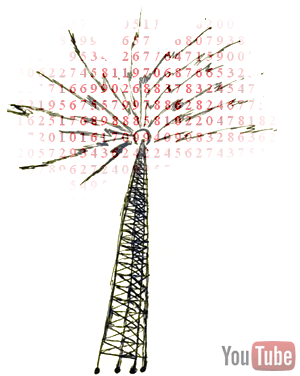
Numbers stations are shortwave radio stations of uncertain origin. They generally broadcast artificially generated voices reading streams of numbers, words, letters (sometimes using a spelling alphabet), tunes or Morse code. They are in a wide variety of languages and the voices are usually female, though sometimes male or children’s voices are used. Numbers stations appear and disappear over time (although some follow regular schedules), and their overall activity has increased slightly since the early 1990s.
Evidence supports popular assumptions that the broadcasts are used to send messages to spies. This usage has not been publicly acknowledged by any government that may operate a numbers station, but in 1892, the United States tried the Cuban Five for spying for Cuba. The group had received and decoded messages that had been broadcast from a Cuban numbers station. In 2009, the United States charged Walter Kendall Myers with conspiracy to spy for Cuba and receiving and decoding messages broadcast from a numbers station operated by the Cuban Intelligence Service.
Posted in Politics, Technology, War |
Leave a Comment »
November 17, 2010
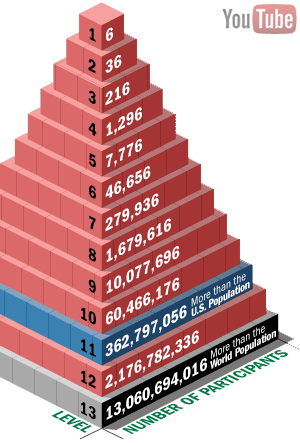
A pyramid scheme is a non-sustainable business model that involves promising participants payment primarily for enrolling other people into the scheme, rather than from any real investment or sale of products or services to the public. Pyramid schemes are a form of fraud. Pyramid schemes are illegal in many countries and have existed for at least a century, some with variations to hide their true nature.
Posted in Money, Politics |
Leave a Comment »
November 17, 2010


Multi-level marketing (MLM) is a marketing strategy in which the sales force is compensated not only for sales they personally generate, but also for the sales of others they recruit, creating a downline of distributors and a hierarchy of multiple levels of compensation. Other terms for MLM include network marketing, direct selling, and referral marketing. Although the products and company are supposed to be marketed directly to consumers and potential business partners by means of relationship referrals and word of mouth marketing, critics have charged that most MLMs are pyramid schemes.
MLM companies have been a frequent subject of criticism as well as the target of lawsuits. Criticism has focused on their similarity to illegal pyramid schemes, price-fixing of products, high initial start-up costs, emphasis on recruitment of lower-tiered salespeople over actual sales, encouraging if not requiring salespeople to purchase and use the company’s products, potential exploitation of personal relationships which are used as new sales and recruiting targets, complex and sometimes exaggerated compensation schemes, and cult-like techniques which some groups use to enhance their members’ enthusiasm and devotion. Not all MLM companies operate the same way, and MLM groups have persistently denied that their techniques are anything but legitimate business practices.
Posted in Money, Politics |
Leave a Comment »
November 17, 2010

Luna, also called the ‘Stafford Giant,’ is a 600 to 1000-year-old redwood tree in Humboldt County, California, that activist Julia Butterfly Hill lived in for 738 days beginning in 1997. The name Luna was given to it in 1997 by a group of Earth First! members, who built a small platform from salvaged wood to serve as a tree-sit platform. Hill occupied the tree in order to save the grove from being clear-cut by the Pacific Lumber Company. Although many refer to the tree as ‘she,’ giant redwoods produce both male and female cones, and technically are neither male nor female, but monoecious.
In November of 2000, an unknown vandal used a chainsaw to cut halfway through the tree. Civil engineer Steve Salzman designed a system to help the tree withstand the extreme windstorms which frequent the Northern California hillside, at speeds which peak between 60 and 100 miles per hour. Tree climbers installed a steel cable ‘collar’ around Luna’s main trunk 100 feet above the ground. Four cables radiate from this collar and are attached with turnbuckles to four remote anchor points 100-150 feet away.
Posted in Politics |
Leave a Comment »
November 17, 2010

Zener [zeh-ner] cards are cards used to conduct experiments for extra-sensory perception (ESP), most often clairvoyance. Perceptual psychologist Karl Zener designed the cards in the early 1930s for experiments conducted with his colleague, parapsychologist J. B. Rhine. Originally, tests for ESP were conducted using a standard deck of playing cards. There are just five different Zener cards: a hollow circle (one curve), a Greek cross (two lines), three vertical wavy lines (or ‘waves’), a hollow square (four lines), and a hollow five-pointed star. There are 25 cards in a pack, five of each design.
When Zener cards were first used, they were made out of a fairly thin translucent white paper. Several subjects or groups of subjects scored very highly until it was discovered that they had often been able to see the symbols through the backs of the cards. A redesign made it impossible to see the designs through the cards under any conditions. A subsequent deck featured an illustration of a building at Duke University on its reverse side, but the use of a non-symmetric reverse design allowed the deck to be exploited as a one-way deck.
Posted in Games, Philosophy, Science |
Leave a Comment »
November 17, 2010

Missing white woman syndrome (MWWS) or missing pretty girl syndrome is a vernacular term for the alleged disproportionately greater degree of coverage in television, radio, newspaper and magazine reporting of a misfortune, most often a missing person case, involving a young, attractive, white, middle-class (or above) woman, compared with cases concerning a missing male, or missing females of other ethnicities or economic classes. Notable cases: Chandra Levy, Elizabeth Smart, Laci Peterson, and Natalee Holloway.
Posted in Politics |
Leave a Comment »


 The Daily Omnivore