November 17, 2010
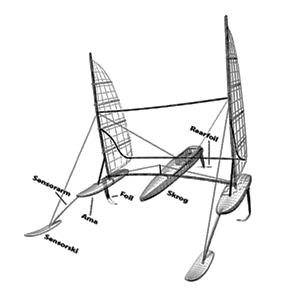
The Hobie TriFoiler is the fastest production sailboat ever created with a top speed of around 35 mph. Designed by the brothers Greg and Dan Ketterman, this trimaran has two sails, one on each ama, and hydrofoils that lift the hulls out of the water at speed. It lifts on the foils at wind speeds between 10 and 11 mph (18 km/h) and quickly accelerates to twice that speed in seconds.
The TriFoiler’s high price-tag ($12,900), fragility, and usage limited to winds between 10 and 25 mph (40 km/h) with low waves, led the Hobie Cat Company to discontinue production. Approximately 30 Trifoilers were built prior to production starting at Hobie in 1995 and another 170 were produced by Hobie before halt of production in 1999.
Posted in Games, Technology |
Leave a Comment »
November 16, 2010

Vladimir Grigoryevich Tretchikoff (1913 – 2006) was one of the most commercially successful artists of all time – his painting Chinese Girl (popularly known as ‘The Green Lady’) is one of the best selling art prints ever. Tretchikoff was a self-taught artist who painted realistic figures, portraits, still life and animals, with subjects often inspired by his early life in China and Malaysia, and later life in South Africa. Tretchikoff’s work was immensely popular with the general public, but is often seen by art critics as the epitome of kitsch (indeed, he was nicknamed the ‘King of Kitsch’).
He worked in oil, watercolour, ink, charcoal and pencil but is best known for his reproduction prints which sold worldwide in huge numbers. The reproductions were so popular that it was said Tretchikoff was second only to Picasso in his popularity. Tretchikoff once said that the only difference between himself and Vincent Van Gogh was that Van Gogh had starved whereas he had become rich.
Posted in Art, Money, World |
Leave a Comment »
November 16, 2010

Catullus 16 is a poem by Gaius Valerius Catullus (ca. 84 BC – ca. 54 BC). The poem, written in a hendecasyllabic (11-syllable) meter, was considered so explicit that a full English translation was not openly published until the late twentieth century: Continue reading →
Posted in Art, Language, Sex |
Leave a Comment »
November 16, 2010
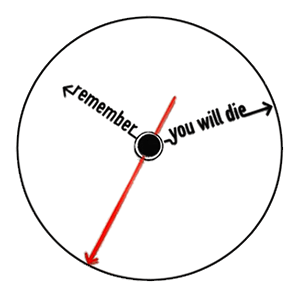
Memento mori is a Latin phrase translated as ‘Remember your mortality’ or “remember you will die’ – (literally: ‘[in the future] remember to die’). It names a genre of artistic creations that vary widely from one another, but which all share the same purpose: to remind people of their own mortality. The phrase has a tradition in art that dates back to antiquity. In ancient Rome, the words are believed to have been used on the occasions when a Roman general was parading through the streets during a victory triumph. Standing behind the victorious general was his slave, who was tasked to remind the general that, though his highness was at his peak today, tomorrow he could fall.
The thought came into its own with Christianity, whose strong emphasis on Divine Judgment, Heaven, Hell, and the salvation of the soul brought death to the forefront of consciousness. Most memento mori works are products of Christian art, although there are equivalents in Buddhist art.
Posted in Art, Death, Philosophy |
Leave a Comment »
November 16, 2010
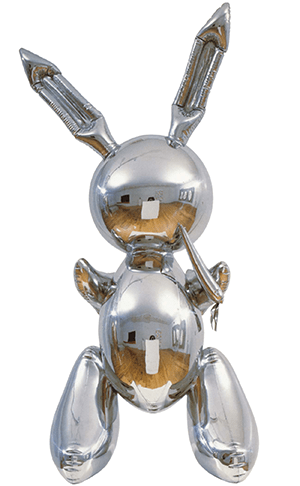
Jeff Koons’s ‘Rabbit‘ began as an inflatable, store-bought, plastic toy. Its transformation started when Koons bought it, blew it up, and had it cast in highly polished stainless steel. It has crinkled ears like an inflatable toy, a spherical head, and bulbous appendages, yet its face is blank. While it appears to be a shiny, lightweight, Mylar balloon, it is actually quite heavy and hard and stands 41 inches tall.
Rabbit’s surface also calls to mind the use of shiny metals in both historical and social contexts. According to Koons, ‘Polished objects have often been displayed by the church and by wealthy people to set a stage of both material security and enlightenment of spiritual nature; the stainless steel is a fake reflection of that stage.’
Posted in Art |
Leave a Comment »
November 16, 2010

Principia Discordia is a Discordian religious text written by Greg Hill (Malaclypse The Younger) and Kerry Thornley (Omar Khayyam Ravenhurst). It was originally published under the title ‘Principia Discordia or How The West Was Lost’ in a limited edition of 5 copies in 1965. Discordianism is a religion centered on the idea that chaos is all that there is, and that disorder and order are both illusions that are imposed on chaos. There is some division as to whether it should be regarded as a parody religion, and if so to what degree.
It has been called ‘Zen for roundeyes,’ based on similarities with absurdist interpretations of the Rinzai school of Buddhism. Discordianism recognizes chaos, discord, and dissent as valid and desirable qualities, in contrast with most religions, which idealize harmony and order. While the Principia is full of literal contradictions and unusual humor, it contains several passages which propose that there is serious intent behind the work. Saints identified include Emperor Norton, Yossarian, Don Quixote, and Bokonon.
Posted in Humor, Language, Philosophy |
1 Comment »
November 16, 2010


Fnord is the typographic representation of disinformation or irrelevant information intending to misdirect, with the implication of a worldwide conspiracy. The word was coined as a nonsensical term with religious undertones in the Discordian religious text Principia Discordia (1965) by Kerry Thornley and Greg Hill, but was popularized by The Illuminatus! Trilogy (1975) of satirical conspiracy fiction novels by Robert Shea and Robert Anton Wilson.
Continue reading →
Posted in Humor, Language, Philosophy |
Leave a Comment »
November 16, 2010

Kilgore Trout is a fictional character created by author Kurt Vonnegut. He was originally created as a fictionalized version of author Theodore Sturgeon (Vonnegut’s colleague in the genre of science fiction), although Trout’s consistent presence in Vonnegut’s works has also led critics to view him as the author’s own alter ego.
Trout, who has supposedly written over 117 novels and over 2000 short stories, is usually described as an unappreciated science fiction writer whose works are used only as filler material in pornographic magazines. However, he does have at least three fans: Eliot Rosewater and Billy Pilgrim—both Vonnegut characters—have a near-complete collection of Trout’s work or have read most of his work.
Continue reading →
Posted in Art, Humor |
Leave a Comment »
November 15, 2010

City Hall station, also known as City Hall Loop, was the original southern terminal of the first line of the New York City Subway, built by the Interborough Rapid Transit Company (IRT), named the ‘Manhattan Main Line,’ and now part of the IRT Lexington Avenue Line. Opened on October 27, 1904, this station underneath the public area in front of City Hall was designed to be the showpiece of the new subway. The station was designed by Spanish architect, Rafael Guastavino.
This station is unusually elegant in architectural style, and is unique among the original IRT stations, employing Romanesque Revival architecture. The platform and mezzanine feature Guastavino tile, skylights, colored glass tilework and brass chandeliers. Passenger service was discontinued on December 31, 1945, making it a ghost station, although the station is still used as a turning loop for 6 and <6> trains.
Posted in Art, Technology |
Leave a Comment »
November 15, 2010

A kytoon [kahy-toon] (kite + balloon) is a kite with a significant amount of aerostatic lift from a lighter than air gas carried within. The primary advantage of a kytoon is that it remains up and at a reasonably stable position above the tether point, irrespective of the wind. Kytoons have been used in peace and war, been employed for raising rescue signals, antennae, and turbines for generating electricity.
Kytoons may be flown in earth or other planetary atmospheres. Any gas may be used to inflate the bladder parts of a kytoon. Hydrogen, methane, air, helium, etc. may be used to inflate the balloon aspect of a kytoon.
Posted in Language, Technology |
Leave a Comment »
November 15, 2010
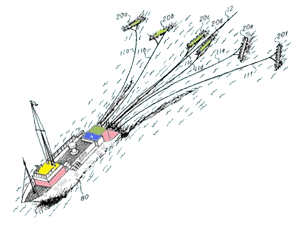

A paravane [par-uh-veyn], also called a water kite, is a towed winged (hydrofoiled) underwater object. Paravanes have applications in sport or commercial fishing, marine exploration, and defense. Navies equip paravanes with cable cutters to sever moored mines, and explosive paravanes are essentially towable mines. Commercial fishers use paravanes to tow bait and lead fish into trolling nets. Paravanes are also used for sampling water chemistry, taking seismic readings, and mapping marine geography.
Human-on-board paravanes are used to transport explorers, scuba divers, and spear-fishers. Foilboards used for recreation are also a type of water kite. Early work in coupling water kites was done by the late J.C. Hagedoorn, a geophysics professor at Delft University. His system coupled manned parafoils with water kites he named ‘hapas.’ Later experimenters also used the terminology ‘chien de mer’ (French for ‘sea dog’).
Posted in Language, Technology |
Leave a Comment »
November 15, 2010

A foilboard or hydrofoil board is a surfboard with a hydrofoil that extends below the board into the water. Laird Hamilton, a prominent figure in the invention of tow-in surfing (the use of a jet ski to tow the rider into a wave), is credited with popularizing the foilboard. Mango Carafino, a big wave tow surfing athlete and water sport instructor from the Hawaiian Island of Maui, is the leading developer of the hydrofoil board design for stand-up hydro foil boarding applications.
The stand-up design allows the rider to glide with the moving wave and eliminates the effects of choppy or rough conditions. Kite surfing with a foilboard allows the rider to angle higher into the wind than on traditional boards which ride on the surface of the water. As a result of reduced friction, hydrofoils can attain high speeds and lift at lower speeds compared to conventional designs. In addition to surfboards, hydrofoils have been employed on wakeboards, skis, seat towers, and windsurfers.
Posted in Games |
Leave a Comment »




 The Daily Omnivore