November 11, 2010

Google Dashboard is a service launched by Google that allows a person with a Google Account to compile all the personal information associated with their account, or in their words, ‘Dashboard helps you answer the question: What information does Google have about me?’ The tool pulls together personal information from Google’s applications and services, such as Gmail, YouTube, or Blogger, and indicates whether the information is public or not. The service was launched in November, 2009.
Google created Dashboard in response to privacy concerns about how the company handles personal information. It launched the service at the 31st International Conference of Data Protection and Privacy Commissioners. The service allows a user to review and delete recent Google searches and view documents and other content created using Blogger, Picasa, Google Calendar, and other services.
Posted in Politics, Technology |
Leave a Comment »
November 10, 2010

A Million Random Digits with 100,000 Normal Deviates is a 1955 book by the RAND Corporation. The book, comprising primarily of a random number table, was an important 20th century work in the field of statistics and random numbers. It was produced starting in 1947 by an electronic simulation of a roulette wheel attached to a computer, the results of which were then carefully filtered and tested before being used to generate the table. The book was one of the last of a series of random number tables produced from the mid-1920s through the 1950s, after which the development of high speed computers allowed faster operation through the generation of pseudorandom numbers rather than reading them from tables.
The RAND table was an important breakthrough in delivering random numbers, because such a large and carefully prepared table had never before been available. In addition to being available in book form, one could also order the digits on a series of punched cards. The main use of the tables was in statistics and the experimental design of scientific experiments, especially those which employed the ‘Monte Carlo method,’ a class of computational algorithms used in cryptography.
Posted in Language, Technology |
Leave a Comment »
November 10, 2010

Xerostomia [zeer-uh-stoh-mee-uh] is the medical term for the subjective complaint of dry mouth due to a lack of saliva; sometimes colloquially called pasties, cottonmouth, drooth, doughmouth or des (like a desert). Xerostomia can cause difficulty in speech and eating. It also leads to halitosis and a dramatic rise in the number of cavities, as the protective effect of saliva’s remineralizing the enamel is no longer present, and can make the mucosa and periodontal tissue of the mouth more vulnerable to infection.
Notably, a symptom of heavy methamphetamine use usually called ‘meth mouth’ is largely caused by xerostomia which is worsened by the fact that methamphetamine at recreational doses can cause tight clenching of the jaw, bruxism (compulsive grinding of the teeth), or a repetitive ‘chewing’ movement like the user is chewing without food in the mouth.
Posted in Health, Language |
Leave a Comment »
November 10, 2010

Meta (from Greek: ‘after,’ ‘beyond,’ ‘with,’ ‘adjacent,’ ‘self’), is a prefix used in English to indicate a concept which is an abstraction from another concept, used to complete or add to the latter. In epistemology, the prefix meta is used to mean about (its own category). For example, metadata are data about data (who has produced them, when, what format the data are in and so on). Similarly, metamemory in psychology means an individual’s knowledge about whether or not they would remember something if they concentrated on recalling it.
Another, slightly different interpretation of this term is ‘about’ but not ‘on’ (exactly its own category). For example, in linguistics a grammar is considered as being expressed in a metalanguage, or a sort of language for describing another language (and not itself). In Greek, the prefix meta- is generally less esoteric than in English; Greek meta- is equivalent to the Latin words post- or ad-. The use of the prefix in this sense occurs occasionally in scientific English terms derived from Greek. For example: the term Metatheria (the name for the clade of marsupial mammals) uses the prefix meta- merely in the sense that the Metatheria occur on the tree of life adjacent to the Theria (the placental mammals).
Posted in Language, Philosophy |
Leave a Comment »
November 10, 2010

The term ‘Fucking New Guy‘ (FNG) is a derogatory term for new recruits, made popular by US troops in the Vietnam war. Every unit had an FNG, and the term was used across all unit types, from front line combat through to support and medical units. The term was not gender specific; female personnel could be FNGs as well.
FNGs were an important part of the group dynamic of US units in Vietnam and their treatment had at its core an overall sense of ‘us’ (those with experience of the war) and ‘them’ (those who were back in the United States). As one soldier said, FNGs were ‘still shitting stateside chow.’ It was in combat units that the FNG was truly ignored and hated by his colleagues. An FNG in a combat unit was ‘treated as a non-person, a pariah to be shunned and scorned, almost vilified, until he passed that magic, unseen line to respectability.’
Continue reading →
Posted in Humor, Language, War |
Leave a Comment »
November 9, 2010

Jay Pinkerton (born June 15, 1977) is a nationally published humorist and a former editor of both CRACKED.com and Cracked magazine. Prior to joining Cracked, Pinkerton served as the managing editor of NationalLampoon.com. Since joining Cracked, Pinkerton has helped make CRACKED.com a leading comedy site, including by bringing in new contributors.
Jay Pinkerton initially registered his website, Jaypinkerton.com, to be a portfolio of his comedy and artwork. Afterwards, Pinkerton joined the forums of the Internet humor website ‘Pointless Waste of Time’ (PWOT), and took the attention of the site’s owner, David Wong, with whom Pinkerton worked with on a series of comedy articles. It was around this time that he first published his redone Spider-Man comics, spawning an Internet phenomenon. In addition to Cracked, Pinkerton’s work has also appeared on McSweeney’s Internet Tendency, Modern Humorist, CollegeHumor.com and numerous other sites. He has also been hired by Valve Software to write some of the sequel to Portal, Portal 2.
Posted in Art, Humor |
Leave a Comment »
November 9, 2010

‘Turtles all the way down‘ is a jocular expression of the infinite regress problem in cosmology. The joke goes as follows: An Eastern guru affirms that the earth is supported on the back of a tiger. When asked what supports the tiger, he says it stands upon an elephant; and when asked what supports the elephant he says it is a giant turtle. When asked, finally, what supports the giant turtle, he is briefly taken aback, but quickly replies ‘Ah, after that it is turtles all the way down.’
The phrase was popularized by Stephen Hawking in 1988. The ‘turtle’ metaphor in the anecdote represents a popular notion of a primitive cosmological myth, viz. the flat earth supported on the back of a World Turtle.
Posted in Humor, Philosophy |
Leave a Comment »
November 9, 2010

Easter eggs are hidden messages, in-jokes or features in things like video games, web sites, DVDs and other media. For example, the HP 54622D, a professional oscilloscope, has an ‘Asteroids’ clone called ‘Rocks’ that can be accessed by entering a secret sequence of buttons. Google Maps contains an easter egg whereby a user asking for directions from Japan to China would be directed to jetski across the Pacific Ocean.
Continue reading →
Posted in Games, Humor, Technology |
Leave a Comment »
November 9, 2010

Traditional Arabic houses sometimes have a Bab Al-Sirr: a secret door used as an emergency exit built into the walls and hidden with a window sill or a bookcase. The name comes from one of the six gates cut through an ancient wall in Aden (in modern-day Yemen), which was opened only in the event of a state security emergency. In modern-day Spain, the Arab fortress of Benquerencia has a Bab al-Sirr known as the ‘Door of Treason.’
Posted in Technology, World |
Leave a Comment »
November 9, 2010

A spider hole is U.S. military parlance for a camouflaged one-man foxhole, used for observation. They are typically a shoulder-deep, protective, round hole, often covered by a camouflaged lid, in which a soldier can stand and fire a weapon. A spider hole differs from a foxhole in that a foxhole is usually deeper and designed to emphasize cover rather than concealment.
The term is usually understood to be an allusion to the camouflaged hole constructed by the trapdoor spider. According to United States Marine Corps historian Major Chuck Melson, the term originated in the American Civil War, when it meant a hastily-dug foxhole. Spider holes were used during World War II by Japanese forces in many Pacific battlefields, including Leyte in the Philippines and Iwo Jima. The Japanese called them ‘octopus pots.’ On 13 December 2003, U.S. troops in Iraq undertaking Operation Red Dawn discovered Iraqi dictator Saddam Hussein hiding in what was characterized as a spider hole in a farmhouse near his hometown of Tikrit.
Posted in Language, War, World |
Leave a Comment »
November 9, 2010
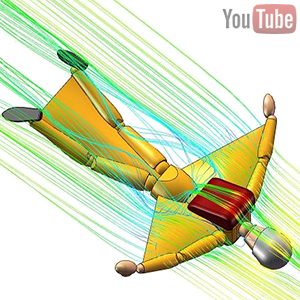
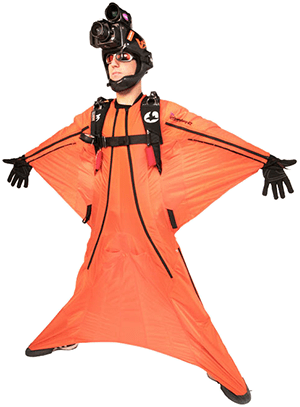
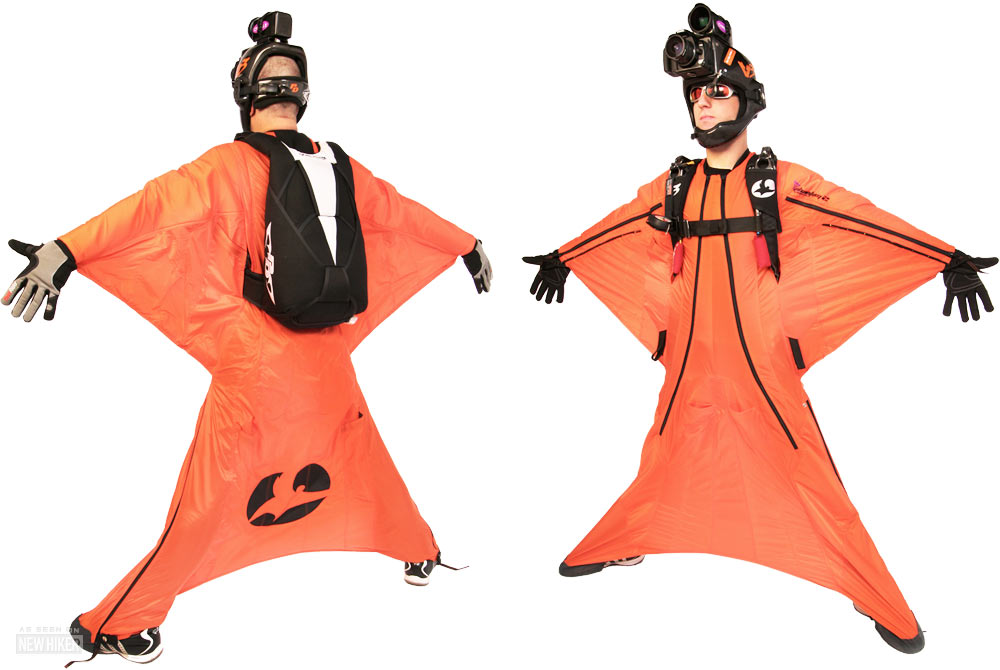
Wingsuit flying is the sport of flying the human body through the air using a special jumpsuit, called a wingsuit, which adds surface area to the human body to create lift. The wingsuit creates the surface area with fabric between the legs and under the arms. A wingsuit may be referred to as a birdman suit or squirrel suit. A wingsuit flight ends with a parachute opening, so a wingsuit can be flown from any point that provides sufficient altitude to glide through the air, such as skydiving aircraft or BASE jumping exit points, and to allow a parachute to deploy. In the mid-1990s, French skydiver Patrick de Gayardon developed a wingsuit that had unparalleled safety and performance. Unfortunately, de Gayardon died on April 13, 1998 while testing a new modification to his parachute container in Hawaii; his death is attributed to a rigging error which was part of the new modification rather than a flaw in the suit’s design.
In early 1998, Tom Begic, a BASE jumper from Australia, built and flew his own wingsuit based on a photograph of Patrick de Gayardon and his ideas. The suit was developed to assist Begic in capturing freefall footage of BASE jumpers while jumping the high cliffs of Europe. The benefits of the suit included: reduced freefall descent rates, increased freefall times, greater maneuverability around other jumpers and objects whilst in freefall, the potential to jump off sites around the world that were not possible without wingsuits, and the ability to accelerate away from underhung walls much more quickly.
Posted in Games |
Leave a Comment »
November 9, 2010

Speedflying (also known as speedriding) is a form of snowkiting, which is an outdoor winter sport where people uses kite power to glide on snow or ice. The sport is similar to kitesurfing, but with the footwear used in snowboarding or skiing. In the early days of snowkiting, foil kites were the most common type; nowadays some kitesurfers use their water gear such as inflatable kites. Snowkiting differs from other alpine sports in that it is possible for the snowkiter to travel uphill and downhill with any wind direction.
Snowkiting is becoming increasingly popular in places often associated with skiing and snowboarding, such as Russia, Canada, Iceland, France, Switzerland, Austria, Norway, Sweden and the Northern and Central United States. The sport is becoming more diverse as adventurers use kites to travel great distances and sports enthusiasts push the boundaries of freestyle, big air and back country exploration Riders can reach speeds over 90 miles per hour; descending from the top of Mont Blanc to the valley floor in Chamonix, 12,000 feet below takes about 10 minutes.
Posted in Games |
Leave a Comment »


 The Daily Omnivore