September 30, 2010

Internet2 is a not-for-profit networking consortium, which operates a next-generation Internet Protocol and optical network. As the Internet gained in public recognition and popularity, universities were among the first institutions to outgrow their bandwidth limitations. The National Science Foundation and MCI developed the very-high-performance Backbone Network Service (vBNS) in 1995 to support high-bandwidth applications like data mining, medical imaging and particle physics. The Internet2 project was established in 1996, and in partnership with Qwest, built the first Internet2 Network, called Abilene in 1998.
In 2003 it was a prime investor in the National LambdaRail project, the first transcontinental 10-Gigabit Ethernet network. In 2007, Internet2 officially retired Abilene and now refers to its new, higher capacity network as the Internet2 Network. The network itself is a dynamic, robust and cost-effective hybrid optical and packet network. It furnishes a 100Gb/s network backbone to more than 210 U.S. educational institutions, 70 corporations and 45 non-profit and government agencies.
Posted in Education, Technology |
Leave a Comment »
September 30, 2010

Unit 8200 is an Israeli Defence Force (IDF) Intelligence Corps unit, responsible for collecting signal intelligence and code decryption. It is the largest unit in the IDF, with several thousand soldiers. It is comparable in its function to the United States’ National Security Agency, except that it is not a separate civilian body.
In March 2004, The Commission to investigate the intelligence network following the War in Iraq recommended turning the unit into a civilian National SIGINT Agency, as is largely the case in other Western countries, but this proposal has yet to be implemented. Urim SIGINT Base is the most important signal intelligence-gathering installation operated by Israel’s military and is part of Unit 8200. The Urim base is located in the Negev desert approximately 30km from Beersheba.
Posted in Politics, War |
Leave a Comment »
September 30, 2010


Bolex is a Swiss company that manufactures motion picture cameras and lenses. The most notable products of which are in the 16 mm and Super 16 mm formats. The Bolex was initially founded by Ukranian engineer and inventor Jacques Bogopolsky in the 1940s. Bolex is derived from his name. He had previously designed cameras for Alpa. Bolex cameras were particularly important for early television news, nature films, documentaries and the avant garde, and are still favoured by many animators today.
Some later models are electrically powered, the majority of those manufactured since the 1930s use a spring-wound clockwork. The 16 mm spring-wound Bolex is a popular introductory camera in film schools. Today, the Bolex factory in Switzerland continues to produce new 16mm and Super 16 film cameras and also can convert Bolex H16 reflex models to super 16mm.
Posted in Art, Technology, World |
1 Comment »
September 29, 2010

The Pineberry is a strawberry cultivar owned by breeder Hans de Jongh and commercialized by VitalBerry BV in Made, The Netherlands. The fruit flesh can range from soft white to orange and is very fragrant with a slight pineapple flavor. Pineberries begin life as green berries, then become slightly white. By the time their deeply set seeds turn deep red, the white fruit is deemed ripe.
Posted in Food, World |
Leave a Comment »
September 28, 2010
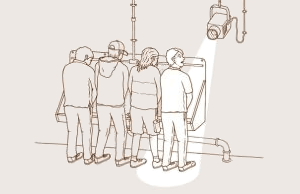

Paruresis [pahr-yew-ree-sis] is a type of phobia in which the sufferer is unable to urinate in the (real or imaginary) presence of others, such as in a public restroom. It most commonly affects males, though there are female sufferers too. The analogous condition that affects bowel movement is called parcopresis.
Many people have brief, isolated episodes of urinary difficulty in situations where other people are in close proximity. Paruresis is also known by many colloquial terms, including bashful bladder, bashful kidneys, mental cloggery, stage fright, pee fright, urophobia, pee-shyness, the slow dribbles, creeping pee-pee, public piss syndrome, shy bladder syndrome, air-blockage, and psychogenic urinary retention.
Continue reading →
Posted in Health |
Leave a Comment »
September 27, 2010
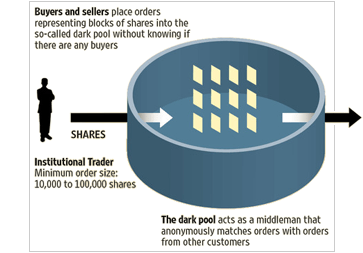

Dark pools of liquidity are financial trading venues or crossing networks similar to exchanges but that provide liquidity that is not displayed on order books. This is useful for traders who wish to move large numbers of shares without revealing themselves to the open market. Dark liquidity pools offer institutional investors many of the efficiencies associated with trading on the exchanges’ public limit order books but without showing their actions to others. Dark liquidity pools avoid this risk because neither the price nor the identity of the trading company is displayed.
Dark pools are recorded to the national consolidated tape. However, they are recorded as over-the-counter transactions. Therefore detailed information about the volumes and types of transactions is left to the crossing network to report to clients if they desire and are contractually obligated. Dark pools allow funds to line up and move large blocks of equities without tipping their hands as to what they are up to. Modern trading platforms and the lack of human interaction have reduced the time scale on market movements. This increased responsiveness of the price of an equity to market pressures has made it more difficult to move large blocks of stock without affecting the price.
Posted in Money |
Leave a Comment »
September 27, 2010


Superflat is a postmodern art movement, founded by Japanese artist Takashi Murakami, which is influenced by manga and anime. Superflat is used by Murakami to refer to various flattened forms in Japanese graphic art, animation, pop culture and fine arts, as well as the ‘shallow emptiness of Japanese consumer culture.’ A self-proclaimed art movement, it was a successful piece of niche marketing, a branded art phenomenon designed for Western audiences.
Murakami defines Superflat in broad terms, so the subject matter is very diverse. Often the works take a critical look at the consumerism and sexual fetishism that is prevalent in post-war Japanese culture. One target of this criticism is lolicon art, which is satirized by works such as those by Henmaru Machino. These works are an exploration of otaku sexuality through grotesque and/or distorted images. Other works are more concerned with a fear of growing up. For example, Yoshitomo Nara’s work often features playful graffiti on old Japanese ukiyo-e executed in a childish manner. And some works focus on the structure and underlying desires that comprise otaku and overall post-war Japanese culture.
Posted in Art, World |
Leave a Comment »
September 27, 2010
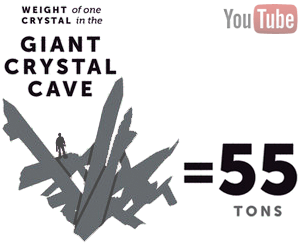
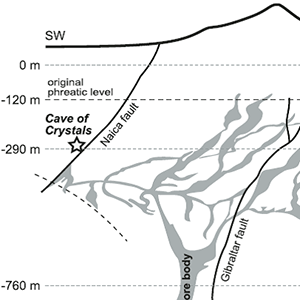
Cave of the Crystals (Cueva de los Cristales) is a cave connected to the Naica Mine 300 metres (980 ft) deep in Chihuahua, Mexico, discovered in 2000. The main chamber contains giant selenite crystals, some of the largest natural crystals ever found. The cave’s largest crystal found to date is 11 m (36 ft) in length, 4 m (13 ft) in diameter and 55 tons in weight. The cave is extremely hot with air temperatures reaching up to 58 °C (136 °F) with 90 to 100 percent humidity.
The cave is relatively unexplored due to the extreme temperatures and high humidity. Without proper protection people can only endure approximately ten minutes of exposure at a time. Additionally, the caves are accessible today only because the mining company’s pumping operations keep them clear of water. If the pumping were stopped, the caves would be submerged.
Posted in Science, World |
Leave a Comment »
September 27, 2010

Stuxnet is a Windows computer worm discovered in July 2010 that targets industrial software and equipment. While it is not the first time that hackers have targeted industrial systems, it is the first discovered malware that spies on and subverts industrial systems. The worm initially spreads indiscriminately, but includes a highly specialized malware payload that is designed to target only Siemens Supervisory Control And Data Acquisition systems that are configured to control and monitor specific industrial processes.
The probable target of Stuxnet is widely suspected to be uranium enrichment infrastructure in Iran, which confirmed that its nuclear program had indeed been damaged. The infestation by this worm may therefore have damaged Iran’s nuclear facilities in Natanz and eventually delayed the start up of Iran’s Bushehr Nuclear Power Plant. Security experts have concluded that the sophisticated attack could only have been conducted with nation-state support and it has been speculated that Israel may have been involved.
Posted in Technology, War |
Leave a Comment »
September 26, 2010

The Ahnenerbe was a Nazi German think tank that promoted itself as a ‘study society for Intellectual Ancient History.’ Founded on July 1, 1935, by Heinrich Himmler, Herman Wirth, and Richard Walther Darré, the Ahnenerbe’s goal was to research the anthropological and cultural history of the Aryan race, and later to experiment and launch voyages with the intent of proving that prehistoric and mythological Nordic populations had once ruled the world.
The Ahnenerbe had several different research institutions. Most of these were archeological and anthropological but others included a meteorology department, devoted to ‘Welteislehre’ (World Ice Theory), a pseudoscientific cosmological theory proposed by Hans Hörbiger, an Austrian engineer and inventor. According to his theory, ice was the basic substance of all cosmic processes, and ice moons, ice planets, and the ‘global ether’ (also made of ice) had determined the entire development of the universe. There was also a section devoted to musicology, whose aim was to determine ‘the essence’ of German music. The section made sound recordings, transcribed manuscripts and songbooks, and photographed and filmed instrument use and folk dances. The lur, a Bronze Age musical instrument, became central to this research, which concluded that Germanic consonance was in direct conflict to Jewish atonalism.
Posted in Science, War |
Leave a Comment »
September 25, 2010

The Flat Earth Society is an organization that seeks to further the belief that the Earth is flat rather than the scientifically accepted view that it is a sphere or a geoid. The modern organization was founded by Englishman Samuel Shenton in 1956. The belief that the Earth was flat was typical of ancient cosmologies until about the 4th century BC, when the Ancient Greek philosophers proposed the idea that the Earth was a sphere, or at least rounded in shape. Aristotle was one of the first thinkers to propose a spherical Earth in 330 BC. By the early Middle Ages, it was widespread knowledge throughout Europe that the Earth was a sphere.
Modern hypotheses supporting a flat Earth originated with English inventor Samuel Rowbotham (1816–1884). Based on his interpretation of certain biblical passages, Rowbotham published a 16-page pamphlet, which he later expanded into a 430-page book, ‘Earth Not a Globe,’ expounding his views. According to Rowbotham’s system, which he called ‘Zetetic Astronomy,’ the earth is a flat disc centered at the North Pole and bounded along its southern edge by a wall of ice (Antarctica), with the sun and moon 3000 miles (4800 km) and the ‘cosmos’ 3100 miles (5000 km) above earth. As of September 2009, two web-based discussion forums exist devoted to the Flat Earth Society is also represented on Twitter and Facebook.
Posted in Humor, Science, World |
Leave a Comment »
September 24, 2010

Helium-3 (He-3) is a light, non-radioactive isotope of helium with two protons and one neutron. It is rare on Earth, and is sought for use in nuclear fusion research. The abundance of helium-3 is thought to be greater on the Moon (embedded in the upper layer of regolith by the solar wind over billions of years) and the solar system’s gas giants (left over from the original solar nebula), though still low in quantity.
Its existence was first proposed in 1934 by the Australian nuclear physicist Mark Oliphant. Helium-3 is proposed as a second-generation fusion fuel for fusion power uses. Tritium, with a 12-year half-life, decays into helium-3, which can be recovered. Irradiation of lithium in a nuclear reactor — either a fusion or fission reactor — can also produce tritium, and thus (after decay) helium-3.
Posted in Science |
Leave a Comment »







 The Daily Omnivore