March 25, 2015

Basic bitch (or simply ‘basic’) is a slang term in American popular culture used to pejoratively describe people who like popular, mainstream products or music. Interpretations of the term vary and its use has been criticized for being an overly vague and a misogynistic insult. Their male counterparts are usually termed ‘basic bros.’
The term was created by comedian Lil’ Duval in 2010. Over the next two years, it appeared in several American rap songs. In the songs ‘Hard in the Paint’ by Tyga and ‘I’m a Human Being’ by Lil Wayne, the singers insist that they are not basic bitches, while in the song ‘Basic Bitch’ by The Game, the singer warns others to avoid basic bitches because they are ‘fake.’ In 2011, rapper Kreayshawn debuted her song ‘Gucci Gucci,’ which included the chorus: ‘Gucci Gucci, Louis Louis, Fendi, Fendi Prada … basic bitches wear that shit so I don’t even bother.’ Continue reading →
Posted in Humor, Language |
Leave a Comment »
March 24, 2015

Postdiction [pohst-dik-shuhn], also known as retroactive clairvoyance, is an effect of hindsight bias (the tendency to perceive events that have already occurred as having been more predictable than they actually were) that explains claimed predictions of significant events, such as plane crashes and natural disasters. In religious contexts it is frequently referred to by the Latin term ‘vaticinium ex eventu,’ or ‘foretelling after the event.’
Through this term, skeptics postulate that many biblical prophecies (and similar prophecies in other religions) appearing to have come true may have been written after the events supposedly predicted, or that their text or interpretation may have been modified after the event to fit the facts as they occurred. Continue reading →
Posted in Philosophy, Science |
Leave a Comment »
March 23, 2015

Yaeba [yah-ey-bah] is a term used to describe human teeth, especially upper canines, with an uncommonly fang-like appearance. In Japan it is perceived as a sign of youthfulness. For that reason, undergoing a body modification procedure to produce such an appearance for cosmetic purposes is gaining popularity among Japanese females
Cosmetic alterations to teeth have been practiced for centuries among many cultures throughout the world. In some cultures sharpening teeth is seen as a rite of passage for adolescents into adulthood.
Posted in Sex, World |
Leave a Comment »
March 22, 2015
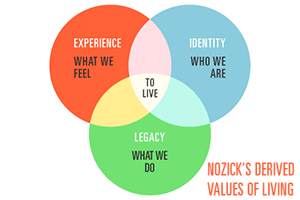

The Experience Machine or Pleasure Machine is a thought experiment put forward by philosopher Robert Nozick in his 1974 book ‘Anarchy, State, and Utopia.’ He describes a choice between everyday reality and an apparently preferable simulated reality as a refutation of ethical hedonism, the idea that people have the right to do everything in their power (that doesn’t infringe on others) to achieve the greatest amount of pleasure possible to them.
If the primary thesis of hedonism is that ‘pleasure is the good,’ then any component of life that is not pleasurable does nothing directly to increase one’s well-being. This is a view held by many value theorists (who study how, why, and to what degree people value things), but most famously by some classical utilitarians (who believe that the morally best action is the one that makes the most overall happiness or ‘utility’ (usefulness). Nozick argues that if he can show that there is something other than pleasure that has value and thereby increases our well-being, then hedonism is defeated. Continue reading →
Posted in Philosophy, Technology |
1 Comment »
March 20, 2015
In philosophy, Pascal’s mugging is a thought experiment demonstrating a problem in expected utility maximization. A rational agent should choose actions whose outcomes, when weighed by their probability, have higher utility. But some very unlikely outcomes may have very great utilities, and these utilities can grow faster than the probability diminishes. Hence the agent should focus more on vastly improbable cases with implausibly high rewards. The name refers to Pascal’s Wager (an argument by French mathematician Blaise Pascal that the potential cost of not believing in God is higher than the cost of believing), but unlike the wager does not require infinite rewards. This removes any objections to the dilemma that are based on the nature of infinity.
British philosopher Jeremy Bentham’s: ‘The greatest good for the greatest number’ formed the foundation of utilitarianism, which says that the morally best action is the one that makes the most overall happiness or ‘utility’ (usefulness). Pascal’s mugging points out that in extreme case this philosophy can fail. The term for this problem was coined by artificial intelligence researcher Eliezer Yudkowsky in the ‘Less Wrong’ internet forum and his original example was: ‘Now suppose someone comes to me and says, ‘Give me five dollars, or I’ll use my magic powers from outside the Matrix to run a Turing machine that simulates and kills [trillions of] people.’ Even though the chance of this actually happening is negligible, the threatened outcome is so large a rational agent must accede to the demand.
Continue reading →
Posted in Money, Philosophy, Technology |
Leave a Comment »
March 17, 2015

The information explosion is the rapid increase in the amount of published information or data and the effects of this abundance. As the amount of available data grows, the problem of managing the information becomes more difficult, which can lead to information overload. The earliest use of the phrase seems to have been in an IBM advertising supplement to the ‘New York Times’ published on April 30, 1961, and by Frank Fremont-Smith, Director of the American Institute of Biological Sciences Interdisciplinary Conference Program. Techniques to gather knowledge from an overabundance of electronic information (e.g., data fusion may help in data mining) have existed since the 1970s.
Since ‘information’ in electronic media is often used synonymously with ‘data,’ the term ‘information explosion’ is closely related to the concept of ‘data flood’ (also dubbed ‘data deluge’), the ever-increasing amount of electronic data exchanged per time unit. The awareness about non-manageable amounts of data grew along with the advent of ever more powerful data processing since the mid-1960s. By August 2005, there were over 70 million web servers. Two years later there were over 135 million web servers. According to ‘Technorati,’ the number of blogs doubles about every 6 months with a total of 35.3 million blogs as of April 2006. This is an example of the early stages of logistic growth, where growth is approximately exponential, since blogs are a recent innovation. As the number of blogs approaches the number of possible producers (humans), saturation occurs, growth declines, and the number of blogs eventually stabilizes.
Posted in Education, Science, Technology |
Leave a Comment »
March 16, 2015
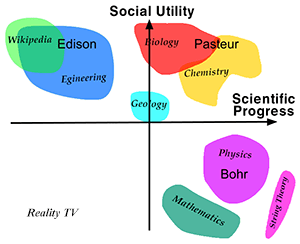

Blue skies research is scientific research in domains where ‘real-world’ applications are not immediately apparent. It has been defined as ‘research without a clear goal’ and ‘curiosity-driven science.’ It is sometimes used interchangeably with the term ‘basic research.’ Proponents of this mode of science argue that unanticipated scientific breakthroughs are sometimes more valuable than the outcomes of agenda-driven research, heralding advances in genetics and stem cell biology as examples of unforeseen benefits of research that was originally seen as purely theoretical in scope. Because of the inherently uncertain return on investment, blue-sky projects are politically and commercially unpopular and tend to lose funding to more reliably profitable or practical research.
Raytheon founder Vannevar Bush’s 1945 report, ‘Science: The Endless Frontier,’ made the argument for the value of basic research in the postwar era, and was the basis for many appeals to the federal funding of basic research. The 1957 launch of Sputnik prompted the United States Air Force Office of Scientific Research to sponsor basic science research into the 1960s. By the 1970s, financial strains brought pressure on public expenditure on the sciences, first in the UK and the Netherlands, and by the 1990s in Germany and the US. Continue reading →
Posted in Money, Science, Technology |
1 Comment »
March 15, 2015


‘Galápagos syndrome‘ (‘Garapagosu-ka’) is a term of Japanese origin, which refers to an isolated development branch of a globally available product. The term is a reference to similar phenomena Charles Darwin encountered in the Galápagos Islands, with its isolated flora and fauna, which were key observations in the development of Evolutionary Theory. The term was originally coined to refer to Japanese 3G mobile phones, which had developed a large number of specialized features and dominated Japan, but were unsuccessful abroad. The term arose as part of the dialog about Japan’s position as an island nation, and related anxiety about being isolated from the world at large. A derived term is ‘gara-kei’ (‘Galápagos cellphone’), used to refer to Japanese feature phones, which remain popular despite the emergence of smartphones.
The term has since been used for similar phenomena in other markets, such as the outdated usage of magnetic stripe for credit cards in the US, as everywhere else has moved onto using EMV smart cards. ‘It has been claimed that the indigenous American automotive industry has suffered from the Galapagos Syndrome – its products have evolved separately from the rest of the world.’ ‘The Galapagosization of Japan continues. A shocking two-thirds of the country’s white-collar workers said they didn’t want to work abroad…ever.’
Posted in Technology, World |
Leave a Comment »
March 14, 2015

Wrap rage, also called package rage, is the common name for heightened levels of anger and frustration resulting from the inability to open hard-to-openpackaging, particularly some heat-sealed plastic blister packs and clamshells. People suffer thousands of injuries per year, such as cut fingers and sprained wrists, from tools used to open packages and from packaging itself, and in some cases damage the items they are trying to free from packaging. Easy-opening systems are available to improve package opening convenience.
Packaging sometimes must be made difficult to open. For example, regulations dictate that some over-the-counter drugs have tamper resistance to deter unauthorized opening prior to the intended customer and be in child-resistant packaging. Other packages are intentionally made difficult to open to reduce package pilferage and shoplifting. Hard plastic blister packs also protect the products while they are being shipped. In addition, using transparent plastic allows customers to view products directly before purchasing them.
Posted in Humor, Money |
Leave a Comment »
March 13, 2015

‘Why Zebras Don’t Get Ulcers‘ is a 1994 (2nd ed. 1998, 3rd ed. 2004) book by Stanford University biologist Robert M. Sapolsky. The book proclaims itself as a ‘Guide to Stress, Stress-Related Diseases, and Coping’ on the front cover of its third and most recent edition. The title derives from Sapolsky’s idea that for animals such as zebras, stress is generally episodic (e.g., running away from a lion), while for humans, stress is often chronic (e.g., worrying about financial burdens). Therefore, many wild animals are less susceptible than humans to chronic stress-related disorders such asulcers, hypertension, decreased neurogenesis and increased hippocampal neuronal atrophy. However, chronic stress occurs in some social primates (Sapolsky studies baboons) for individuals on the lower side of the social dominance hierarchy.
Sapolsky focuses on the effects of glucocorticoids (a class of steroid hormones) on the human body, stating that they may be useful to animals in the wild escaping their predators during the fight-or-flight response, but the effects on humans, when secreted at high quantities or over long periods of time, are much less desirable. He relates the history of endocrinology, how the field reacted at times of discovery, and how it has changed through the years. While most of the book focuses on the biological machinery of the body, the last chapter of the book focuses on self-help. He also explains how social phenomena such as child abuse and the chronic stress of poverty affect biological stress, leading to increased risk of disease and disability.
Posted in Health, Language |
Leave a Comment »
March 12, 2015
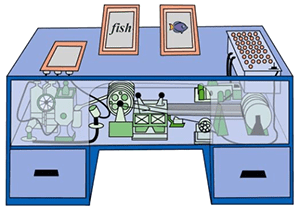
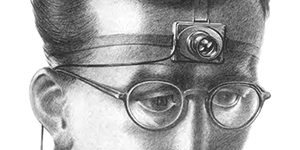
‘As We May Think‘ is an essay by engineer and Raytheon founder Vannevar Bush, first published in ‘The Atlantic’ in July 1945, and republished again as an abridged version two months later — before and after the atomic bombings of Hiroshima and Nagasaki. Bush expresses his concern for the direction of scientific efforts toward destruction, rather than understanding, and explicates a desire for a sort of collective memory machine with his concept of the memex that would make knowledge more accessible, believing that it would help fix these problems. Through this machine, Bush hoped to transform an information explosion into a knowledge explosion.
The article was a reworked and expanded version of Bush’s 1939 essay ‘Mechanization and the Record’ where he described a machine that would combine lower level technologies to achieve a higher level of organized knowledge (like human memory processes). Shortly after the publication of this essay, Bush coined the term ‘memex’ in a letter written to the editor of ‘Fortune’ magazine. That letter became the body of ‘As We May Think,’ adding only an introduction and conclusion. Continue reading →
Posted in Language, Technology, War |
Leave a Comment »
March 11, 2015


Susan Kare (b. 1954) is an artist and graphic designer who created many of the interface elements for the Apple Macintosh in the 1980s. She left Apple with Steve Jobs in 1985 to be the Creative Director at his new company NeXT.
Kare was born in Ithaca, New York, and is the sister of noted aerospace engineer Jordin Kare. She graduated from Harriton High School in 1971, received her B.A., summa cum laude, in Art from Mount Holyoke College in 1975 and her Ph.D. from New York University in 1978. She next moved to San Francisco and worked for the Museum of Modern Art. Today, the MOMA store in New York City carries stationery and notebooks featuring her designs. Continue reading →
Posted in Art, Technology |
Leave a Comment »


 The Daily Omnivore