March 14, 2015

Wrap rage, also called package rage, is the common name for heightened levels of anger and frustration resulting from the inability to open hard-to-openpackaging, particularly some heat-sealed plastic blister packs and clamshells. People suffer thousands of injuries per year, such as cut fingers and sprained wrists, from tools used to open packages and from packaging itself, and in some cases damage the items they are trying to free from packaging. Easy-opening systems are available to improve package opening convenience.
Packaging sometimes must be made difficult to open. For example, regulations dictate that some over-the-counter drugs have tamper resistance to deter unauthorized opening prior to the intended customer and be in child-resistant packaging. Other packages are intentionally made difficult to open to reduce package pilferage and shoplifting. Hard plastic blister packs also protect the products while they are being shipped. In addition, using transparent plastic allows customers to view products directly before purchasing them.
Posted in Humor, Money |
Leave a Comment »
March 13, 2015
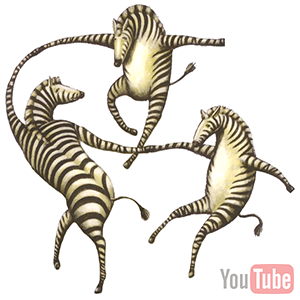
‘Why Zebras Don’t Get Ulcers‘ is a 1994 (2nd ed. 1998, 3rd ed. 2004) book by Stanford University biologist Robert M. Sapolsky. The book proclaims itself as a ‘Guide to Stress, Stress-Related Diseases, and Coping’ on the front cover of its third and most recent edition. The title derives from Sapolsky’s idea that for animals such as zebras, stress is generally episodic (e.g., running away from a lion), while for humans, stress is often chronic (e.g., worrying about financial burdens). Therefore, many wild animals are less susceptible than humans to chronic stress-related disorders such asulcers, hypertension, decreased neurogenesis and increased hippocampal neuronal atrophy. However, chronic stress occurs in some social primates (Sapolsky studies baboons) for individuals on the lower side of the social dominance hierarchy.
Sapolsky focuses on the effects of glucocorticoids (a class of steroid hormones) on the human body, stating that they may be useful to animals in the wild escaping their predators during the fight-or-flight response, but the effects on humans, when secreted at high quantities or over long periods of time, are much less desirable. He relates the history of endocrinology, how the field reacted at times of discovery, and how it has changed through the years. While most of the book focuses on the biological machinery of the body, the last chapter of the book focuses on self-help. He also explains how social phenomena such as child abuse and the chronic stress of poverty affect biological stress, leading to increased risk of disease and disability.
Posted in Health, Language |
Leave a Comment »
March 12, 2015
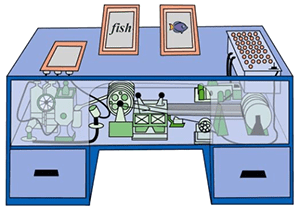
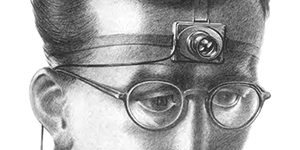
‘As We May Think‘ is an essay by engineer and Raytheon founder Vannevar Bush, first published in ‘The Atlantic’ in July 1945, and republished again as an abridged version two months later — before and after the atomic bombings of Hiroshima and Nagasaki. Bush expresses his concern for the direction of scientific efforts toward destruction, rather than understanding, and explicates a desire for a sort of collective memory machine with his concept of the memex that would make knowledge more accessible, believing that it would help fix these problems. Through this machine, Bush hoped to transform an information explosion into a knowledge explosion.
The article was a reworked and expanded version of Bush’s 1939 essay ‘Mechanization and the Record’ where he described a machine that would combine lower level technologies to achieve a higher level of organized knowledge (like human memory processes). Shortly after the publication of this essay, Bush coined the term ‘memex’ in a letter written to the editor of ‘Fortune’ magazine. That letter became the body of ‘As We May Think,’ adding only an introduction and conclusion. Continue reading →
Posted in Language, Technology, War |
Leave a Comment »
March 11, 2015


Susan Kare (b. 1954) is an artist and graphic designer who created many of the interface elements for the Apple Macintosh in the 1980s. She left Apple with Steve Jobs in 1985 to be the Creative Director at his new company NeXT.
Kare was born in Ithaca, New York, and is the sister of noted aerospace engineer Jordin Kare. She graduated from Harriton High School in 1971, received her B.A., summa cum laude, in Art from Mount Holyoke College in 1975 and her Ph.D. from New York University in 1978. She next moved to San Francisco and worked for the Museum of Modern Art. Today, the MOMA store in New York City carries stationery and notebooks featuring her designs. Continue reading →
Posted in Art, Technology |
Leave a Comment »
March 10, 2015

David Graeber (b. 1961) is an American anthropologist, anarchist and activist, who is Professor of Anthropology at the London School of Economics. Specializing in theories of value and social theory, he was an assistant professor and associate professor of anthropology at Yale University from 1998 to 2007, although Yale controversially declined to rehire him. From Yale, he went on to become a Reader in Social Anthropology at Goldsmiths, University of London from 2007-13.
Graeber has been involved in social and political activism, including the protests against the 3rd Summit of the Americas in Quebec City in 2001 and the World Economic Forum in New York City in 2002. He is also a leading figure in the Occupy Wall Street movement. Continue reading →
Posted in Money, Politics, Science |
Leave a Comment »
March 9, 2015
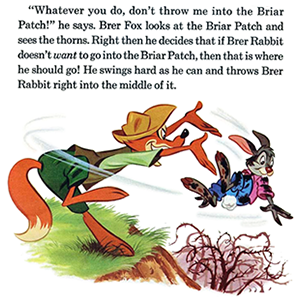
Reverse psychology is a technique involving the advocacy of a belief or behavior that is opposite to the one desired, with the expectation that this approach will encourage the subject of the persuasion to do what actually is desired: the opposite of what is suggested. This technique relies on the psychological phenomenon of reactance, in which a person has a negative emotional reaction to being persuaded, and thus chooses the option which is being advocated against. The one being manipulated is usually unaware of what is really going on.
Reverse psychology is often used on children due to their high tendency to respond with reactance, a desire to restore threatened freedom of action (e.g. telling children to stay in the house when you really want them to choose to go outside and play). Questions have however been raised about such an approach when it is more than merely instrumental, in the sense that ‘reverse psychology implies a clever manipulation of the misbehaving child’ and nothing more. With respect to ’emotional intelligence,’ the advice has been given: ‘don’t try to use reverse psychology….such strategies are confusing, manipulative, dishonest, and they rarely work’. In addition, consistently allowing a child to do the opposite of what he/she is being advised, undermines the authority of the parent. Continue reading →
Posted in Health, Science |
Leave a Comment »
March 8, 2015

In social psychology, the boomerang effect refers to the unintended consequences of an attempt to persuade resulting in the adoption of an opposing position instead. It is sometimes referred to as ‘the theory of psychological reactance,’ stating that attempts to restrict a person’s freedom often produce an ‘anticonformity boomerang effect.’ The tactic of reverse psychology, which is a deliberate exploitation of an anticipated boomerang effect, involves one’s attempt of feigning a desire for an outcome opposite to that of the truly desired one, such that the prospect’s resistance will work in the direction that the exploiter actually desires.
The first study on the subject in 1953 noted that it is more likely under certain conditions: When weak arguments are paired with a negative source; When weak or unclear persuasion leads the recipient to believe the communicator is trying to convince them of a different position than what the communicator intends; When the persuasion triggers aggression or unalleviated emotional arousal; When the communication adds to the recipient’s knowledge of the norms and increases their conformity; When non-conformity to their own group results in feelings of guilt or social punishment; and When the communicator’s position is too far from the recipient’s position and thus produces a ‘contrast’ effect and thus enhances their original attitudes. Continue reading →
Posted in Science |
Leave a Comment »
March 7, 2015
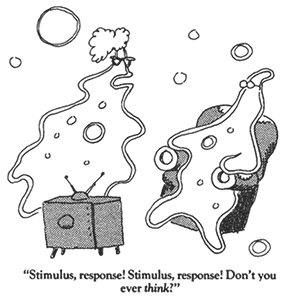
Microbial intelligence is the intelligence shown by microorganisms, including complex adaptive behavior shown by single cells, and altruistic and/or cooperative behavior in populations of like or unlike cells. While the number of microorganisms in a colony can run into the billions, each individual is able to stay synchronized by sharing simple chemical messages. Complex cells, like protozoa or algae, show remarkable abilities to organize themselves in changing circumstances. Shell-building by amoebae, reveals complex discrimination and manipulative skills that are ordinarily thought to occur only in multicellular organisms.
Even bacteria, which show primitive behavior as isolated cells, can display more sophisticated behavior as a population. Examples include: myxobacteria (which form motile slime colonies), quorum sensing (a system of stimulus and response correlated to population density), and biofilms (cells that cooperate to stick to each other on a surface). It has been suggested that a bacterial colony loosely mimics a biological neural network (i.e. a brain). The bacteria can take inputs in form of chemical signals, process them and then produce output chemicals to signal other bacteria in the colony. Continue reading →
Posted in Science |
Leave a Comment »
March 7, 2015
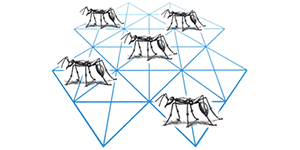
Swarm Intelligence (SI) refers to numerous, simple units working in concert to solve complex problems. It is field in computer science and artificial intelligence based on examples from nature such as an ant colony, made of many animals that communicate with each other to achieve unified goals. In computer models the ‘animals,’ or individual units, are called ‘agents.’ Swarm intelligence emerges from decentralized, self-organizing systems, natural or artificial. The expression was introduced by electrical engineers Gerardo Beni and Jing Wang in 1989, in the context of cellular robotic systems. The application of swarm principles to robots is called ‘swarm robotics,’ while ‘swarm intelligence’ refers to the more general set of algorithms. ‘Swarm prediction’ has been used in the context of forecasting problems.
SI systems consist typically of a population of simple agents or ‘boids’ (named for a 1986 artificial life program that simulates the flocking behavior of birds) interacting locally with one another and with their environment. A number of natural systems have been used as models (e.g. animal herding, bacterial growth, fish schooling and microbial intelligence). The agents follow very simple rules, and although there is no centralized control structure dictating how each unit should behave, local, and to a certain degree random, interactions between such agents lead to the emergence of ‘intelligent’ global behavior, unknown to the individuals. Continue reading →
Posted in Science, Technology |
Leave a Comment »
March 6, 2015
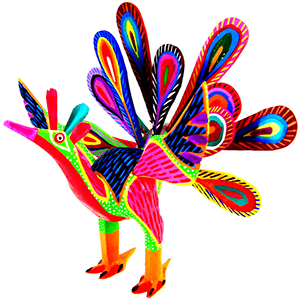
Alebrijes [ah-lay-bree-hay] are brightly colored Oaxacan folk art sculptures of fantastical creatures. The first alebrijes, along with use of the term, originated with Mexican artisan Pedro Linares (1906 – 1992). Linares specialized in making piñatas, carnival masks, and ‘Judas’ figures from papier-mâché. In the 1930s, he fell ill and dreamt of a strange place resembling a forest. There, he saw clouds that transformed into strange, brightly colored animals. He saw a donkey with butterfly wings, a rooster with bull horns, a lion with an eagle head, and all of them were shouting the nonsensical word, ‘Alebrijes.’ Upon recovery, he began recreating the creatures he saw in cardboard and paper mache and called them Alebrijes.
His work caught the attention of a gallery owner in Cuernavaca, in the south of Mexico and later, of artists Diego Rivera and Frida Kahlo. In the 1980s, British Filmmaker, Judith Bronowski, arranged an itinerant Mexican art craft demonstration workshop in the US featuring Linares, Manuel Jiménez, and a textile artisan Maria Sabina. Linares demonstrated his designs on family visits and which were adapted to the carving of a local wood called copal. The paper mache-to-wood carving adaptation was pioneered by Jiménez. This version of the craft has since spread to a number of other towns, most notably San Martín Tilcajete and La Unión Tejalapan, and become a major source of income for the area, especially for Tilcajete. The success of the craft, however, has led to the depletion of the native copal trees.
Posted in Art, World |
Leave a Comment »
March 5, 2015

Neural oscillation is rhythmic or repetitive neural activity in the central nervous system. For example Delta waves (0-4 Hz on an EEG) is the lowest frequency neural oscillation and is associated with deep sleep. Gamma waves are the highest frequency pattern at 25-100 Hz (though 40 Hz is typical), and according to a popular theory, they may be related to subjective awareness.
Gamma waves were initially ignored before the development of digital electroencephalography as analog electroencephalography is restricted to recording and measuring rhythms that are usually less than 25 Hz. One of the earliest reports on them was in 1964 using recordings of the electrical activity of electrodes implanted in the visual cortex of awake monkeys. Continue reading →
Posted in Health, Philosophy, Science |
Leave a Comment »
March 4, 2015

Sleep inertia is a physiological state characterized by a decline in motor dexterity and a subjective feeling of grogginess immediately following an abrupt awakening. The impaired alertness may interfere with the ability to perform mental or physical tasks. Sleep inertia can also refer to the tendency of a person wanting to return to sleep.
Sleep inertia occurs normally after awakening. Upon awakening in the morning, subjective alertness and mental performance are significantly impaired. Morning sleep inertia takes two to four hours to dissipate completely, though some people require less time. Continue reading →
Posted in Health |
Leave a Comment »




