September 10, 2014


Liebeck v. McDonald’s Restaurants, also known as the McDonald’s coffee case, was a 1994 product liability lawsuit that became a flash point in the tort reform debate in the US. A New Mexico civil jury awarded $2.86 million to plaintiff Stella Liebeck, a 79-year-old woman who suffered third-degree burns in her pelvic region when she accidentally spilled hot coffee in her lap after purchasing it from a McDonald’s restaurant. Liebeck was hospitalized for eight days while she underwent skin grafting, followed by two years of medical treatment.
Liebeck’s attorneys argued that at 180–190 °F coffee was defective, claiming it was too hot and more likely to cause serious injury than coffee served at any other establishment. The jury damages included $160,000 to cover medical expenses and $2.7 million in punitive damages. The trial judge reduced the final verdict to $640,000, and the parties settled for a confidential amount before an appeal was decided. The case was said by some to be an example of frivolous litigation; ABC News called it, ‘the poster child of excessive lawsuits,’ while legal scholar Jonathan Turley said it was ‘a meaningful and worthy lawsuit.’
Continue reading →
Posted in Food, Money, Politics |
Leave a Comment »
September 9, 2014

Postprandial [pohst-pran-dee-uhl] somnolence [som-nuh-luhns] (colloquially known as a food coma) is a normal state of drowsiness or lassitude following a meal. It has two components: a general state of low energy related to activation of the parasympathetic nervous system (can be thought of as ‘rest and digest’ as opposed to the ‘fight-or-flight’ effects of the sympathetic nervous system) in response to mass in the gastrointestinal tract, and a specific state of sleepiness caused by hormonal and neurochemical changes related to the rate at which glucose enters the bloodstream and its downstream effects on amino acid transport in the central nervous system.
In response to the arrival of food in the stomach and small intestine, the activity of the parasympathetic nervous system increases and the activity of the sympathetic nervous system decreases. This shift in the balance of autonomic (involuntary) tone towards the parasympathetic system results in a subjective state of low energy and a desire to be at rest, the opposite of the fight-or-flight state induced by high sympathetic tone. The larger the meal, the greater the shift in autonomic tone towards the parasympathetic system, regardless of the composition of the meal. Continue reading →
Posted in Food, Health |
1 Comment »
September 8, 2014

Charles Proteus Steinmetz (1865 – 1923) was a mathematician and electrical engineer known as the Wizard of Schenectady. He fostered the development of alternating current that made possible the expansion of the electric power industry in the US, formulating mathematical theories for engineers.
He made ground-breaking discoveries in the understanding of hysteresis (the lag time when magnetizing a ferromagnetic material) that enabled engineers to design better electromagnetic apparatus equipment, especially electric motors for use in industry. Continue reading →
Posted in Science, Technology |
Leave a Comment »
September 7, 2014
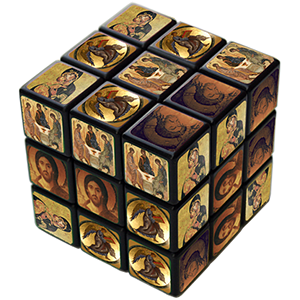
God’s algorithm is a notion originating in discussions of ways to solve the Rubik’s Cube puzzle, but which can also be applied to other combinatorial (sequential move) puzzles and mathematical games. It refers to any algorithm which produces a solution having the fewest possible number of moves, the idea being that an omniscient being would know an optimal step from any given configuration. The notion applies to puzzles that can assume a finite number of ‘configurations,’ with a relatively small, well-defined arsenal of ‘moves’ that may be applicable to configurations and then lead to a new configuration.
An algorithm for finding optimal solutions for Rubik’s Cube was published in 1997 by computer scientist Richard Korf. While it had been known since 1995 that 20 was a lower bound on the number of moves for the solution in the worst case, it was proved in 2010 through extensive computer calculations that no configuration requires more than 20 moves. Thus 20 is a sharp upper bound on the length of optimal solutions. This number is known as God’s number.
Posted in Games, Science |
1 Comment »
September 5, 2014
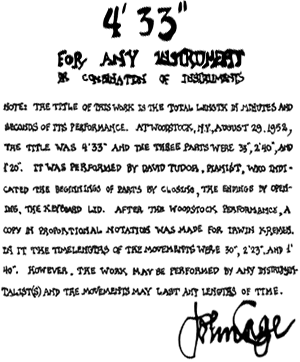
Silence is the lack of audible sound or presence of sounds of very low intensity. By analogy, the term also refers to an absence of communication, including in media other than speech. Silence is also used as ‘total communication,’ in reference to nonverbal communication and spiritual connection. It is an important factor in many cultural spectacles, as in rituals, both positive and negative. For example, in a Christian Methodist faith organization quiet reflection during a sermon might mean indicate assent, while in a Southern Baptist church, silence might mean disagreement with what is being said, or perhaps disconnectedness from the congregated community. A common way to remember a tragic incident is a commemorative moment of silence.
In discourse analysis, speakers use brief absences of speech to mark the boundaries of prosodic units (segments of speech that occurs with a single pitch and rhythm contour). Silence in speech can be hesitation, stutters, self-correction—or deliberate slowing of speech to clarify or aid processing of ideas. These are short silences; longer pauses in language occur in interactive roles, turn-taking, or reactive tokens (short utterance that indicate a listener is following a conversation). Continue reading →
Posted in Language, Philosophy, Science |
Leave a Comment »
September 4, 2014
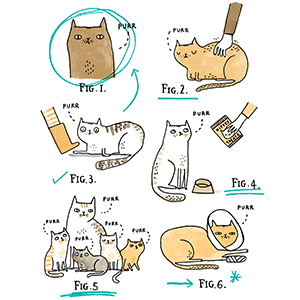
A purr is a continuous, soft, vibrating sound made in the throat by most species of felines. Domestic cat kittens can purr as early as two days of age. This tonal rumbling can characterize different personalities in domestic cats and is often believed to indicate a positive emotional state, however, felines sometimes purr when they are ill, tense, or experiencing traumatic or painful moments. Purring varies between cats (for example by loudness and tone), and from species to species, but can be characterized as a tonal buzzing.
The term ‘purring’ has been used liberally in literature, and it has been claimed that many non-cats including viverrids (civet, mongoose, genet), bears, badgers, and hyaenas purr. Others are reported to purr only at specific times, for example rabbits, squirrels, guinea pigs, tapirs, ring-tailed lemurs, elephants, raccoons and gorillas are claimed to purr while eating. However, using a strict definition of purring that continuous sound production must alternate between pulmonic egressive and ingressive airstream (breathing in and out) and usually go on for minutes, a 2002 study reached the conclusion that until then only ‘purring cats’ (Felidae) and two species of genets, Genetta tigrina, and most likely also Genetta genetta, had been documented to purr. Continue reading →
Posted in Health, Language, Science |
1 Comment »
September 3, 2014

Directed attention fatigue (DAF) is a neurological phenomenon that results from overuse of the brain’s inhibitory attention mechanisms, which handle incoming distractions while maintaining focus on a specific task. The greatest threat to a given focus of attention is competition from other stimuli that can cause a shift in focus. This is because one maintains focus on a particular thought by inhibiting all potential distractions and not by strengthening that central mental activity.
Directed attention fatigue occurs when a particular part of the brain’s global inhibitory system is overworked due to the suppression of increasing numbers of stimuli. This temporary condition is not a clinical illness or a personality disorder. It is rather a temporary exhaustion of mental resources. According to inhibition theory it is natural for one to alternate imperceptibly between periods of attention (work) and distraction (non-work) while completing a task. Even when every undertaking is unique, each incoming stimulus calls upon the same directed attention mechanism. Continue reading →
Posted in Health, Science |
Leave a Comment »
September 2, 2014

The phrase ‘Nixon goes to China‘ or ‘It took Nixon to go to China’ is a historical reference to President Richard Nixon’s 1972 visit to the People’s Republic of China, where he met with Chairman Mao Zedong.
As a political metaphor, it refers to the ability of a politician with an unassailable reputation among his supporters for representing and defending their values to take actions that would draw their criticism and even opposition if taken by someone without those credentials. Although Nixon’s example is that of a hardliner taking steps toward peace with a traditional enemy (the most common application of the metaphor), it could also be applied to a reputedly cautious diplomat defying expectations by taking military action, or a political leader reforming aspects of the political system of which they have been strong supporters. Continue reading →
Posted in Politics, World |
1 Comment »
August 30, 2014


A superhuman is a person with extraordinary and unusual capabilities enabling feats beyond anything a layperson could conceivably achieve, even through extensive training. Superhuman can mean an improved human, for example, by genetic modification, cybernetic implants, nanotechnology, or natural evolution. Occasionally, it could mean an otherwise ‘normal’ human with purported super-abilities, such as psychic/psionic powers, levitation or flight, herculean strength, or unique proficiency at some task.
Superhuman can also mean something that is not human, but considered to be ‘superior’ to humans in some ways. This might include a robot that easily passed the Turing test (an indicator of a machine’s ability to exhibit intelligent behavior) that possessed greater than human strength, which is already common in robots today. A very intelligent or strong alien could be considered superhuman. In its most basic sense it means anything beyond (typical) human capabilities, e.g. a tiger may be described as having ‘superhuman strength.’ Continue reading →
Posted in Games, Health, Science |
Leave a Comment »
August 29, 2014

The True Believer: Thoughts On The Nature Of Mass Movements is a 1951 social psychology book by American moral philosopher Eric Hoffer that discusses the psychological causes of fanaticism. The book analyzes and attempts to explain the motives of the various types of personalities that give rise to mass movements; why and how mass movements start, progress and end; and the similarities between them, whether religious, political, radical or reactionary.
Hoffer argues that even when their stated goals or values differ mass movements are interchangeable, that adherents will often flip from one movement to another, and that the motivations for mass movements are interchangeable. Thus, religious, nationalist, and social movements, whether radical or reactionary, tend to attract the same type of followers, behave in the same way and use the same tactics and rhetorical tools. As examples, the book often refers to Communism, Fascism, National Socialism, Christianity, Protestantism, and Islam.
Continue reading →
Posted in Health, Language, Politics |
Leave a Comment »
August 27, 2014

The term artistamp (a portmanteau of the words ‘artist’ and ‘stamp’) or artist’s stamp refers to a postage stamp-like art form used to depict or commemorate any subject its creator chooses. Artistamps are a form of ‘Cinderella stamp’ (unofficial stamps, not valid for postage), but they differ from forgeries or bogus Illegal stamps in that typically the creator has no intent to defraud postal authorities or stamp collectors.
Artistamp creators often include their work on legitimate mail, alongside valid postage stamps, in order to decorate the envelope with their art. In many countries this practice is legal, provided the artistamp isn’t passed-off as or likely to be mistaken for a genuine postage stamp. When so combined (and sometimes, less strictly speaking, even when not so) the artistamp may be considered part of the ‘mail art’ genre (a populist artistic movement centered around sending small scale works through the postal service, initially developed out of the Fluxus movement in the 1950s and 60s). Continue reading →
Posted in Art, Politics |
Leave a Comment »
August 26, 2014

The Congress is a 2013 French-Israeli live-action/animation science fiction drama film written and directed by Ari Folman. The film premiered at the Cannes Film Festival. Independent film distributor Drafthouse Films announced, along with Films We Like In Toronto, their co-acquisition of the North American rights to the film and a US theatrical and VOD/digital release planned for 2014.
Robin Wright plays an aging actress with a reputation for being fickle and unreliable, so much so that nobody is willing to offer her roles anymore. She agrees to sell the film rights to her digital image to Miramount Studios (a portmanteau of Miramax and Paramount) in exchange for a hefty sum and the promise to never act again. After her body is digitally scanned, the studio will be able to make films starring her using only computer-generated characters. Continue reading →
Posted in Art, Technology |
Leave a Comment »


 The Daily Omnivore