June 11, 2014
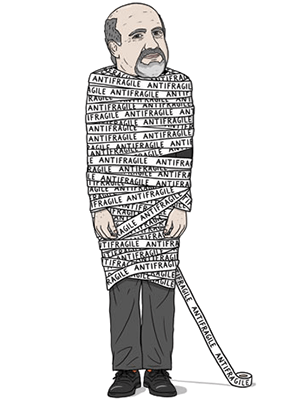
The Lindy Effect is a theory of the permanence of non-perishable things. Unlike biological organisms, the life expectancy of an idea or technology increases as it ages. The origin of the concept can be traced to biographer Albert Goldman and a 1964 article he wrote for ‘The New Republic’ titled ‘Lindy’s Law.’ In it he stated that ‘the future career expectations of a television comedian is proportional to the total amount of his past exposure on the medium.’ The term refers to a NY deli known as a hangout for comedians; they would ‘foregather every night at Lindy’s, where… they conduct post-mortems on recent show biz ‘action.’
Mathematician Benoit Mandelbrot formally coined the term ‘Lindy Effect’ in his 1984 book ‘The Fractal Geometry of Nature.’ Mandelbrot expressed mathematically that for certain things bounded by the life of the producer, like human promise, future life expectancy is proportional to the past: ‘However long a person’s past collected works, it will on the average continue for an equal additional amount. When it eventually stops, it breaks off at precisely half of its promise.’ Continue reading →
Posted in Philosophy, Science, Technology |
1 Comment »
June 9, 2014


Survivorship bias is the logical error of concentrating on the people or things that ‘survived’ some process and inadvertently overlooking those that did not because of their lack of visibility. The concept applies to actual people (e.g. subjects in a medical study), as well as companies, or anything that must make it past some selection process to be considered further (e.g. job applicants).
Survivorship bias can lead to overly optimistic beliefs because failures are ignored, such as when companies that no longer exist are excluded from analyses of financial performance. It can also lead to the false belief that the successes in a group always have some special property, rather than just benefiting from coincidence. For example, if the three of the five students with the best college grades went to the same high school, that can lead one to believe that the high school must offer an excellent education. This could be true, but the question cannot be answered without looking at the grades of all the other students from that high school, not just the ones who ‘survived’ the top-five selection process. Continue reading →
Posted in Death, Health, Science |
Leave a Comment »
June 6, 2014

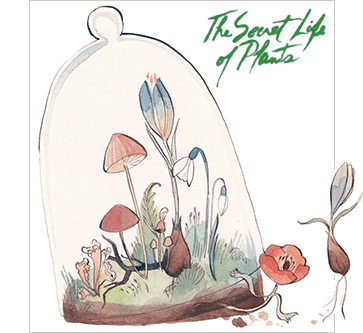
Hormonal [hawr-moh-nl] sentience [sen-shuhns], first described by nanotechnology researcher Robert A. Freitas Jr., describes the information processing rate in plants, which are mostly based on hormones instead of neurons like in all major animals (except sponges). Plants can to some degree communicate with each other and there are even examples of one-way-communication with animals.
Acacia trees produce tannin to defend themselves when they are grazed upon by animals. The airborne scent of the tannin is picked up by other acacia trees, which then start to produce it themselves to ward off nearby grazers. When attacked by caterpillars, some plants can release chemical signals to attract parasitic wasps that attack the caterpillars. Continue reading →
Posted in Science |
Leave a Comment »
June 5, 2014

The sentience [sen-shuhns] quotient [kwoh-shuhnt] (SQ) was introduced by nanotechnology researcher Robert A. Freitas Jr. in the late 1970s. It defines sentience as the relationship between the information processing rate (in bits per second) of each individual processing unit (neuron), the weight/size of a single unit, and the total number of processing units (expressed as mass). This is a non-standard usage of the word ‘sentience,’ which normally relates to an organism’s capacity to perceive the world subjectively (it is derived from the Latin word ‘sentire’ meaning ‘to feel’ and is closely related to the word ‘sentiment’; intelligence or cognitive capacity is better denoted by ‘sapience’).
The potential and total processing capacity of a brain, based on the amount of neurons and the processing rate and mass of a single one, combined with its design (e.g. myelin coating, specialized areas) and programming, lays the foundations of the brain level of the individual. Not just in humans, but in all organisms, even artificial ones such as computers (although their ‘brain’ is not based on neurons). The SQ of an individual is therefore a measure of the efficiency of an individual brain, not its relative intelligence. Continue reading →
Posted in Science, Technology |
1 Comment »
June 4, 2014
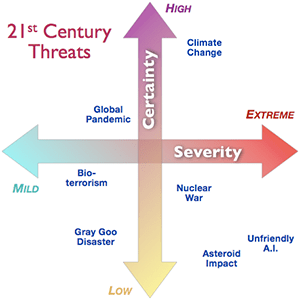

Ecophagy [ih-koh-fuh-jee] is a term coined by molecular engineering scientist Robert Freitas that means the literal consumption of an ecosystem. He wrote: ‘Perhaps the earliest-recognized and best-known danger of molecular nanotechnology is the risk that self-replicating nanorobots capable of functioning autonomously in the natural environment could quickly convert that natural environment (e.g., ‘biomass’) into replicas of themselves (e.g., ‘nanomass’) on a global basis, a scenario usually referred to as the ‘grey goo problem’ but perhaps more properly termed ‘global ecophagy.”
The term has since been used to describe several other world destroying events including nuclear war, catastrophic monoculture (lack of biodiversity in farming), and mass extinction due to climate change. Scholars suggest that these events might result in ecocide in that they would undermine the capacity of the Earth’s biological population to repair itself. Others suggest that more mundane and less spectacular events—the unrelenting growth of the human population, the steady transformation of the natural world by human beings—will eventually result in a planet that is considerably less vibrant, and one that is, apart from humans, essentially lifeless.
Posted in Death, Technology, World |
Leave a Comment »
June 3, 2014

‘The Machine Stops’ is a science fiction short story written in 1909 by E. M. Forster, who known for his ironic and well-plotted novels examining class difference and hypocrisy in early 20th-century British society. After initial publication in ‘The Oxford and Cambridge Review,’ the story was republished in Forster’s ‘The Eternal Moment and Other Stories’ in 1928. It is particularly notable for predicting new technologies such as instant messaging and the Internet.
Forster describes a world in which most of the human population has lost the ability to live on the surface of the Earth. Individuals lives in isolation below ground in a standard ‘cell,’ with all bodily and spiritual needs met by the omnipotent, global ‘Machine.’ Travel is permitted but unpopular and rarely necessary. Communication is made via a kind of instant messaging/video conferencing machine called the speaking apparatus, with which people conduct their only activity: the sharing of ideas and what passes for knowledge. Continue reading →
Posted in Language, Philosophy, Technology |
1 Comment »
June 2, 2014

Because of the complexity and sophistication of its narrative structure, H.G. Wells’s 1905 novel ‘A Modern Utopia‘ (1905) has been called ‘not so much a modern as a postmodern utopia.’ The book is best known for its notion that a voluntary order of nobility known as the Samurai could effectively rule a ‘kinetic and not static’ world state so as to solve ‘the problem of combining progress with political stability.’
In terms of Northrop Frye’s classification of literary genres, ‘A Modern Utopia’ is not a novel but an anatomy, a book that divides a topic into parts for detailed examination or analysis. Frye, narrowed the definition of the word to mean a work resembling a ‘Menippean satire,’ which ridicules foolish or undisciplined mental attitudes instead of specific individuals. Continue reading →
Posted in Language, Philosophy |
Leave a Comment »
June 2, 2014

The genre of Menippean [meh-nip-pee-uhn] satire is a form of satire (ridicule of foolishness and moral failings), usually in prose, which has a length and structure similar to a novel and is characterized by attacking mental attitudes instead of specific individuals. Other features found in Menippean satire are different forms of parody and mythological burlesque (humorous caricatures of the gods), a critique of the myths inherited from traditional culture, a rhapsodic nature, a fragmented narrative, the combination of many different targets, and the rapid moving between styles and points of view.
The term is used by classical grammarians and by philologists mostly to refer to satires in prose. Typical mental attitudes attacked and ridiculed by Menippean satires are ‘pedants, bigots, cranks, parvenus, virtuosi, enthusiasts, rapacious and incompetent professional men of all kinds,’ which are treated as diseases of the intellect. The term Menippean satire distinguishes it from the earlier satire pioneered by Aristophanes, which was based on personal attacks. Continue reading →
Posted in Art, Humor, Language |
1 Comment »
June 1, 2014

Baby jumping (‘El Colacho’) is a traditional Spanish holiday dating back to 1620 that takes place annually to celebrate the Catholic feast of Corpus Christi in the village of Castrillo de Murcia in northern Spain. During the act, known as ‘El Salto del Colacho’ (‘the devil’s jump’), men dressed as the Devil (the Colacho) jump over babies born during the previous twelve months of the year who lie on mattresses in the street. The Brotherhood of Santísimo Sacramento de Minerva organizes the week-long festivities which culminate on Sunday when the Colacho jumps over the babies on the mattresses placed on the procession route traversing the town.
The festival has been rated as one of the most dangerous in the world. The origins of the tradition are unknown but it is said to cleanse the babies of original sin, ensure them safe passage through life and guard against illness and evil spirits. In recent years, Pope Benedict has asked Spanish priests to distance themselves from El Colacho, and to downplay the tradition’s connection with Catholicism. The Church still teaches that it is baptism by water, not a giant leap by an airborne devil, which cleanses the soul of original sin.
Posted in Games, Philosophy, World |
Leave a Comment »
May 30, 2014

Fordite, also known as ‘Detroit agate,’ is old automobile paint which has hardened sufficiently to be cut and polished.
It was formed from the built up of layers of enamel paint slag on tracks and skids on which cars were hand spray-painted (a now automated process), which have been baked numerous times. In recent times the material has been recycled as eco-friendly jewelry.
Posted in Art, Technology |
Leave a Comment »
May 29, 2014

A Beer mile is a drinking race combining running and speed drinking. Typically, the event takes place on a standard 400 meter or 1/4 mile running track. Each lap must be preceded by the drinking of a standard amount of beer, typically a 12-ounce can. Rules vary by region. One custom requires runners to prove they have finished their beer by inverting it over their heads before commencing a lap.
The standard rules published by BeerMile.com are based on the most common rules used in North America. They specify that any competitor who vomits prior to finishing the race must complete a penalty lap immediately following the fourth lap. The penalty lap does not require the drinking of an additional beer. The standard rules also dictate that the beer be consumed directly from the pour of the can (i.e. tampering with the cans, such as ‘shotgunning,’ is not allowed). The beer used for the competition must also be full-strength, or at least 5.0% ABV. Hard ciders and other alcoholic beverages are generally not allowed.
Continue reading →
Posted in Drugs, Games, Humor |
Leave a Comment »
May 28, 2014


‘Thank God for Mississippi’ is a common adage in the US, particularly in the south, that is generally used when discussing rankings of states (e.g. educational achievement, overall health, poverty rate, quality of life). Since the state of Mississippi generally ranks at the bottom of such lists, residents of other states ranking near the bottom frequently proclaim, ‘Thank God for Mississippi,’ for sparing them from the shame of finishing in last place.
The saying has been attributed since before the induction of Alaska and Hawaii as states in 1959, and is especially common in Alabama, which shares significant cultural and historical ties with its neighbor and former Mississippi Territory co-constituent. Its use is also noted in nearby Arkansas and other frequently low-ranking states such as West Virginia and Texas.
Posted in Humor, Politics |
Leave a Comment »


 The Daily Omnivore