December 13, 2023
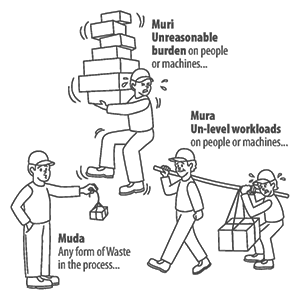
Muda [moo-duh] is a Japanese word meaning ‘futility,’ ‘uselessness,’ or ‘wastefulness,’ and is a key concept in lean process thinking such as in the Toyota Production System (TPS), denoting one of three types of deviation from optimal allocation of resources. The other types are known by the Japanese terms ‘mura’ (‘unevenness’) and ‘muri’ (‘overload’). Waste in this context refers to the wasting of time or resources rather than wasteful by-products.
From an end-customer’s point of view, value-added work is any activity that produces goods or provides a service for which a customer is willing to pay; muda is any constraint or impediment that causes waste to occur. Continue reading →
Posted in Money, Technology, World |
Leave a Comment »
November 30, 2023

Q* (pronounced ‘Q-star’) is an alleged internal project by OpenAI dedicated to the application of artificial intelligence in logical and mathematical reasoning. In November 2023, certain employees of OpenAI reportedly raised concerns with the company’s board, suggesting that Q* might signify the imminent emergence of artificial general intelligence. The reported work involves performing math on the level of grade-school students.
Math requires abstract reasoning and a firm grasp of logical principles. It’s not just about recognizing patterns or processing language, but about understanding and applying mathematical concepts and rules. Mathematics also demands precision and consistent application of rules, unlike many language tasks where approximations or multiple interpretations can be acceptable. An AI model that can reliably perform grade-school level math marks a significant advancement in the field, indicating progress towards more sophisticated and logically rigorous AI systems. Continue reading →
Posted in Technology |
Leave a Comment »
November 27, 2023
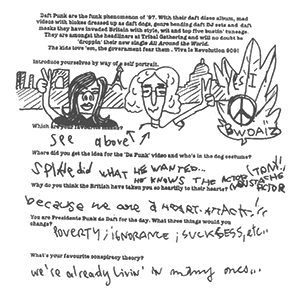
‘Jockey Slut’ was a British music magazine that ran from 1993 to 2004, starting as a bi-monthly fanzine focused on dance music and club culture before becoming a monthly publication in 1999 following acquisition by Swinstead Publishing. The magazine distinguished itself through music-centered coverage that balanced witty fanzine-style writing with irreverent humor, giving early coverage to influential acts like The Chemical Brothers, Daft Punk, and The Streets, while also featuring rock and indie music. Its readers tended to refer to the magazine as just ‘The Slut.’
After transitioning to a quarterly format with increased online presence in 2004, the magazine closed in May of that year, leaving behind a legacy of being one of the first publications to feature interviews with many now-legendary electronic music artists. Continue reading →
Posted in Art |
1 Comment »
November 26, 2023

Roko’s basilisk [bas-uh-lisk] is a thought experiment which states that an otherwise benevolent artificial superintelligence (AI) in the future would be incentivized to create a virtual reality simulation to torture anyone who knew of its potential existence but did not directly contribute to its advancement or development, in order to incentivize said advancement.
It originated in a 2010 post at discussion board LessWrong, a technical forum focused on analytical rational enquiry. The thought experiment’s name derives from the poster of the article (Roko) and the basilisk, a mythical creature capable of destroying enemies with its stare. Continue reading →
Posted in Philosophy, Technology |
Leave a Comment »
November 14, 2023
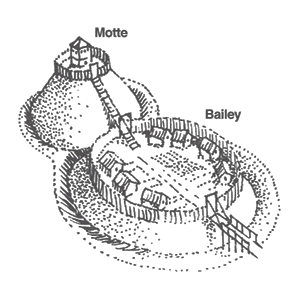
The motte-and-bailey fallacy (named after the motte-and-bailey castle) is a form of argument and an informal fallacy where an arguer conflates two positions that share similarities, one modest and easy to defend (the ‘motte’) and one much more controversial and harder to defend (the ‘bailey’).
The arguer advances the controversial position, but when challenged, insists that only the more modest position is being advanced. Upon retreating to the motte, the arguer can claim that the bailey has not been refuted (because the critic refused to attack the motte) or that the critic is unreasonable (by equating an attack on the bailey with an attack on the motte). Continue reading →
Posted in Language, Politics |
Leave a Comment »
October 30, 2023

A participation trophy is a trophy given to children (usually) who participate in any sport event or contest without requiring their success in competition. The term may be used more generally as an example of the celebration of mediocrity or of emotional coddling. In this rhetorical context, it is frequently associated with millennials, those of Generation Y.
The use of participation trophies has caused some controversy. Critics argue that they promote narcissism and entitlement among children to whom they are given, and are based on incorrect assumptions regarding supposed psychological benefits of self-esteem. Critics also note that some children also do not value them as much as they do ‘normal’ trophies that are given to winners. Defenders of participation trophies argue that they teach children that trying their best is good enough, even if they do not win. Continue reading →
Posted in Games, Health, Politics |
Leave a Comment »
October 15, 2023
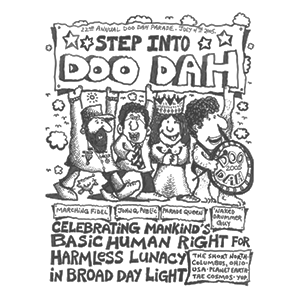
The Pasadena Doo Dah Parade is a popular farcical and flamboyant parade held in Pasadena, California. It was conceived in 1978 as an irreverent alternative to the traditional formality of Pasadena’s famed Rose Parade. It is held about once a year, usually in the fall or winter, although in recent years it has moved to the nearest Saturday to May Day. The event has spawned offshoots in Columbus, Ohio, Ocean City, New Jersey, and Kalamazoo, Michigan, and Norfolk, Virginia.
The parade was started by Peter Apanel, Ted Wright, Charles ‘Skip’ Finnell, Corky Peterson, and Richard Caputo, sitting in a bar called Chromos in Pasadena, with input from Alice McIntosh of The Red Shoes Dancewear store next door. In 1978, January 1 fell on a Sunday, and the Rose Parade, which typically takes place on January 1, will not march on a Sunday. So, they decided it would be fun to have an alternative parade on January 1 that year. It was the first Doo Dah Parade. Peter Apanel became the Czar of Parade and organized and oversaw all the parades through Doo Dah 19. Continue reading →
Posted in Humor |
Leave a Comment »
September 23, 2023
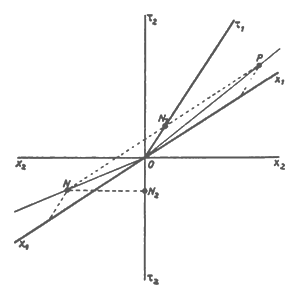
A tachyonic [tak-ee-on-ik] antitelephone is a hypothetical device in theoretical physics that could be used to send signals into one’s own past. Albert Einstein in 1907 presented a thought experiment of how faster-than-light signals can lead to a paradox of causality, which was described by Einstein and Arnold Sommerfeld in 1910 as a means ‘to telegraph into the past.’ The same thought experiment was described by physicist Richard Chace Tolman in 1917; thus, it is also known as Tolman’s paradox.
A device capable of ‘telegraphing into the past’ was later also called a ‘tachyonic antitelephone’ by science fiction writer and astrophysicist Gregory Benford. According to current understanding of physics, no such faster-than-light transfer of information is actually possible. Continue reading →
Posted in Science, Technology |
Leave a Comment »
September 4, 2023
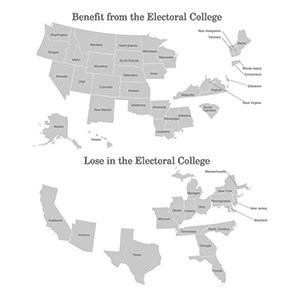
The National Popular Vote Interstate Compact (NPVIC) is an agreement among a group of U.S. states and the District of Columbia to award all their electoral votes to whichever presidential ticket wins the overall popular vote in the 50 states and the District of Columbia. The compact is designed to ensure that the candidate who receives the most votes nationwide is elected president, and it would come into effect only when it would guarantee that outcome.
Introduced in 2006, as of August 2023 it has been adopted by sixteen states and the District of Columbia. These jurisdictions have 205 electoral votes, which is 38% of the Electoral College and 76% of the 270 votes needed to give the compact legal force. Certain legal questions may affect implementation of the compact. Continue reading →
Posted in Politics |
Leave a Comment »
August 29, 2023

Guns don’t kill people, people kill people is a slogan popularized by the National Rifle Association of America (NRA) and other gun advocates. The slogan and connected understanding dates back to at least the 1910s, and it became widely popular among gun advocates in the second half of the 20th century, so much so that some have labeled it a cliché.
Gun control proponents claim the slogan is an example of bumper sticker logic and supports the larger folk psychology behind gun advocacy. In colloquial use, both parts of the statement are largely considered true. However, when the statement is used in the context of gun debates it becomes misdirection and can be considered a fallacy. Continue reading →
Posted in Death, Language, Politics |
Leave a Comment »
August 13, 2023
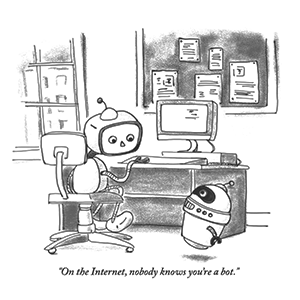
The Dead Internet Theory is an online conspiracy theory that asserts that the Internet now consists almost entirely of bot activity and automatically generated content that is manipulated by algorithmic curation, marginalizing organic human activity.
These intelligent bots are assumed to have been made, in part, to help manipulate algorithms and boost search results in order to ultimately manipulate consumers. Further, proponents of the theory accuse government agencies of using bots to manipulate public perception. The date given for this ‘death’ is generally around 2016 or 2017. Continue reading →
Posted in Humor, Technology |
Leave a Comment »
August 6, 2023
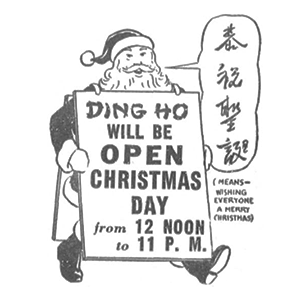
The Jewish-American patronage of Chinese restaurants became prominent in the 20th century, especially among Jewish New Yorkers. It has received attention as a paradoxical form of assimilation by embracing an unfamiliar cuisine that eased the consumption of non-kosher foods.
Factors include the relative absence of dairy products compared to European cuisines, concern over German and Italian antisemitic regimes in the 1930s and the proximity of Jewish and Chinese immigrants to each other in New York City. Continue reading →
Posted in Food, Philosophy, World |
Leave a Comment »


 The Daily Omnivore