March 27, 2014

Out of hacker culture, and especially the artificial intelligence community at MIT, there have sprung a number of humorous short stories about computer science dubbed hacker koans [koh-ahns]; most of these are recorded in an appendix to the Jargon File (a glossary of computer programmer slang). Most do not fit the usual pattern of koans, but they do tend to follow the form of being short, enigmatic, and often revealing an epiphany.
One notable example, titled ‘Uncarved block,’ describes an exchange between professor Marvin Minsky and student Jerry Sussman: ‘In the days when Sussman was a novice, Minsky once came to him as he sat hacking at the PDP-6. ‘What are you doing?’, asked Minsky. ‘I am training a randomly wired neural net to play Tic-tac-toe,’ Sussman replied. ‘Why is the net wired randomly?’, asked Minsky. ‘I do not want it to have any preconceptions of how to play,’ Sussman said. Minsky then shut his eyes. ‘Why do you close your eyes?’ Sussman asked his teacher. ‘So that the room will be empty.’ At that moment, Sussman was enlightened.’
Continue reading →
Posted in Humor, Philosophy, Technology |
Leave a Comment »
March 26, 2014
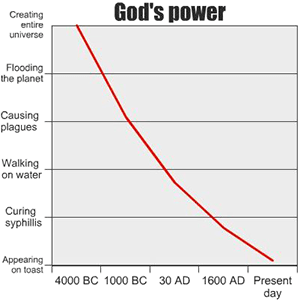
God of the gaps is a theological perspective in which gaps in scientific knowledge are taken to be evidence or proof of God’s existence. The term was invented by Christian theologians not to discredit theism but rather to point out the fallacy of relying on teleological arguments (argument from design) for God’s existence. Some use the phrase to refer to a form of the argument from ignorance fallacy (in which ignorance stands for ‘lack of evidence to the contrary’).
The concept, although not the exact wording, goes back to Henry Drummond, a 19th-century evangelist lecturer, from his Lowell Lectures on ‘The Ascent of Man.’ He chastises those Christians who point to the things that science cannot yet explain—’gaps which they will fill up with God’—and urges them to embrace all nature as God’s, as the work of ‘… an immanent God, which is the God of Evolution, is infinitely grander than the occasional wonder-worker, who is the God of an old theology.’ (Immanence here is related to pantheism, the belief that God and the universe are equivalent.)
Continue reading →
Posted in Philosophy, Science |
3 Comments »
March 25, 2014

Ietsism [eets-iz-uhm] (Dutch: ‘somethingism’) is an unspecified belief in some higher force. In some Eastern European censuses (Albanian, for example), those having ietsistic beliefs are counted as believers without religion. An opinion poll conducted by the Dutch daily newspaper ‘Trouw’ in 2004 indicated that some 40% of its readership felt broadly this way.
It indicates a range of beliefs held by people who, on the one hand, inwardly suspect – or indeed believe – that there is ‘More between Heaven and Earth’ than we know about, but on the other hand do not necessarily accept or subscribe to the established belief system, dogma or view of the nature of God offered by any particular religion. Some of the English language equivalent terms are agnostic theism (the belief that one or more gods exist, but that a person cannot know that god or those gods) and deism (the belief that while a higher being exists, people should rely on logic and reason and not religious traditions).
Continue reading →
Posted in Language, Philosophy, World |
Leave a Comment »
March 24, 2014


A paperless office is a work environment in which the use of paper is eliminated or greatly reduced by converting documents into digital form. Proponents claim that ‘going paperless’ can save money, boost productivity, save space, make documentation and information sharing easier, keep personal information more secure, and help the environment. The concept can be extended to communications outside the office as well.
Traditional offices have paper-based filing systems, which may include filing cabinets, folders, shelves, microfiche systems, and drawing cabinets, all of which require maintenance, equipment, considerable space, and are resource-intensive. In contrast, a paperless office could simply have a desk, chair, and computer (with a modest amount of local or network storage), and all of the information would be stored in digital form. Speech recognition and speech synthesis could also be used to facilitate the storage of information digitally.
Continue reading →
Posted in Technology |
Leave a Comment »
March 23, 2014

Jacob Barnett (b. 1998) is a mathematician and astrophysicist who, while still a teenager, has became an orator of Physics at Indiana University. Barnett was diagnosed with moderate to severe autism when he was 2 years old and was educated and taught privately by his parents. His mother, Kristine, wrote a book about this educational journey called ”The Spark: A Mother’s Story of Nurturing, Genius, and Autism.’ He was just 12 years old when he was enrolled into college at the Indiana University Purdue University Indianapolis, skipping 7 grades, having learned the majority of his school’s math syllabus within two weeks.
At the age of 15 he became a PSI-student at the Perimeter Institute for Theoretical Physics in Waterloo, Ontario, Canada and is expected to receive a PhD in late 2014. Barnett has been working on Einstein’s theory of relativity and thinks he will be able to amend it or even prove it wrong. He also expressed doubts about the Big Bang Theory and thinks he will be able to amend it too. Professor Scott Tremaine of the Institute of Advanced Study wrote ‘The theory that he’s working on involves several of the toughest problems in astrophysics and theoretical physics. Anyone who solves these will be in line for a Nobel Prize.’
Posted in Education, Health, Science |
1 Comment »
March 22, 2014
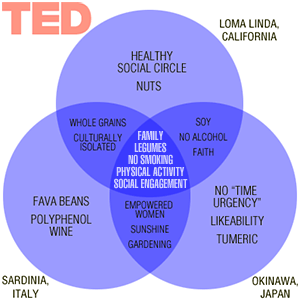
Blue Zone is a concept used to identify a demographic and/or geographic area of the world where people live measurably longer lives, as described in Dan Buettner’s book, ‘The Blue Zones: Lessons for Living Longer from people who lived the longest.’ The concept grew out of demographic work done by Gianni Pes and Michel Poulain, who identified Sardinia’s Nuoro province as the region with the highest concentration of male centenarians.
As the two men zeroed in on the cluster of villages with the highest longevity, they drew concentric blue circles on the map and began referring to the area inside the circle as the Blue Zone. Buettner identifies other zones in Okinawa, Japan; Nicoya, Costa Rica; Icaria, Greece; Vilcabamba, Ecuador; and among the Seventh-day Adventists in Loma Linda, California.
Continue reading →
Posted in Death, Health, World |
1 Comment »
March 21, 2014

Ikigai [ee-key-guy] is a Japanese term for one’s reason for being, discovery of which brings satisfaction and meaning to life. Everyone, according to the Japanese, has an ikigai. Finding it requires a deep and often lengthy search of self. Such a search is regarded as being very important, since it is believed that discovery of one’s ikigai brings satisfaction and meaning to life.
In the culture of Okinawa, ikigai is thought of as ‘a reason to get up in the morning’; that is, a reason to enjoy life. In a TED Talk, author Dan Buettner offered ikigai as one of the reasons people in the area had such long lives.
Posted in World |
Leave a Comment »
March 20, 2014

Gaydar is a colloquialism referring to the intuitive ability of a person to assess others’ sexual orientations as gay, bisexual or heterosexual. Gaydar relies almost exclusively on non-verbal clues and LGBT stereotypes. These include (but are not limited to) the sensitivity to social behaviors and mannerisms; for instance, acknowledging flamboyant body language, the tone of voice used by a person when speaking, overtly rejecting traditional gender roles, a person’s occupation, and grooming habits.
The detection of sexual orientation by outward appearance or behavior is frequently challenged by situations in which masculine gay men who do not act in a stereotypically ‘gay’ fashion, or with metrosexual men (regardless of sexuality) who exhibit a lifestyle, spending habits, and concern for personal appearance stereotypical of fashionable urban gay men.
Continue reading →
Posted in Language, Science, Sex |
Leave a Comment »
March 19, 2014
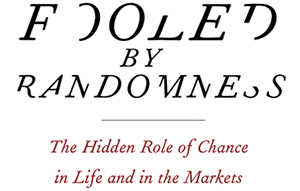
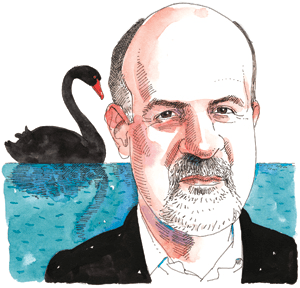
The black swan theory or theory of black swan events is a metaphor that describes an event that comes as a surprise, has a major effect, and is often inappropriately rationalized after the fact with the benefit of hindsight.
The theory was developed by Lebanese American statistician Nassim Nicholas Taleb to explain the disproportionate role of high-profile, hard-to-predict, and rare events that are beyond the realm of normal expectations in history, science, finance, and technology. It further examined the non-computability of the probability of the consequential rare events using scientific methods (owing to the very nature of small probabilities), and the psychological biases that make people individually and collectively blind to uncertainty and unaware of the massive role of the rare event in historical affairs.
Continue reading →
Posted in Money, Philosophy, Science |
Leave a Comment »
March 18, 2014

The Mule is a fictional character from Isaac Asimov’s ‘Foundation’ series (first appearing in 1955 under the title ‘The 1,000-Year Plan,’ it is the story of scientist Hari Seldon’s effort to preserve knowledge as the civilizations around him begin to regress). One of the greatest conquerors the galaxy has ever seen, the Mule is a mentalic, a psychic mutant, who has the ability to reach into the minds of others and ‘adjust’ their emotions, individually or en masse, using this capability to conscript followers for his cause.
Mentalics are not capable of direct mind-control, but can subtly influence other’s subconscious; individuals under the Mule’s influence behave otherwise normally – logic, memories, and personality intact. This gives the Mule the capacity to disrupt Seldon’s plan by invalidating the assumption that no single individual could have a measurable effect on galactic socio-historical trends on their own. Seldon’s discipline, called psychohistory, relied on the predictability of the actions of very large numbers of people.
Continue reading →
Posted in Art |
Leave a Comment »
March 18, 2014
‘Here be dragons‘ means dangerous or unexplored territories, in imitation of the medieval practice of putting dragons, sea serpents and other mythological creatures in uncharted areas of maps. There are just two known historical use of this phrase in the Latin form ‘HC SVNT DRACONES.’ The term appeared on the 16th century Lenox Globe around the east coast of Asia, and might be related to the Komodo dragons in the Indonesian islands, tales of which were quite common throughout East Asia.
It also appeared on another globe of that era engraved on two conjoined halves of ostrich eggs. Earlier maps contain a variety of references to mythical and real creatures, but the Lenox Globe and the egg globe are the only known surviving maps to bear this phrase. An investigation of the egg globe performed by collector Stefaan Missinne concluded that the Hunt-Lenox Globe is a cast of the egg globe.
Continue reading →
Posted in Language, Philosophy, World |
Leave a Comment »
March 17, 2014

The Wayback Machine is a digital archive of the World Wide Web and other information on the Internet created by the Internet Archive, a non-profit organization, based in San Francisco, California. It was set up by Brewster Kahle and Bruce Gilliat, co-founders of Alexa Internet, which provides commercial web traffic data, and is maintained with content from Alexa (currently a subsidiary of Amazon.com). The service enables users to see archived versions of web pages across time, which the Archive calls a ‘three dimensional index.’
The name Wayback Machine was chosen as a droll reference to a plot device in an animated cartoon series, ‘The Rocky and Bullwinkle Show.’ In it, Mr. Peabody and Sherman routinely used a time machine called the ‘WABAC machine’ (pronounced ‘Wayback’) to witness, participate in, and, more often than not, alter famous events in history.
Continue reading →
Posted in Technology |
Leave a Comment »


 The Daily Omnivore