February 20, 2014

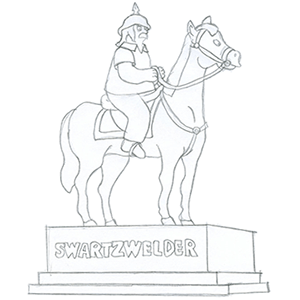
‘Army Man‘ (tagline: ‘America’s Only Magazine’) was a short-lived comedy magazine published in the late 1980s by George Meyer, the acclaimed writer for ‘The Simpsons.’ The magazine consisted mostly of very short and very surreal jokes, along with some cartoons. Each issue also featured Jack Handey’s ‘Deep Thoughts,’ as well as other pieces written by him. Only three issues were ever published. Although Army Man was never widely distributed, it gathered a lot of attention in the comedy world.
Two of its writers (John Swartzwelder and Jon Vitti) were picked up alongside Meyer to be part of the original writing staff of ‘The Simpsons’ by the show’s developer and show-runner Sam Simon, an enormous fan of the magazine. Eventually other ‘Army Man’ writers would go on to write for ‘The Simpsons’ in later seasons. The writers were usually people Meyer knew from his years at the ‘Harvard Lampoon’ or who worked with him in TV shows like ‘Late Night with David Letterman,’ ‘The New Show,’ ‘Not Necessarily The News,’ and ‘Saturday Night Live.’
Posted in Art, Humor, Language |
Leave a Comment »
February 19, 2014
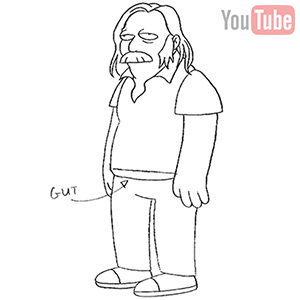
John Swartzwelder (b. 1950) is an American comedy writer and novelist, best known for his work on the animated television series ‘The Simpsons,’ as well as a number of novels. He is credited with writing the largest number of ‘Simpsons’ episodes by a large margin (59 full episodes, with contributions to several others). Swartzwelder was one of several writers recruited to show from the pages of George Meyer’s ‘Army Man’ magazine (a short-lived comedy periodical published in the late 1980s; Meyer would also go on to become an acclaimed ‘Simpsons’ writer).
Swartzwelder has been animated in the background of several episodes of ‘The Simpsons.’ His animated likeness closely resembles musician David Crosby, which prompted Matt Groening to state that anytime that David Crosby appears in a scene for no apparent reason, it is really John Swartzwelder. Additionally, Matt Groening has stated that the recurring character ‘Herman Hermann’ (the owner of Herman’s Military Antiques) was originally physically based on Swartzwelder–with the exception of his one arm.
Continue reading →
Posted in Art, Humor, Language |
Leave a Comment »
February 18, 2014

‘Battle Hymn of the Tiger Mother‘ is a 2011 book by Yale law professor Amy Chua. The complete subtitle of the book is: ‘This is a story about a mother, two daughters, and two dogs. This was supposed to be a story of how Chinese parents are better at raising kids than Western ones. But instead, it’s about a bitter clash of cultures, a fleeting taste of glory, and how I was humbled by a thirteen-year-old.’
Chua reported that in one study of 48 Chinese immigrant mothers, the vast majority ‘said that they believe their children can be ‘the best’ students, that ‘academic achievement reflects successful parenting,’ and that if children did not excel at school then there was ‘a problem’ and parents ‘were not doing their job.” Chua contrasts them with the view she labels ‘Western’ – that a child’s self-esteem is paramount.
Continue reading →
Posted in Education, Language, World |
Leave a Comment »
February 17, 2014

Middleman minority (also known as market-dominant minorities) is any minority population that, while subject to discrimination, does not hold an ‘extreme subordinate’ status in society. There are numerous examples of such groups gaining eventual prosperity in their adopted country despite discrimination. Often, they will take on roles between producer and consumer, such as trading and moneylending.
Famous examples such as Jews throughout Europe even at times when the discrimination against them was at their peak such as during World War II they still had great success in some parts of Europe, Chinese throughout Southeast Asia, Parsis in India, Igbos in Nigeria, Indians in East Africa, people from the Soviet Blocs in the USA during the Cold War, and many others.
Continue reading →
Posted in Money, Politics, World |
Leave a Comment »
February 15, 2014

A holodeck, in the fictional ‘Star Trek’ universe, is a simulated reality facility located on starships and starbases. It first appeared in the pilot episode of ‘Star Trek: The Next Generation,’ ‘Encounter at Farpoint,’ although a conceptually similar ‘recreation room’ appeared in an episode of ‘Star Trek: the Animated Series’ in 1974. In the timeline of the fictional universe, the concept of a holodeck was first shown to humans in an encounter with the Xyrillian race in the ‘Star Trek: Enterprise’ episode ‘Unexpected.’
The holodeck is depicted as an enclosed room in which objects and people are simulated by a combination of transported matter, replicated matter, tractor beams, and shaped force fields onto which holographic images are projected. Most holodeck programs shown in the episodes run in first person ‘subjective mode,’ in which the user actively interacts with the program and its characters. The user may also employ third-person ‘objective mode,’ in which he or she is unseen by program characters.
Continue reading →
Posted in Art, Technology |
1 Comment »
February 13, 2014

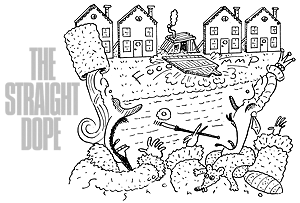
The phrase Potemkin [poh-tem-kin] villages was originally used to describe a fake village, built only to impress. According to the story, Russian statesman Grigory Potemkin erected fake settlements along the banks of the Dnieper River in order to fool Empress Catherine II during her visit to Crimea in 1787.
The phrase is now used, typically in politics and economics, to describe any construction (literal or figurative) built solely to deceive others into thinking that some situation is better than it really is. Some modern historians claim the original story is exaggerated.
Continue reading →
Posted in Money, Politics, World |
Leave a Comment »
February 12, 2014


The mola [moh-luh] forms part of the traditional woman’s attire for the Kuna (an indigenous people of Panama and Colombia), two mola panels being incorporated as front and back panels in a blouse. The full costume traditionally includes a patterned wrapped skirt (saburet), a red and yellow headscarf (musue), arm and leg beads (wini), a gold nose ring (olasu), and earrings in addition to the mola blouse (dulemor).
In Dulegaya, the Kuna’s native language, ‘mola’ means ‘shirt’ or ‘clothing.’ The mola originated with the tradition of Kuna women painting their bodies with geometrical designs, using available natural colors; in later years these same designs were woven in cotton, and later still, sewn using cloth bought from the European settlers of Panamá.
Continue reading →
Posted in Art, World |
Leave a Comment »
February 11, 2014

A woonerf [voh-nairf] is a living street where pedestrians and cyclists have legal priority over motorists as implemented in the Netherlands and in Flanders. Techniques include shared space, traffic calming, and low speed limits. Under Article 44 of the Dutch traffic code, motorized traffic in a woonerf or ‘recreation area’ is restricted to walking pace.
The word literally translates as ‘living yard.’ In 1999 the Netherlands had over 6000 woonerven. Today around 2 million Dutch people are living in woonerven. The benefits of the woonerf are promoted by woonERFgoed, a network of professionals and residents. In the UK these are called ‘home zones.’ In the US ‘complete streets’ are a similar concept where equal priority is given to all modes of transportation including automobiles, bicycles, and pedestrians.
Posted in Politics, World |
Leave a Comment »
February 10, 2014

The Monuments, Fine Arts, and Archives (MFAA) program under the Civil Affairs and Military Government Sections of the Allied armies was established in 1943 to help protect cultural property in war areas during and after World War II. The group of about 400 servicemembers and civilians worked with military forces to safeguard historic and cultural monuments from war damage, and as the conflict came to a close, to find and return works of art and other items of cultural importance that had been stolen by the Nazis or hidden for safekeeping.
Many of the men and women of the MFAA, also known as Monuments Men, went on to have prolific careers. Largely art historians and museum personnel, they had formative roles in the growth of many of the United States’ greatest cultural institutions, including the National Gallery of Art, the Metropolitan Museum of Art, and the New York City Ballet, as well as in museums and other institutions in Europe.
Continue reading →
Posted in Art, War |
Leave a Comment »
February 7, 2014
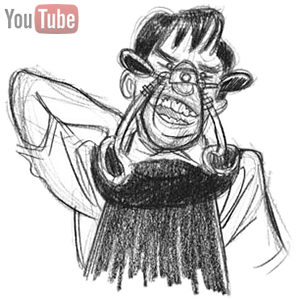
In psychology, sublimation [suhb-luh-mey-shuhn] is a mature type of defense mechanism where socially unacceptable impulses or idealizations are consciously transformed into socially acceptable actions or behavior, possibly resulting in a long-term conversion of the initial impulse. Sigmund Freud believed that sublimation was a sign of maturity (indeed, of civilization), allowing people to function normally in culturally acceptable ways.
He defined sublimation as the process of deflecting sexual instincts into acts of higher social valuation, being ‘an especially conspicuous feature of cultural development; it is what makes it possible for higher psychical activities, scientific, artistic or ideological, to play such an important part in civilised life.’ Sublimation is when displacement ‘serves a higher cultural or socially useful purpose, as in the creation of art or inventions.’ Psychoanalysts often refer to it as the only truly successful defense mechanism.
Continue reading →
Posted in Health, Philosophy, Sex |
1 Comment »
February 6, 2014

A wardrobe malfunction is accidental exposure of intimate parts. It is different from indecent exposure or flashing, as the latter ones imply a deliberate exposure. There has been a long history of such incidents, though the term itself was coined in the mid-2000s and has become one of the most common fashion faux pas. In everyday context it often happens as a ‘nipple slip’ to women and is relatively common, but wardrobe malfunction suggests a public event or performance, particularly when there are allegations that it was deliberately staged for publicity reasons.
The American Dialect Society defines it as ‘an unanticipated exposure of bodily parts.’ Global Language Monitor, which tracks usage of words on the internet and in newspapers worldwide, identified the term as the top Hollywood contribution to English in 2004, surpassing words like ‘girlie men’ and ‘Yo!’
Continue reading →
Posted in Humor, Politics, Sex |
Leave a Comment »
February 4, 2014


A temporal paradox is a thought experiment where a time traveler goes to the past, and does something that would prevent him from time travel in the first place. If he does not go back in time, he does not do anything that would prevent his traveling to the past, so time travel would be possible for him. However, if he goes back in time and does something that would cause him/her to not make a time machine he would not travel back in the first place causing him to make one then go back and not make one.
A typical example of this kind is the grandfather paradox, where a person goes back in time to kill his grandfather before he had any biological descendant. If they succeed, one of their parents would never exist and they themselves would never exist either. This would make it impossible for them to go back in time in the first place, making them unable to kill their grandfather, who would continue to produce offspring and restart the situation. But if they fail, their grandfather would live and produce offspring. This has the same affect as prevailing.
Continue reading →
Posted in Philosophy, Science |
Leave a Comment »




 The Daily Omnivore