November 22, 2011

Glamorama is a novel by American writer Bret Easton Ellis, published in 1998. Unlike Ellis’ previous novels, Glamorama is set in and satirizes the 1990s, specifically celebrity culture and consumerism. Ellis wanted to write a Stephen King-style ghost story novel (which would eventually become ‘Lunar Park’); finding it difficult at the time, he began work on the other novel which he had in mind, a Robert Ludlum-style thriller, with the intention of using one of his own vapid characters who lack insight as the narrator. The novel is a satire of modern celebrity culture, featuring models-turned-terrorists.
A character remarks, ‘basically, everyone was a sociopath…and all the girls’ hair was chignoned.’ (A chignon is an arrangement of long hair in a roll or knot at the back of the head). The novel plays upon the conspiracy thriller conceit of someone ‘behind all the awful events,’ to dramatize the revelation of a world of random horror. The lack of resolution contributes to Ellis’ artistic effect. The obsession with beauty is reflected in consistent namedropping; this satirizes Victor’s obsession with looks, and perhaps is indicative of the author’s own attraction to glamor.
read more »
Posted in Art, Language, Money |
Leave a Comment »
October 28, 2011
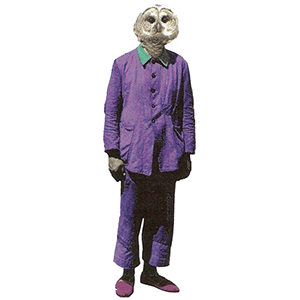
The Obscene Bird of Night (El obsceno pájaro de la noche, 1970) is the most acclaimed novel by the Chilean writer José Donoso (1924-1996). Donoso was a member of the Latin American literary boom and the literary movement known as magical realism. The novel explores the cyclical nature of life and death, in that our fears and fantasies of childhood resurface in adulthood and old age. It is about the deconstruction of self – to the extreme of trying ‘to live’ in non-existence.
The Imbunche myth is a major theme in the novel. According to legend, the Imbunche was a male child kidnapped by, or sold by his parents to a sorcerer who turns the child into a monster to guard his lair. It symbolizes the process of implosion of the physical and/or intellectual self, turning the living being into a thing or object incapable of interacting with the outside world, and depriving it of its individuality and even of its name. This can either be self-inflicted or forced upon by others.
read more »
Posted in Death, Language, Philosophy |
Leave a Comment »
October 21, 2011

Watership Down is a classic heroic fantasy novel, written by English author Richard Adams, about a small group of rabbits. Although the animals in the story live in their natural environment, they are anthropomorphized, possessing their own culture, language (Lapine), proverbs, poetry, and mythology. Evoking epic themes, the novel recounts the rabbits’ odyssey as they escape the destruction of their warren to seek a place in which to establish a new home, encountering perils and temptations along the way.
The novel takes its name from the rabbits’ destination, Watership Down, a hill in the north of Hampshire, England, near the area where Adams grew up. The story is based on a collection of tales that Adams told to his young children to pass the time on trips to the countryside.
read more »
Posted in Language |
1 Comment »
August 25, 2011

Snow Crash is Neal Stephenson’s third novel, published in 1992. Like many of Stephenson’s other novels it covers a large range of topics including: history, linguistics, anthropology, archaeology, religion, computer science, politics, cryptography, memetics, and philosophy. Stephenson explained the title of the novel in his 1999 essay ‘In the Beginning… was the Command Line’ as his term for a particular software failure mode on the early Apple Macintosh computer, ‘When the computer crashed and wrote gibberish into the bitmap, the result was something that looked vaguely like static on a broken television set — a ‘snow crash.”
The book presents the Sumerian language as the firmware programming language for the brainstem, which is supposedly functioning as the BIOS for the human brain. According to characters in the book, the semetic goddess Asherah is the personification of a ‘linguistic virus,’ similar to a computer virus. The Sumerian god Enki created a counter-program which he called a ‘nam-shub’ that caused all of humanity to speak different languages as a protection against Asherah (a re-interpretation of the ancient Near Eastern story of the Tower of Babel).
read more »
Posted in Art, Money, Technology |
Leave a Comment »
June 30, 2011
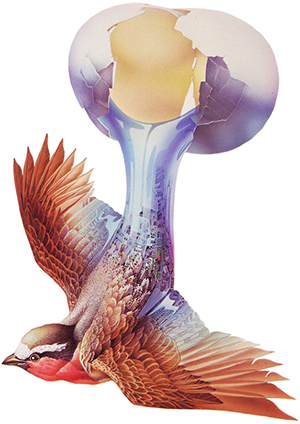
‘Demian: The Story of Emil Sinclair’s Youth’ is a 1919 novel by Herman Hesse. It is a bildungsroman, a novel showing a character’s maturation from youth to adulthood. The book was first published under the pseudonym ‘Emil Sinclair,’ the name of the narrator of the story, but Hesse was later revealed to be the author.
Emil Sinclair is a young boy raised in a bourgeois home, amid what is described as a ‘Scheinwelt,’ a play on words that means ‘world of light’ as well as ‘world of illusion.’ Emil’s entire existence can be summarized as a struggle between two worlds: the show world of illusion (related to the Hindu concept of maya) and the real world, the world of spiritual truth. In the course of the novel, accompanied and prompted by his mysterious classmate ‘Max Demian,’ he detaches from and revolts against the superficial ideals of the world of appearances and eventually awakens into a realization of self.
read more »
Posted in Art, Language, Philosophy |
Leave a Comment »
June 3, 2011

Starship Troopers is a military science fiction novel by Robert A. Heinlein, first published (in abridged form) as a serial in ‘The Magazine of Fantasy & Science Fiction’ in 1959, published hardcover later that year. The first-person narrative is about a young soldier named Juan ‘Johnnie’ Rico and his exploits in the Mobile Infantry, a futuristic military unit equipped with powered armor.
Rico’s military career progresses from recruit to non-commissioned officer and finally to officer against the backdrop of an interstellar war between mankind and an arachnoid species known as ‘the Bugs.’ Through Rico’s eyes, Heinlein examines moral and philosophical aspects of suffrage, civic virtue, the necessities of war and capital punishment, and the nature of juvenile delinquency.
read more »
Posted in Art, Technology, War |
Leave a Comment »
June 3, 2011

Ender’s Game is a 1985 science fiction novel by American author Orson Scott Card that originated as the short story published in a 1977 issue of ‘Analog Science Fiction and Fact.’ Card released an updated version of Ender’s Game in 1991, changing some political facts to accurately reflect the times, including the decline of the Soviet Union. In his 1991 introduction, he discussed the influence of Isaac Asimov’s ‘Foundation’ series on the novel. Historian Bruce Catton’s work on the American Civil War also influenced him heavily. Set in Earth’s future, the novel presents an imperiled humankind who have barely survived two conflicts with the Formics (an insectoid alien race).
In preparation for an anticipated third invasion, an international fleet maintains a school to find and train future fleet commanders. The world’s most talented children, including the novel’s protagonist, Ender Wiggin, are taken at a very young age to a training center known as the Battle School. There, teachers train them in the arts of war through increasingly difficult games including ones undertaken in zero gravity in the Battle Room where Ender’s tactical genius is revealed. Reception to the book was generally positive, though some critics have denounced Card’s perceived justification of his characters’ violent actions. It has also become suggested reading for many military organizations, including the United States Marine Corps.
Posted in Art, Technology, War |
Leave a Comment »
June 3, 2011
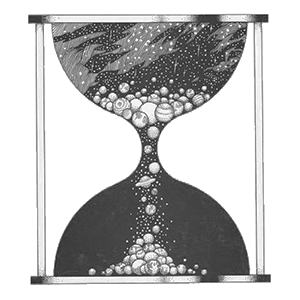
The Forever War is a 1974 science fiction novel by American author Joe Haldeman, telling the contemplative story of soldiers fighting an interstellar war between humanity and the enigmatic Tauran species.
The pithy, insightful explorations of the inhumanity of war and of bureaucracy, and of the psychological effects resulting from time dilation space travel (a soldier returns home after centuries away), won acclaim immediately.
read more »
Posted in Art, Technology, War |
Leave a Comment »
May 16, 2011
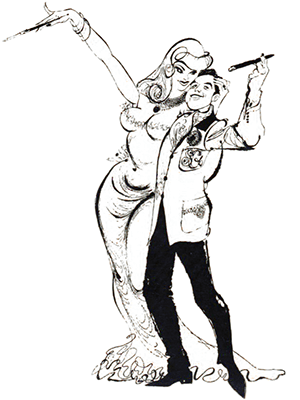
‘What Makes Sammy Run?‘ is a 1941 novel by Budd Schulberg. It is a rags to riches story chronicling the rise and fall of Sammy Glick, a Jewish boy born in New York’s Lower East Side who very early in his life makes up his mind to escape the ghetto and climb the ladder of success.
Reputedly, film mogul Samuel Goldwyn offered Schulberg money to not have the novel published, because Goldwyn felt that the author was perpetuating an anti-Semitic stereotype by making Glick so venal. It was later made into a long-running Broadway musical.
read more »
Posted in Art, Money |
Leave a Comment »
March 8, 2011

A Clockwork Orange is a 1962 dystopian novella by Anthony Burgess. The novel contains an experiment in language; Burgess creates teenage slang of the not-too-distant future called Nadsat. In a prefatory note to ‘A Clockwork Orange: A Play with Music,’ Burgess wrote that the title was a metaphor for ‘…an organic entity, full of juice and sweetness and agreeable odor, being turned into an automaton.’ and the ‘title would be appropriate for a story about the application of Pavlovian or mechanical laws to an organism which, like a fruit, was capable of color and sweetness.’
The title alludes to the protagonist’s positively conditioned responses to feelings of evil which prevent the exercise of his free will. To reverse this conditioning, he is subjected to a technique in which his emotional responses to violence are systematically paired with a negative stimulation in the form of nausea caused by an emetic medicine administered just before the presentation of films depicting violent, and ‘ultra-violent’ situations.
read more »
Posted in Art, Politics |
Leave a Comment »
March 2, 2011

Rendezvous with Rama is a novel by Arthur C. Clarke first published in 1972. Set in the 22nd century, the story involves a fifty-kilometre-long cylindrical alien starship that enters Earth’s solar system. The story is told from the point of view of a group of human explorers, who intercept the ship in an attempt to unlock its mysteries. It is considered a science fiction classic, and is particularly seen as a key hard science fiction text.
The ‘Rama’ of the title is the alien star ship, initially mistaken for an asteroid and named after the king Rama who is considered to be the seventh avatar of the Hindu god Vishnu (Clarke mentions that by the 22nd century, scientists have used the names of all the Greek and Roman mythological figures to name astronomical bodies, and have thus moved on to Hindu mythology).
Posted in Art, Language, Technology |
Leave a Comment »




 The Daily Omnivore