December 13, 2010
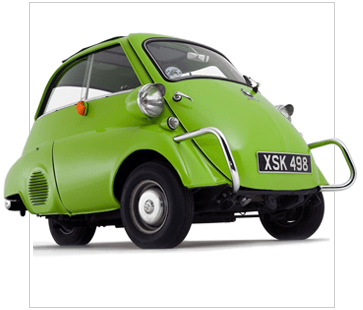
Bubble car is a subjective term used for some small, economical automobiles, usually produced in the 1950s and 1960s. The Messerschmitt KR175 and KR200, and the FMR Tg500, had aircraft-style bubble canopies, giving rise to the term bubble car to refer to all these post-war microcars. Bubble cars became popular in Europe at that time as a demand for cheap personal motorized transport emerged and fuel prices were high due in part to the 1956 Suez Crisis. Most of them were three-wheelers, which in many places qualified them for inexpensive taxes and licensing as motorcycles. Most bubble cars were manufactured in Germany, including by the former German military aircraft manufacturers, Messerschmitt and Heinkel.
BMW manufactured the Italian Iso Rivolta Isetta under licence, using an engine from one of their own motorcycles. France also produced large numbers of similar tiny vehicles called voiturettes, but unlike the German makes, these were rarely sold abroad. There were a small number of British three wheeled microcars, including the larger Regal and Robin from the Reliant Motor Company in Staffordshire and the smaller P50 and Trident from the Peel Engineering Company on the Isle of Man. Bubble cars were superseded by a new wave of ‘proper small cars’ like the 1959 Austin Mini, which gave far more functionality for their owners for only slightly higher costs.
Posted in Money, Technology |
Leave a Comment »
November 17, 2010
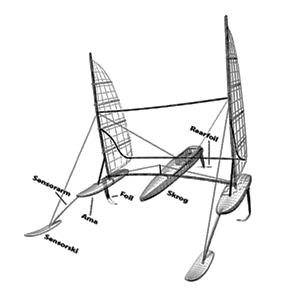
The Hobie TriFoiler is the fastest production sailboat ever created with a top speed of around 35 mph. Designed by the brothers Greg and Dan Ketterman, this trimaran has two sails, one on each ama, and hydrofoils that lift the hulls out of the water at speed. It lifts on the foils at wind speeds between 10 and 11 mph (18 km/h) and quickly accelerates to twice that speed in seconds.
The TriFoiler’s high price-tag ($12,900), fragility, and usage limited to winds between 10 and 25 mph (40 km/h) with low waves, led the Hobie Cat Company to discontinue production. Approximately 30 Trifoilers were built prior to production starting at Hobie in 1995 and another 170 were produced by Hobie before halt of production in 1999.
Posted in Games, Technology |
Leave a Comment »
November 11, 2010

The Lamborghini Countach was a mid-engined sports car produced by Italian automaker Lamborghini from 1974 to 1990. A total of 2,042 cars were built during the Countach’s sixteen year lifetime: Its design both pioneered and popularized the wedge-shaped, sharply angled look popular in many high performance sports cars. The ‘cabin-forward’ design concept, which pushes the passenger compartment forward in order to accommodate a larger engine, was also popularized by the Countach.
The word ‘countach’ is an exclamation of astonishment in the local Piedmontese language — generally used by men on seeing an extremely beautiful woman. The Countach name stuck when Nuccio Bertone first saw ‘Project 112’ in his studio. The prototype was introduced to the world at the 1971 Geneva Motor Show. Most previous and subsequent Lamborghini car names were associated with bulls and bullfighting.
Posted in Language, Technology, World |
Leave a Comment »
October 28, 2010

The Hyundai Equus is a full-size high-end luxury car that serves as the flagship model of Hyundai Motor Company. According to Edmunds the 2011 model offers far more space and equipment than other competing luxury sedans, calling it the equivalent of a loaded $104,000 Mercedes-Benz S550 for the price of a lightly equipped Mercedes E550. The Equus comes standard with a 4.6-liter V8 good for 385 horsepower and 333 pound-feet of torque. The Equus is available in Signature ($58,000) and Ultimate ($64,500) trim levels.
read more »
Posted in Money, Technology |
Leave a Comment »
October 10, 2010
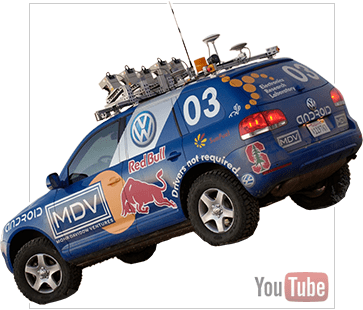
Stanley is an autonomous vehicle created by Stanford University’s Stanford Racing Team in cooperation with the Volkswagen Electronics Research Laboratory (ERL). It competed in, and won, the 2005 DARPA Grand Challenge, earning the Stanford Racing Team the 2 million dollar prize. Stanley’s descendant ‘Junior’ placed second in the 2007 DARPA Urban Challenge. Stanley is based on a diesel engined Volkswagen Toureg, Junior on a Passat. The Stanford Racing Team chose the Touareg for its ‘drive by wire’ control system which could be adapted to run directly from an on-board computer.
To navigate, Stanley used five roof mounted LIDAR units to build a 3-D map of the environment, supplementing the position sensing GPS system. An internal guidance system utilizing gyroscopes and accelerometers monitored the orientation of the vehicle and also served to supplement GPS and other sensor data. Additional guidance data was provided by a video camera used to observe driving conditions out to eighty meters (beyond the range of the LIDAR) and to ensure room enough for acceleration. Stanley also had sensors installed in a wheel well to record a pattern imprinted on the tire and to act as an odometer in case of loss of signal (such as when driving through a tunnel). Using the data from this sensor, the on-board computer can extrapolate how far it has traveled since the signal was lost.
Posted in Technology |
Leave a Comment »
August 16, 2010

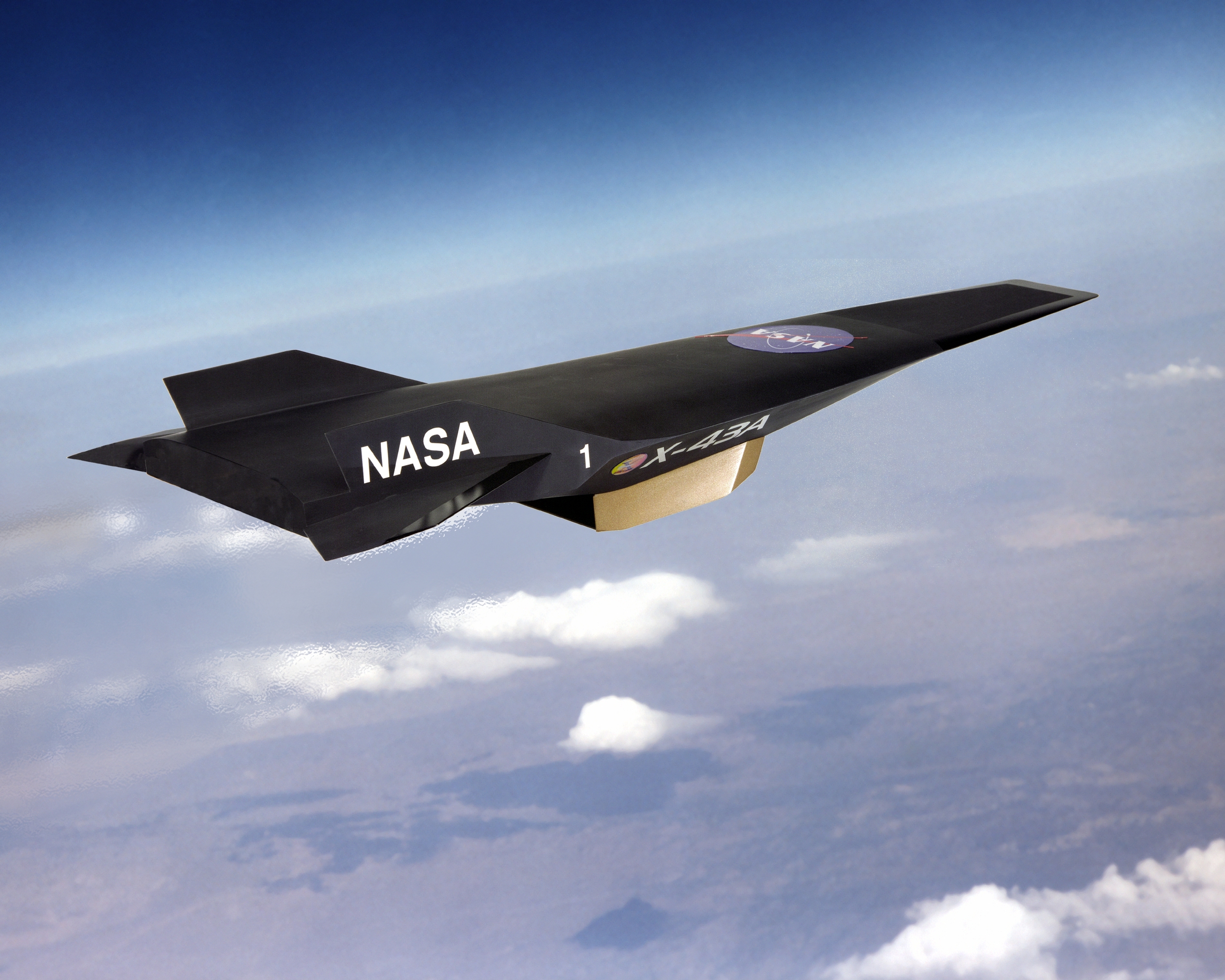
A scramjet (supersonic combustion ramjet) is a type of jet engine in which the combustion process takes place in supersonic airflow. Both ramjets and scramjets rely on high vehicle speed to forcefully compress (ram) the incoming air, but whereas a ramjet decelerates the air to subsonic velocities before combustion, airflow in a scramjet is supersonic throughout the entire engine.
This allows the scramjet to efficiently operate at extremely high speeds: theoretical projections place the top speed of a scramjet between Mach 12 and Mach 24, which is near orbital velocity. For comparison, the fastest manned airbreathing aircraft, the SR-71 Blackbird, has a maximum speed of Mach 3.2.
Posted in Technology |
Leave a Comment »
June 29, 2010
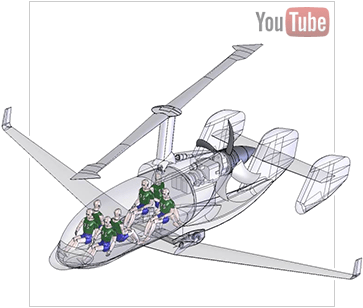
The CarterCopter is an experimental compound autogyro developed by Carter Aviation Technologies to demonstrate slowed rotor technology. In 2005, the CarterCopter became the first rotorcraft to achieve μ-1, an equal ratio of airspeed to rotor tip speed. The prototype has a top speed of about 173 mph. A helicopter requires twice as much power to maintain that velocity.
Posted in Technology |
Leave a Comment »
June 25, 2010

Mine Resistant Ambush Protected (MRAP) vehicles are a family of armored fighting vehicles designed to survive IED attacks and ambushes, which are replacing many High Mobility Multipurpose Wheeled Vehicles (HMMWVs) in Iraq and Afghanistan. There is no common MRAP vehicle design; there are several vendors, each with a competing entry.
Posted in Politics, Technology, War |
Leave a Comment »



 The Daily Omnivore