
The Closing of the American Mind is a 1987 book by American philosopher Allan Bloom. It describes ‘how higher education has failed democracy and impoverished the souls of today’s students.’ He focuses especially upon the ‘openness’ of relativism as leading paradoxically to the great ‘closing’ referenced in the book’s title.
Bloom argues that ‘openness’ and absolute understanding undermines critical thinking and eliminates the ‘point of view’ that defines cultures. According to Bloom: ‘Education in our times must try to find whatever there is in students that might yearn for completion, and to reconstruct the learning that would enable them autonomously to seek that completion.’
read more »
October 21, 2012
The Closing of the American Mind
October 9, 2012
Manufacturing Consent
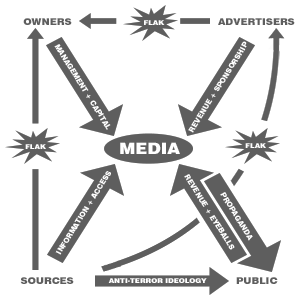
‘Manufacturing Consent: The Political Economy of the Mass Media’ (1988), by Edward S. Herman and Noam Chomsky, is an analysis of the news media, arguing that the mass media of the United States ‘are effective and powerful ideological institutions that carry out a system-supportive propaganda function by reliance on market forces, internalized assumptions, and self-censorship, and without overt coercion.’
The title derives from the phrase ‘the manufacture of consent’ that essayist–editor Walter Lippmann employed in the book ‘Public Opinion’ (1922). Chomsky has said that Australian social psychologist Alex Carey, to whom the book was dedicated, was in large part the impetus of his and Herman’s work. The book introduced the propaganda model of the media. A film, ‘Manufacturing Consent: Noam Chomsky and the Media,’ was later released based on the book.
read more »
October 9, 2012
Amusing Ourselves to Death
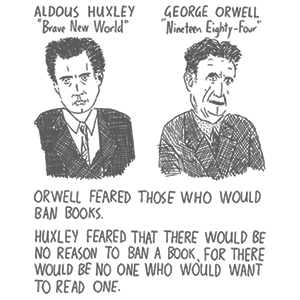
‘Amusing Ourselves to Death: Public Discourse in the Age of Show Business’ (1985) is a book by educator Neil Postman. The book’s origins lie in a talk Postman gave to the Frankfurt Book Fair in 1984. He was participating in a panel on Orwell’s ‘1984’ and the contemporary world. In the introduction to his book Postman said that the contemporary world was better reflected by Aldous Huxley’s ‘Brave New World,’ whose public was oppressed by their addiction to amusement, than by Orwell’s ‘Nineteen Eighty-Four,’ where they were oppressed by state control. It is regarded as one of the most important texts of media ecology (the study of how communication processes affect human perception).
Postman distinguishes the Orwellian vision of the future, in which totalitarian governments seize individual rights, from that offered by Aldous Huxley in ‘Brave New World,’ where people medicate themselves into bliss, thereby voluntarily sacrificing their rights. Drawing an analogy with the latter scenario, Postman sees television’s entertainment value as a present-day ‘soma,’ by means of which the consumers’ rights are exchanged for entertainment. (Note that there is no contradiction between an intentional ‘Orwellian’ conspiracy using ‘Huxleyan’ means)
read more »
October 9, 2012
Technopoly

‘Technopoly: The Surrender of Culture to Technology’ is a book by Neil Postman published in 1992 that describes a society in which technology is deified, meaning ‘the culture seeks its authorization in technology, finds its satisfactions in technology, and takes its orders from technology.’ It is characterized by a surplus of information generated by technology, which technological tools are in turn employed to cope with, in order to provide direction and purpose for society and individuals. Postman considers technopoly to be the most recent of three kinds of cultures distinguished by shifts in their attitude towards technology – tool-using cultures, technocracies, and technopolies.
Each, he says, is produced by the emergence of new technologies that ‘compete with old ones…mostly for dominance of their worldviews.’ According to Postman, a tool-using culture employs technologies only to solve physical problems, as spears, cooking utensils, and water mills do, and to ‘serve the symbolic world’ of religion, art, politics and tradition, as tools used to construct cathedrals do. He claims that all such cultures are either theocratic or ‘unified by some metaphysical theory,’ which forced tools to operate within the bounds of a controlling ideology and made it ‘almost impossible for technics to subordinate people to its own needs.’
read more »
October 7, 2012
An Army of Davids
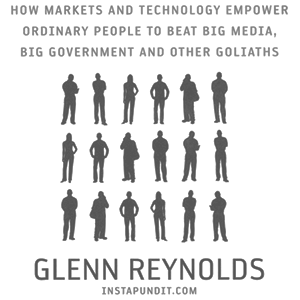
‘An Army of Davids: How Markets and Technology Empower Ordinary People to Beat Big Media, Big Government, and Other Goliaths’ is a2006 book by Glenn Reynolds, a law professor at the University of Tennessee also known as the blogger ‘Instapundit’.
The book looks at modern American society through the lens of individuals versus social institutions, and Reynolds concludes that technological change has allowed more freedom of action for people in contrast to the ‘big’ establishment organizations that used to function as gatekeepers. Thus, he argues that the balance of power between individuals and institutions is ‘flatting out,’ which involves numerous decentralized networks rising up. Reynolds divides the book into two distinct sections. The first focuses on trends currently taking place. The latter describes upcoming trends.
read more »
October 7, 2012
The Cult of the Amateur
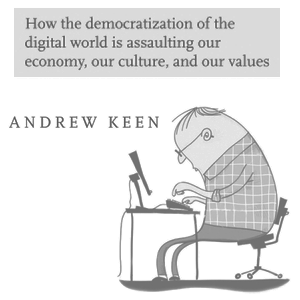
‘The Cult of the Amateur: How Today’s Internet Is Killing Our Culture’ is a 2007 book written by entrepreneur and Internet critic Andrew Keen; it is a critique of the enthusiasm surrounding user generated content, peer production, and other Web 2.0-related phenomena.
The book was written after Keen wrote a controversial essay in ‘The Weekly Standard’ criticizing Web 2.0 for being similar to Marxism, for destroying professionalism and for making it impossible to find high quality material amidst all the user-generated web content. The book was based in part on that essay. Keen argues against the idea of a ‘read-write culture’ in media, stating that ‘most of the content being shared— no matter how many times it has been linked, cross-linked, annotated, and copied— was composed or written by someone from the sweat of their creative brow and the disciplined use of their talent.’
read more »
October 2, 2012
The End of Work

‘The End of Work: The Decline of the Global Labor Force and the Dawn of the Post-Market Era’ is a non-fiction book by American economist Jeremy Rifkin, published in 1995.
Rifkin contended that worldwide unemployment would increase as information technology eliminated tens of millions of jobs in the manufacturing, agricultural, and service sectors. He predicted devastating impact of automation on blue-collar, retail and wholesale employees.
read more »
October 1, 2012
The Cult of Mac

The Cult of Mac is a book by technology writer Leander Kahney about fanaticism for the Apple product line. Professor of marketing Russell Belk argues that, like a religion, the Cult of Mac is a belief system that helps its followers understand technology and the world.
The attitude of Apple sympathizers and fans is viewed by many as being ‘cult-like.’ According to neurological research cited by the BBC on their ‘Secrets of the Superbrands’ documentary, the response from the brain of an Apple enthusiast when viewing the brand-related symbols and imagery is similar to the one of a religious devotee when exposed to religious symbols and images. Apple founder Steve Jobs is compared to a god figure and savior, and his life story is said to resemble Joseph Campbell’s heroic adventure myths. Jobs was often viewed as a saintly figure to Mac users.
read more »
October 1, 2012
Extended Mind

‘The Extended Mind‘ is a book in the field of philosophy of mind edited by MIT philosopher Richard Menary. It contains several papers by different philosophers. The ‘extended mind thesis’ (EMT) refers to an emerging concept that addresses the question as to the division point between the mind and the environment by promoting the view of active externalism.
The EMT proposes that some objects in the external environment are utilized by the mind in such a way that the objects can be seen as extensions of the mind itself. Specifically, the mind is seen to encompass every level of the cognitive process, which will often include the use of environmental aids.
read more »
October 1, 2012
The Ascent of Money

‘The Ascent of Money: A Financial History of the World’ is a 2008 book by Harvard historian Niall Ferguson’s, which was adapted into a series of documentary feature for public television in the US and UK. It examines the long history of money, credit, and banking. From Shylock’s pound of flesh to the loan sharks of Glasgow, from the ‘promises to pay’ on Babylonian clay tablets to the Medici banking system.
Professor Ferguson explains the origins of credit and debt and why credit networks are indispensable to any civilization. He also investigates human bondage. Studying the question: How did finance become the realm of the masters of the universe? Through the rise of the bond market in Renaissance Italy. With the advent of bonds, war finance was transformed and spread to north-west Europe and across the Atlantic. It was the bond market that made the Rothschilds the richest and most powerful family of the 19th century. The book also explores why stock markets produce bubbles and busts.
read more »
September 17, 2012
The Culture of Narcissism
The Culture of Narcissism: American Life in an Age of Diminishing Expectations is a book by the cultural historian Christopher Lasch, first published in 1979. It explores the roots and ramifications of the normalizing of pathological narcissism in 20th century American culture using psychological, cultural, artistic, and historical synthesis.
The book proposes that post-war, late-capitalist America, through the effects of ‘organized kindness’ on the traditional family structure, has produced a personality-type consistent with clinical definitions of ‘pathological narcissism.’ This pathology is not akin to everyday narcissism — a hedonistic egoism — but rather a very weak sense of self requiring constant external validation. For Lasch, ‘pathology represents a heightened version of normality.’
read more »
September 13, 2012
@earth

@earth is a 2011 book made by London born (and based) photomontage artist Peter Kennard with Lebanese artist Tarek Salhany. It is a photo-essay told through photomontage with seven chapters exposing the current state of the earth, the conditions of life on it and the need to resist injustice. Apart from the title (which is also in different languages on its back cover) the pocket book contains no words and its story is told in sequences of constructed images. ‘@earth’ combines images created digitally over the past two years by Kennard with Salhany especially for the project, with Kennard’s earlier darkroom based photomontages (spanning over 40 years of work) some of which are part of the Tate Permanent Collection. They have been recontextualised for the book. The authors met whilst Kennard taught Salhany at the Byam Shaw School of Art in London.
‘@earth’ has received recognition from, amongst others, Naomi Klein (author of ‘No Logo’ and ‘The Shock Doctrine’) who has said: ‘This book perfectly captures the brutal asymmetries of our age: heavy weaponry trained on broken people, all-seeing technologies and disappearing identities, perpetually exhaling industry and an asphyxiating planet. If there’s a word that’s worth a thousand pictures, it’s ‘@earth.”


 The Daily Omnivore
