July 9, 2012

The Age of Spiritual Machines is a book by futurist Ray Kurzweil about the future course of humanity, particularly relating to the development of artificial intelligence and its impact on human consciousness. It is also a study on the concept of technological singularity, the hypothetical future emergence of greater-than-human superintelligence through technological means.
Originally published in 1999, the book predicts that machines with human-like intelligence will be available from affordable computing devices within a couple of decades, revolutionizing most aspects of life, and that eventually humanity and its machinery will become one and the same.
read more »
Posted in Language, Philosophy, Technology |
Leave a Comment »
July 6, 2012

‘Predictably Irrational: The Hidden Forces That Shape Our Decisions’ is a 2008 book by behavioral economist Dan Ariely, in which he challenges readers’ assumptions about making decisions based on rational thought.
Ariely explains, ‘My goal, by the end of this book, is to help you fundamentally rethink what makes you and the people around you tick. I hope to lead you there by presenting a wide range of scientific experiments, findings, and anecdotes that are in many cases quite amusing. Once you see how systematic certain mistakes are–how we repeat them again and again–I think you will begin to learn how to avoid some of them.’
read more »
Posted in Health, Language, Money |
Leave a Comment »
July 3, 2012
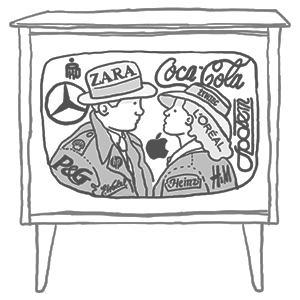
‘Four Arguments for the Elimination of Television‘ is a 1978 book written by liberal activist Jerry Mander which argues that there are a number of problems with the medium of television. Mander argues that many of the problems with television are inherent in the medium and technology itself, and thus cannot be reformed. Mander spent 15 years in the advertising business, including five as president and partner of Freeman, Mander & Gossage, San Francisco, a nationally-known advertising agency.
‘Four Arguments for the Elimination of Television’ argues that the technology of television is not a neutral or benign instrument or tool. The author argues that in varied technologies and institutions such as militaries, automobiles, nuclear power plants, mass production, and advertising, the basic form of the institution and the technology determines its interaction with the world, the way it will be used, the kind of people who use it, and to what ends.
read more »
Posted in Language, Politics, Technology |
2 Comments »
July 3, 2012

‘Invisible Republic: Bob Dylan’s Basement Tapes’ is a 1997 book by music critic Greil Marcus about the creation and cultural importance of ‘The Basement Tapes,’ a series of recordings made by Bob Dylan in 1967 in collaboration with The Hawks, who would subsequently become known as The Band.
When subsequently published in paperback, the book was re-titled ‘The Old, Weird America,’ a term coined by Marcus to describe the often eerie country, blues, and folk music featured on the ‘Anthology of American Folk Music.’ The term has been revived via the musical genre called New Weird America (a subgenre of psychedelic and indie music).
read more »
Posted in Art, Language |
Leave a Comment »
June 26, 2012

The Kama Sutra is an ancient Hindu text widely considered to be the standard work on human sexual behavior in Sanskrit. A portion of the work consists of practical advice on sexual intercourse.
‘Kāma’ which is one of the three goals of Hindu life, means sensual or sexual pleasure, and ‘sūtra’ literally means a thread or line that holds things together, and more metaphorically refers to an aphorism (or line, rule, formula), or a collection of such aphorisms in the form of a manual. Contrary to popular perception, especially in the western world, Kama sutra is not just an exclusive sex manual; it presents itself as a guide to a virtuous and gracious living that discusses the nature of love, family life and other aspects pertaining to pleasure oriented faculties of human life.
read more »
Posted in Language, Philosophy, Sex |
Leave a Comment »
June 21, 2012

‘Simulacra and Simulation‘ [sim-yuh-ley-kruh / sim-yuh-ley-shuhn] is a philosophical treatise by French sociologist Jean Baudrillard seeking to interrogate the relationship among reality, symbols, and society. A simulacrum (singular form of simulacra) in an imperfect simulation (a recreation of something). Baudrillard claims that our current society has replaced all reality and meaning with symbols and signs, and that human experience is of a simulation of reality.
Moreover, these simulacra are not merely mediations of reality, nor even deceptive mediations of reality; they are not based in a reality nor do they hide a reality, they simply hide that anything like reality is irrelevant to our current understanding of our lives. The simulacra that Baudrillard refers to are the significations and symbolism of culture and media that construct perceived reality, the acquired understanding by which our lives and shared existence is and are rendered legible; Baudrillard believed that society has become so saturated with these simulacra and our lives so saturated with the constructs of society that all meaning was being rendered meaningless by being infinitely mutable. Baudrillard called this phenomenon the ‘precession of simulacra.’
read more »
Posted in Language, Philosophy, Science |
Leave a Comment »
June 14, 2012

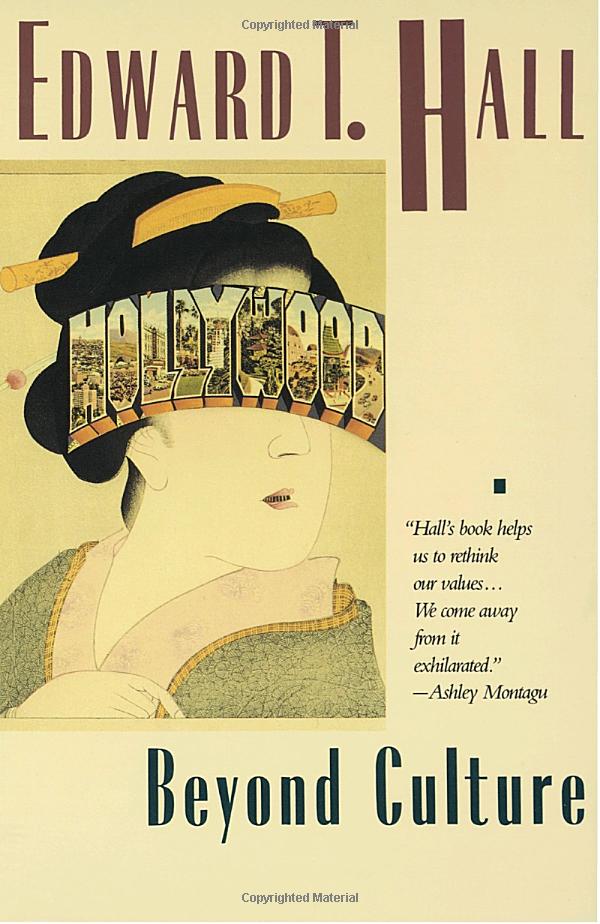
Beyond Culture is a 1976 book by American anthropologist Edward T. Hall where he describes a dichotomy between ‘high context cultures’ (focused upon in-groups) and ‘low context cultures’ (focused upon individuals). Low context cultures like the US don’t cater to ‘in-groups’ (a discrete group having similar experiences and expectations, from which, in turn, inferences are drawn), and there is less use of similar experiences and expectations to communicate. Much more is explained through words, instead of the context.
Conversely, high context cultures prefer high context messages over low context messages in routine communication. This choice of communication styles translates into a culture that will cater to in-groups. In a high context culture, many things are left unsaid, letting the culture explain. Words and word choice become very important in higher context communication, since a few words can communicate a complex message very effectively to an in-group (but less effectively outside that group), while in a lower context culture, the communicator needs to be much more explicit and the value of a single word is less important.
read more »
Posted in Language, Politics, World |
Leave a Comment »
June 10, 2012
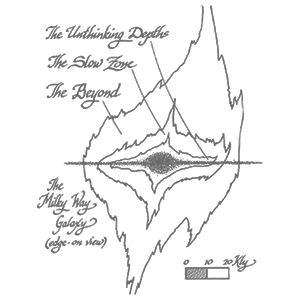
A Fire Upon the Deep is a 1992 science fiction novel by Vernor Vinge. It is a space opera involving superhuman intelligences, aliens, faster-than-light warfare, love, betrayal, genocide, and a galactic Usenet (an early Internet discussion system).
The story is set in Vinge’s ‘Zones of Thought’ in which the results of technological singularities (the achievement of greater-than-human intelligence) are spread out in a predicable pattern: In the ‘Unthinking Depths’ near the core of the galaxy, no intelligence is possible; in the ‘Slow Zone,’ where Earth is, general relativity applies (i.e. faster-than-light travel is impossible); the ‘Beyond’ allows faster-than-light travel and antigravity, and in the ‘Transcend,’ mysterious god-like entities roam the cosmos. Thus, as you head out of the Milky Way, you see the same progression of advancing technologies in other galaxies.
read more »
Posted in Art, Language, Technology |
Leave a Comment »
June 4, 2012

The Family Trade is the first book of a British writer of science fiction and fantasy writer Charles Stross’ alternate history series ‘The Merchant Princes.’
The first novel introduces us to journalist Miriam Beckstein, who finds herself in a parallel world in which her extended family holds power.
read more »
Posted in Language, Money, Technology |
Leave a Comment »
May 31, 2012
‘Lies My Teacher Told Me: Everything Your American History Textbook Got Wrong’ is a 1995 book by sociologist James Loewen. It critically examines twelve American history textbooks and concludes that textbook authors propagate factually false, Eurocentric, and mythologized views of history. In addition to critiquing the dominant historical themes presented in textbooks, Loewen presents a number of his own historical themes that he says are ignored by traditional history textbooks. A revised and updated edition was released in 2008.
Loewen criticizes modern American history textbooks for containing inaccurate depictions of historical figures such as Christopher Columbus. He further criticizes the texts for a tendency to avoid controversy and for their ‘bland’ and simplistic style. He proposes that when American history textbooks elevate American historical figures to the status of heroes, they unintentionally give students the impression that these figures are part of an unattainable past. In other words, the history-as-myth method teaches students that America’s greatest days have already passed. Loewen asserts that the muting of past clashes and tragedies makes history boring to students, especially groups excluded from the positive histories.
Posted in Education, Language, Politics |
Leave a Comment »
May 30, 2012

Bill, the Galactic Hero is a satirical science fiction novel by Harry Harrison, first published in 1965. Harrison reports having been approached by a Vietnam veteran who described Bill as ‘the only book that’s true about the military.’ Harrison introduced a new euphemism, ‘bowb,’ in the series to cover the vulgarity necessary to render military life accurately. It is used extensively in Bill, the Galactic Hero.
Bill is a farmboy on a small backward agricultural planet who is drugged, hypnotized, then shanghaied into the Space Troopers and sent to recruit training under a fanged instructor named Deathwish Drang. After surviving boot camp, he is transferred to active duty as a fuse tender on the flagship of the space fleet in battle with the Chingers, a small reptillian race. Injured and with the fleet almost destroyed, he fires off a shot witnessed by the admiralty and is proclaimed a hero.
Posted in Humor, Language, War |
Leave a Comment »
May 30, 2012

James Bolivar DiGriz, alias ‘Slippery Jim’ and ‘The Stainless Steel Rat,’ is the fictional hero of a series of humorous science fiction novels written by Harry Harrison. He is a futuristic con man, thief and all-round rascal. He is charming and quick-witted, a master of disguise and martial arts, an accomplished bank robber, an expert on breaking and entering, and (perhaps most usefully) a skilled liar. A master of self-rationalization, the Rat frequently justifies his crimes by arguing that he is providing society with entertainment; and besides which, he only steals from institutions which have insurance coverage. He displays a strong morality, albeit in a much more restricted sense than is traditional. (For example, he will happily steal, but deplores killing.)
The character was introduced in Harrison’s short story, ‘The Stainless Steel Rat,’ which was first published in 1957 in ‘Astounding’ magazine. Like other characters created by Harrison, the Rat is a speaker of Esperanto and advocates atheism. From the original publisher’s blurb: ‘…We must be as stealthy as rats in the wainscoting of their society. It was easier in the old days, of course, and society had more rats when the rules were looser, just as old wooden buildings have more rats than concrete buildings. But there are rats in the building now as well. Now that society is all ferrocrete and stainless steel there are fewer gaps in the joints. It takes a very smart rat indeed to find these openings. Only a stainless steel rat can be at home in this environment…’
Posted in Art, Humor, Language |
Leave a Comment »


 The Daily Omnivore