October 21, 2011

Blake Snyder (1957 – 2009) was an American screenwriter based in Los Angeles, who became one of the most popular writing mentors in the film industry. The author of three books on screenwriting and story structure, Snyder led international seminars and workshops for writers in various disciplines, as well as consultation sessions for some of Hollywood’s largest studios. His nonfiction book ‘Save the Cat!
The Last Book on Screenwriting You’ll Ever Need’ was written in a no-nonsense and conversational tone, which has resonated with both seasoned and novice screenwriters. The title is a term coined by Snyder and describes the scene where the audience meets the hero of a movie for the first time. The hero does something nice — e.g. saving a cat—that makes the audience like the hero and root for him. According to Snyder, it is a simple scene that helps the audience invest themselves in the character and the story, but is often lacking in many movies.
read more »
Posted in Art, Language, Money |
Leave a Comment »
October 21, 2011
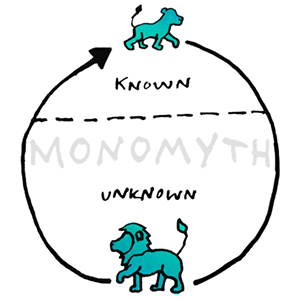
The Hero with a Thousand Faces (first published in 1949) is a non-fiction book, and seminal work of comparative mythology by Joseph Campbell. In this publication, Campbell discusses his theory of the journey of the archetypal hero found in world mythologies. Since publication, Campbell’s theory has been consciously applied by a wide variety of modern writers and artists. The best known is perhaps George Lucas, who has acknowledged a debt to Campbell regarding the stories of the ‘Star Wars’ films.
Campbell explores the theory that important myths from around the world which have survived for thousands of years all share a fundamental structure, which Campbell called the monomyth and ‘the hero’s journey. ‘In a well-known quote from the introduction to ‘The Hero with a Thousand Faces,’ Campbell summarized the monomyth: ‘A hero ventures forth from the world of common day into a region of supernatural wonder: fabulous forces are there encountered and a decisive victory is won: the hero comes back from this mysterious adventure with the power to bestow boons on his fellow man.’
read more »
Posted in Art, Language, Philosophy |
Leave a Comment »
October 21, 2011

Watership Down is a classic heroic fantasy novel, written by English author Richard Adams, about a small group of rabbits. Although the animals in the story live in their natural environment, they are anthropomorphized, possessing their own culture, language (Lapine), proverbs, poetry, and mythology. Evoking epic themes, the novel recounts the rabbits’ odyssey as they escape the destruction of their warren to seek a place in which to establish a new home, encountering perils and temptations along the way.
The novel takes its name from the rabbits’ destination, Watership Down, a hill in the north of Hampshire, England, near the area where Adams grew up. The story is based on a collection of tales that Adams told to his young children to pass the time on trips to the countryside.
read more »
Posted in Language |
1 Comment »
October 14, 2011

Future Shock is a book written by the futurist Alvin Toffler in 1970. In the book, Toffler defines the term ‘future shock’ as a certain psychological state of individuals and entire societies. His shortest definition for the term is a personal perception of ‘too much change in too short a period of time.’ The book, which became an international bestseller, grew out of an article ‘The Future as a Way of Life’ in ‘Horizon’ magazine in 1965.
Toffler argues that society is undergoing an enormous structural change, a revolution from an industrial society to a ‘super-industrial society.’ This change will overwhelm people, the accelerated rate of technological and social change leaving them disconnected and suffering from ‘shattering stress and disorientation’ – future shocked. Toffler stated that the majority of social problems were symptoms of the future shock. In his discussion of the components of such shock, he also popularized the term ‘information overload.’
Posted in Language, Politics, Technology |
1 Comment »
October 7, 2011

‘Dune‘ is a science fiction novel written by Frank Herbert, published in 1965. It won the Hugo Award in 1966, and the inaugural Nebula Award for Best Novel, the highest honors bestowed in science fiction and fantasy writing.
‘Dune’ is frequently cited as the world’s best-selling science fiction novel. Set in the far future amidst a sprawling feudal interstellar empire where planetary fiefdoms are controlled by noble houses that owe an allegiance to the Imperial House Corrino, Dune tells the story of young Paul Atreides (heir of House Atreides) as he and his family accept control of the desert planet Arrakis, the only source of the ‘spice’ melange, the most important and valuable substance in the universe. The story explores the complex and multi-layered interactions of politics, religion, ecology, technology, and human emotion, as the forces of the Empire confront each other for control of Arrakis and its ‘spice.’
read more »
Posted in Art, Language |
1 Comment »
August 25, 2011

Snow Crash is Neal Stephenson’s third novel, published in 1992. Like many of Stephenson’s other novels it covers a large range of topics including: history, linguistics, anthropology, archaeology, religion, computer science, politics, cryptography, memetics, and philosophy. Stephenson explained the title of the novel in his 1999 essay ‘In the Beginning… was the Command Line’ as his term for a particular software failure mode on the early Apple Macintosh computer, ‘When the computer crashed and wrote gibberish into the bitmap, the result was something that looked vaguely like static on a broken television set — a ‘snow crash.”
The book presents the Sumerian language as the firmware programming language for the brainstem, which is supposedly functioning as the BIOS for the human brain. According to characters in the book, the semetic goddess Asherah is the personification of a ‘linguistic virus,’ similar to a computer virus. The Sumerian god Enki created a counter-program which he called a ‘nam-shub’ that caused all of humanity to speak different languages as a protection against Asherah (a re-interpretation of the ancient Near Eastern story of the Tower of Babel).
read more »
Posted in Art, Money, Technology |
Leave a Comment »
August 23, 2011

Infinite Jest is a 1996 novel by David Foster Wallace that presents a dystopian vision of North America in the near future. The intricate narrative treats elements as diverse as junior tennis, substance abuse and recovery programs, depression, child abuse, family relationships, advertising and popular entertainment, film theory, and Quebec separatism. The novel includes copious endnotes which explain or expound upon points in the story.
In an interview with Charlie Rose, Wallace characterized their use as a method of disrupting the linearity of the text while maintaining some sense of narrative cohesion. The novel’s title is from ‘Hamlet,’ who holds the skull of the court jester, Yorick, and says ‘Alas, poor Yorick! I knew him, Horatio: a fellow of infinite jest, of most excellent fancy: he hath borne me on his back a thousand times; and now, how abhorred in my imagination it is!’
read more »
Posted in Art, Language, Money |
Leave a Comment »
August 3, 2011

The Electric Kool-Aid Acid Test is a work of literary journalism by Tom Wolfe, published in 1968. Using techniques from the genre of hysterical realism and pioneering new journalism, the ‘nonfiction novel’ tells the story of Ken Kesey and his band of Merry Pranksters.
The book follows the Pranksters across the country driving in a psychedelic painted school bus dubbed ‘Furthur,’ reaching what they considered to be personal and collective revelations through the use of LSD and other psychedelic drugs. The book also describes the Acid Tests, early performances by The Grateful Dead, and Kesey’s exile to Mexico.
Posted in Art, Drugs, Language |
Leave a Comment »
July 24, 2011

The Selfish Gene is a book on evolution by Richard Dawkins, published in 1976. It builds upon the principal theory of George C. Williams’s first book ‘Adaptation and Natural Selection.’ Dawkins coined the term ‘selfish gene’ as a way of expressing the gene-centred view of evolution as opposed to the views focused on the organism and the group. From the gene-centred view follows that the more two individuals are genetically related, the more sense (at the level of the genes) it makes for them to behave selflessly with each other. Therefore the concept is especially good at explaining many forms of altruism, regardless of a common misuse of the term along the lines of a selfishness gene.
An organism is expected to evolve to maximize its inclusive fitness — the number of copies of its genes passed on globally (rather than by a particular individual). As a result, populations will tend towards an evolutionarily stable strategy. The book also coins the term ‘meme’ for a unit of human cultural evolution analogous to the gene, suggesting that such ‘selfish’ replication may also model human culture, in a different sense. Memetics has become the subject of many studies since the publication of the book.
read more »
Posted in Language, Science, Sex |
Leave a Comment »
July 22, 2011

The ‘Demon-Haunted World: Science as a Candle in the Dark’ is a book by astrophysicist Carl Sagan, which was first published in 1995. The book is intended to explain the scientific method to laypeople, and to encourage people to learn critical or skeptical thinking. It explains methods to help distinguish between ideas that are considered valid science, and ideas that can be considered pseudoscience. Sagan states that when new ideas are offered for consideration, they should be tested by means of skeptical thinking, and should stand up to rigorous questioning.
In the book, Sagan states that if a new idea continues in existence after an examination of the propositions has revealed it to be false, it should then be acknowledged as a supposition. Skeptical thinking essentially is a means to construct, understand, reason, and recognize valid and invalid arguments. Wherever possible, there must be independent validation of the concepts whose truth should be proved. He states that reason and logic would succeed once the truth is known. Conclusions emerge from premises, and the acceptability of the premises should not be discounted or accepted because of bias.
Posted in Language, Philosophy, Science |
Leave a Comment »
July 8, 2011
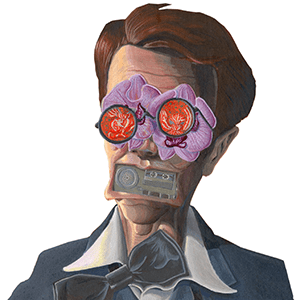
The Doors of Perception is a 1954 book by Aldous Huxley detailing his experiences when taking mescaline, a hallucinogen found naturally in the peyote cactus.
The book takes the form of Huxley’s recollection of a drug trip which took place over the course of an afternoon, and takes its title from William Blake’s poem ‘The Marriage of Heaven and Hell.’ Huxley recalls the insights he experienced, which range from the ‘purely aesthetic’ to ‘sacramental vision.’ He also incorporates later reflections on the experience and its meaning for art and religion.
read more »
Posted in Drugs, Language, Philosophy |
1 Comment »
June 30, 2011

‘Demian: The Story of Emil Sinclair’s Youth’ is a 1919 novel by Herman Hesse. It is a bildungsroman, a novel showing a character’s maturation from youth to adulthood. The book was first published under the pseudonym ‘Emil Sinclair,’ the name of the narrator of the story, but Hesse was later revealed to be the author.
Emil Sinclair is a young boy raised in a bourgeois home, amid what is described as a ‘Scheinwelt,’ a play on words that means ‘world of light’ as well as ‘world of illusion.’ Emil’s entire existence can be summarized as a struggle between two worlds: the show world of illusion (related to the Hindu concept of maya) and the real world, the world of spiritual truth. In the course of the novel, accompanied and prompted by his mysterious classmate ‘Max Demian,’ he detaches from and revolts against the superficial ideals of the world of appearances and eventually awakens into a realization of self.
read more »
Posted in Art, Language, Philosophy |
Leave a Comment »




 The Daily Omnivore